
AI made in Germany
China and the USA have so far been the front runners when it comes to large language models. A German research consortium has now developed its own model in a very short time.
- Soofi S is a German open AI language model for German-language applications.
- The training data, methodology and model weights are transparent and publicly accessible.
- Companies can run Soofi on their own hardware, allowing them to control data and costs more effectively.
- The project aims to promote Germany’s and Europe’s digital sovereignty.
The servers in a computing centre in Munich operated by Deutsche Telekom were started up in March 2026. Up to 1,024 graphic processors worked simultaneously for weeks. They processed 27 trillion text and code tokens. This was done to train a new AI model that was developed and trained by a German research consortium and is optimised for German-language content.
Soofi S was announced in mid-June and attracted great interest. Companies and organisations were eager to get trial access to the system. Soofi S is a language model that is similar to ChatGPT, Claude and DeepSeek, however, it is a non-commercial open-source project. It is also really good: when tested for German-language tasks, Soofi S did better than similar models. Germany and Europe aim to reduce their dependency on the big AI corporations. Models such as Soofi S could help to reach this goal.
Digital dependency
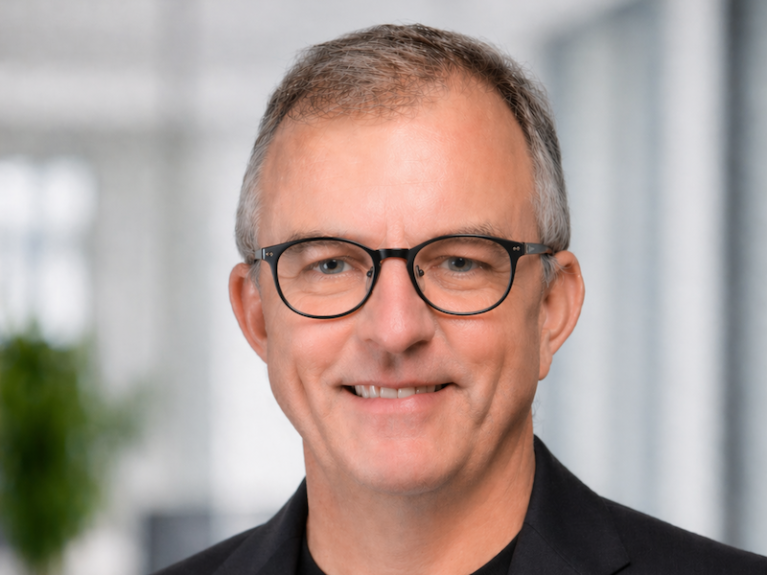
Models from the USA and China have been dominating the market to date. “We are becoming economically and politically dependent, and this is dangerous,” says Jörg Bienert, Managing Director of the Center of Sovereign AI and co-founder of the German Association of Artificial Intelligence Companies that coordinates the Soofi project. The US authority’s decision to block access to the then most powerful model of the US company Anthropic over night in mid-June had been a wake-up call, Mr Bienert points out.
All of a sudden, Claude Fable 5 was no longer available to any companies outside the US. “This is a risk that European companies, authorities and critical infrastructure providers have to take seriously,” Jörg Bienert states. Another aspect is that German companies that use models by companies such as Anthropic or the ChatGPT developers OpenAI do not only have to accept that sensitive data is stored at external computing centres, but they are also at the mercy of such providers when it comes to pricing decisions.
Transparent training data
Researchers from six leading German research institutes and two start-ups are involved in developing Soofi as a so-called open-weight model. The “weights” here are the millions of numerical parameters the model learned as it was trained. This means that they are the actual “knowledge” of the AI. This is publicly accessible. Any company can download the model and run it on its own servers.
This type of model is also available from other providers, such as the French company Mistral or Deep Seek from China. However, the training data used for these models is not transparent. Those using DeepSeek have no way of knowing what may have been censored. Soofi is different in this respect: its training data, methodology and implementation steps are publicly accessible. “We publish the data that would be needed to recreate the model,” Jörg Bienert says.
The model can be used for a wide range of applications. Large language models, for example, form the basis for chatbots and AI agents that can be used to analyse technical or regulatory documentation or to write software code.
- Data control: companies can run Soofi on their own hardware, keeping their data in-house.
- Price independence: Soofi is an open-weight model and no running license fees are charged.
- Low political risk: there is no risk of access to Soofi being blocked all of a sudden, as was the case with Anthropic’s Fable 5 model.
- Transparency: documentation of Soofi’s training data, methodology and implementation steps is available to the public.
- German-language model: Soofi is better than similar models when it comes to many activities performed in German companies, such as contract analysis, technical documentation, communication with authorities.
European alternatives
Soofi is not alone. The development of transparent open-source AI models is being promoted across Europe. A consortium of academic and industrial partners has developed the open model family Euro LLM as part of a project funded by the EU. This model focusses on multilingualism. The Open Euro LLM project is based on a similar approach, and planning provides for the models to be trained in 35 European languages. Tilde Open LLM, too, aims to reflect Europe’s linguistic diversity. This open model was developed last year by the Latvian start-up Tilde with support from the EU.
20 million euros from the Federal Ministry for Economic Affairs
Jörg Bienert thinks that the Soofi project shows that Germany still stands a chance in the international AI race. “We have plenty of talent and theoretical research knowledge here,” he says. “We need projects such as Soofi to translate this knowledge into practical application.” The project enjoys strong political support: the Ministry of Economic Affairs and Energy contributed around 20 million euros in funding as part of the European umbrella initiative 8RA.
Mr Bienert reports that the consortium is currently preparing the general release of Soofi S. The goal is for the final model to have reasoning skills, which means that it uses a structured approach involving intermediate steps. If the project is to be continued, the consortium will focus on developing larger, more powerful basic models.
Soofi stands for Sovereign Open Source Foundational Models for European Intelligence and is developed by a consortium of several German AI research institutes and start-ups. The aim is to develop a basic AI model that can be used to derive highly specialised so-called reasoning models. The main focus of the project is to develop solutions for highly complex tasks, such as AI-controlled robotics. The results of the Soofi project are currently being tested in a number of industrial applications and are made available to the industrial sector free of charge.

