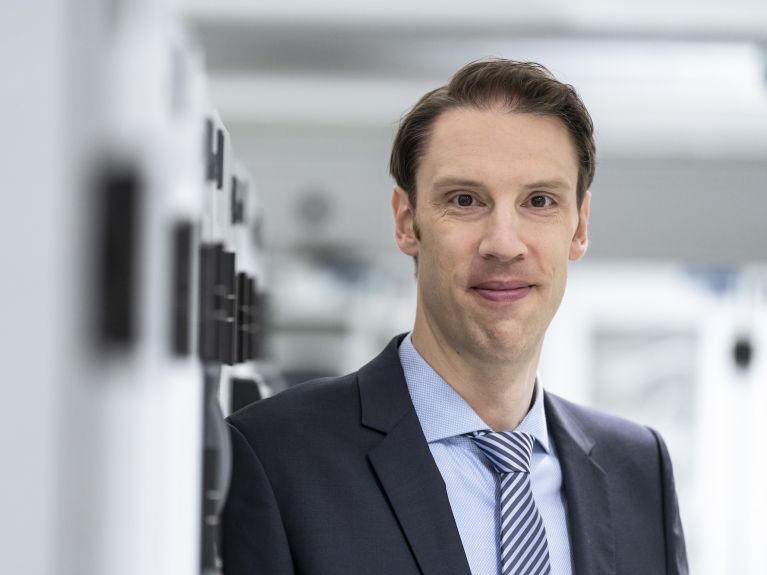
“Artificial intelligence is like electricity“
Since it enables many applications, AI resembles electricity, says Björn Ommer, a researcher. We may soon stop noticing it as an underlying technology.
 Interview: Klaus Lüber
 Professor Ommer, AI chatbots were considered ‘stochastic parrots’ for a long time, as they simply guess what the next word should be. Is this still the case?
That is a bit too simplistic. It’s like saying that to play the piano you just need to press the right keys at the right time. I have been observing a certain degree of emergence in image and language models. The more context a system has on a particular topic, the more differentiated its responses. It can make connections between things, and that is more than parroting.
In which areas do you see the greatest potential for AI?
Artificial intelligence is a technology that makes things possible, much like electricity. Electricity isn’t produced because it’s a nice thing in itself but because it powers millions of other technologies. At this point, AI is helping to generate customised knowledge from a flood of information. I can ask a language model how a news item affects my personal plans. In this way, raw snippets of information are combined to generate actionable knowledge. To some extent, AI is giving everyone access to something that used to be a privilege of company bosses and heads of state, and that is a daily briefing in which everything that is important is classified and I am told: What does that mean for me? How should I address this?
Dieses YouTube-Video kann in einem neuen Tab abgespielt werden
YouTube öffnenThird party content
We use YouTube to embed content that may collect data about your activity. Please review the details and accept the service to see this content.
Open consent formSome people say that Germany is unable to handle the ever growing demand for computing capacity needed for AI. Do you share this opinion?
Large language models benefit from being fed more and more data. It may be true that we are not in the best position to compete in this race for more power and better chips. However, I don’t think that’s a race we even have to join. Our strengths lie in broad AI that can connect different abilities and in industrial AI applications. Innovation can also be achieved by reducing data to what is really relevant. If AI systems interact with the real world, such as in industrial production, it doesn’t do to simply pour in millions of images from social networks. This type of application needs very specific data and domain knowledge, that is expert knowledge about the respective area of application. We have both of that, thanks to our long tradition as an industrial nation and our direct contact with customers.
Germany’s strength lies in industrial application of AI.
How is AI going to develop going forward?
We will soon be working with AI in the same way as with operating systems. We don’t tend to think about the processor of our smartphones but about the apps, and we will stop being aware of the underlying AI in the future, too. Video models are going to be particularly important: they are granting AI access to our visual reality and therefore form the basis for physical AI, such as robotics, medicine, and materials research. Germany is well-positioned for making AI usable on a broad scale. Just like we did with cars: they have been around for over 100 years. However, we made some considerable contributions to their safety, efficiency and accessibility.
Björn Ommer is a Professor in Computer Science at Ludwig-Maximilians-Universität in Munich and the leader of the university’s Computer Vision & Learning Group. His research group has developed the Stable Diffusion AI image generator, one of the world’s most widely used open source models for generative AI.


