Creating a sun machine
Germany is investing massively in a technology that could one day supply large amounts of climate-neutral energy - nuclear fusion.
 Klaus Lüber
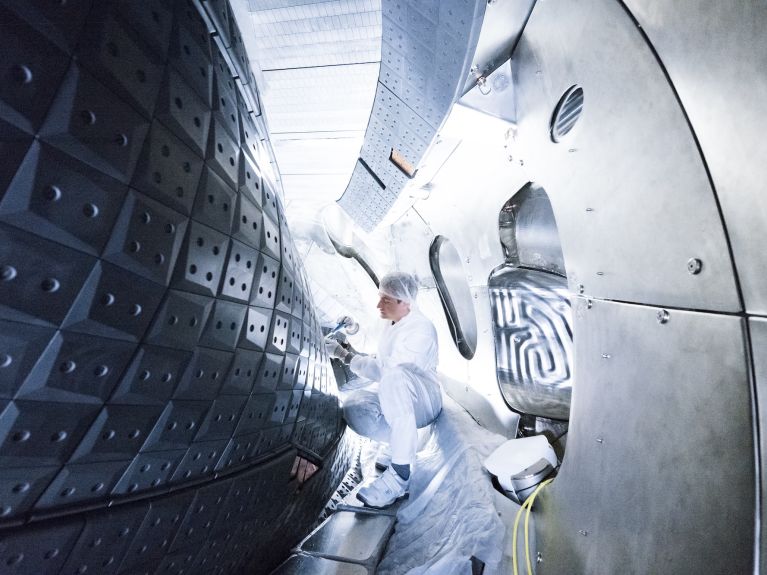
 Researchers in the university town of Greifswald in northern Germany are attempting to recreate the sun here on Earth. Greifswald is home to the Wendelstein 7-X fusion reactor operated by the Max Planck Institute for Plasma Physics (IPP). Inside the reactor, hot plasma that is made of electrically charged particles and reaches temperatures of up to 40 million degrees is kept in check by huge, specially designed magnetic coils. Future fusion power plants will force light atomic nuclei to fuse, just like they do in the sun. Most methods on Earth involve using deuterium and tritium - two hydrogen isotopes. The fusion reaction itself does not release any CO2.
How do fusion power plants work?
Wendelstein 7-X is what is known as a stellarator. That’s the name given to fusion reactors that have magnets designed and arranged in such a way to ensure that the plasma moves in a screw-like fashion. This is intended to make the plasma inside the reactor more stable. Under no circumstances can the extremely hot gas be allowed to touch the reactor shell. The reactor in Greifswald is the largest facility of its kind anywhere in the world.
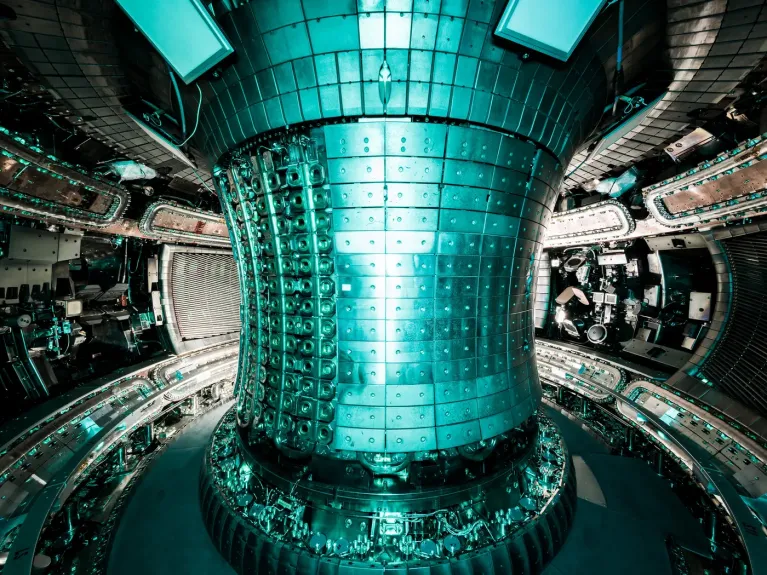
Tokamak reactors use magnets of a much simpler shape and a higher electric current inside the plasma to achieve this. This approach was long favoured because it’s much easier to design. Germany is one of the world’s leaders in this area, too. Among other things, the ASDEX Upgrade Tokamak facility in Garching near Munich is preparing for the operation of the international research project ITER that is currently being built by seven partners in the south of France. ASDEX Upgrade was also developed by the Max Planck Institute for Plasma Physics.
When can we expect the first fusion power plants?
Experts expect the first demonstration facilities to go online in the 2030s. This is also the timeline that Munich start-up and IPP spin-off Proxima Fusion has set itself. It wants to have its Alpha research reactor ready for operation by the early 2030s. Proxima Fusion is prioritising the stellarator technology and, with a valuation of 2.4 billion euros, is currently Europe’s best-funded nuclear fusion company. Marvel Fusion, another start-up based in Munich, has opted to develop laser-based nuclear fusion. Short-pulse high-intensity lasers fuse hydrogen isotopes with boron, briefly bringing about temperatures of roughly 140 million degrees.
The German government is investing massively in fusion research. The Fusion Action Plan of the Federal Ministry of Research, Technology and Space (BMFTR) provides for funding totalling 2.4 billion euros to be made available by 2029. Its stated objective is for Germany to be home to the world’s first commercial fusion power plant. As a first step, the BMFTR is funding three research hubs in Karlsruhe, Biblis and Garching that are working on magnetic fusion, laser fusion and material development. For Proxima Fusion’s Alpha reactor, federal funding of 1.2 billion euros is being discussed.
What opportunities does nuclear fusion offer?
If nuclear fusion proves technically and economically feasible, it could supply large amounts of low-carbon power - regardless of the weather or time of year. While deuterium, one potential fusion fuel, is in plentiful supply, tritium is scarce and would probably have to be created from lithium in future power plants. Nuclear fusion could then be a valuable complement to wind and solar power.


