From lab to solution
International guests are visiting Fraunhofer, Silicon Saxony and innovation hubs in Berlin, and are able to take some concrete ideas for technology transfer back home with them.
 Klaus Lüber
 What is needed to create ideal conditions for innovation and growth? Lucie Beránková has been exploring this question for a long time. Beránková is an analyst at the Second Economic Transformation (2ET) thinktank, an initiative of Czech entrepreneurs that aims to boost the country’s innovative strength and competitiveness. She believes that the transfer of research results into practical application is one of the most important success factors. “Germany is doing very well here. In the Czech Republic we are currently taking a close look at how the Fraunhofer Institutes, for example, are bringing science and industry together to create a powerful innovation cluster.”
Together with 15 other international guests, Lucie Beránková was able to get a first-hand impression. As a participant of the Visitors Programme of the Federal Republic of Germany, she had the opportunity to exchange ideas with researchers from the Fraunhofer Institute for Production Systems and Design Technology in Berlin, to find out about the Silicon Saxony in Dresden innovation cluster, to visit the factory of the chip manufacturer Infineon and to attend Hannover Messe, one of the world’s biggest industrial technology exhibitions. “I was particularly impressed to see how German stakeholders from the areas of science and business have succeeded to build mutual trust. This is key: everybody has to pull in the same direction for innovation to really work.”
Adlershof technology park: bridging the gap between ideas and practical application
A tour of the Adlershof technology park in the south of Berlin was also on the agenda. Adlershof is not purely a research park. The university, start-ups and established companies are working right next door to each other here. The idea is to bridge the gap between knowledge and application. An entire neighbourhood has been created on the 4.6 square kilometres big site since 1991. Alongside the natural science campus of Humboldt-Universität, Adlershof is also home to numerous non-university research facilities and around 1,300 companies. The site is considered Germany’s biggest research and technology park.
As part of their visit, the group members had the opportunity to see a laboratory for further development of solar cells at the Humboldt-Universität’s Center for the Science of Materials Berlin (CSMB). Research on so-called tandem solar cells is taking place here. These combine two different semiconductor materials to achieve significantly higher efficiency levels than traditional silicon cells. It is also true of the CSMB that research results can be directly used by non-university facilities and companies. The tech journalist Justin Hendry from Australia believes that this is the perfect way for ensuring ongoing success. “Just like many other countries, we are currently facing the challenge of transferring technology into application. One of the most important innovations in the area of solar technologies was developed in Australia. However, we were still unable to benefit from it commercially.”
Dieses YouTube-Video kann in einem neuen Tab abgespielt werden
YouTube öffnenThird party content
We use YouTube to embed content that may collect data about your activity. Please review the details and accept the service to see this content.
Open consent formBerlin’s role as a hub: start-ups, capital and AI
A top-performing start-up scene is a key indicator of a country’s innovative strength. Over the past few years, Berlin has made good progress here and is currently ranked fourth in the EU when it comes to raising venture capital. One thing that works particularly well in Germany’s capital is networking among relevant stakeholders. This became apparent to the group when it visited the historic industrial site in the Treptow-Köpenick neighbourhood.
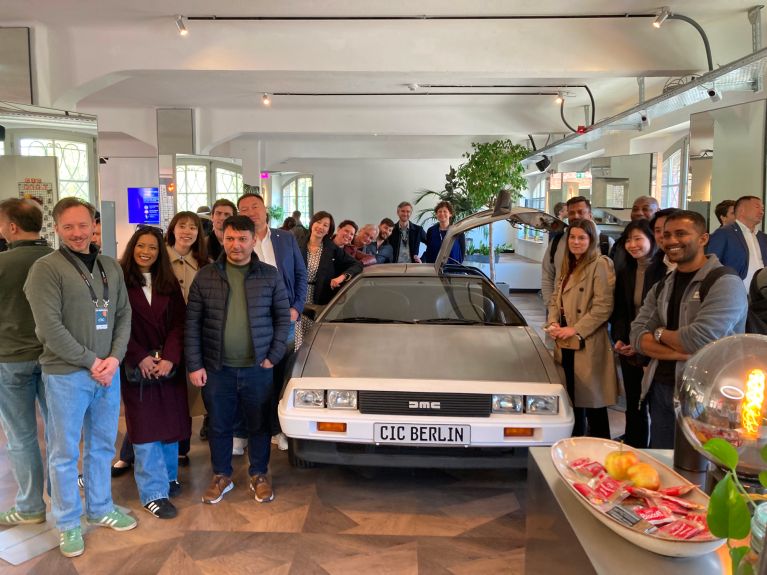
The Cambridge Innovation Center (CIC) is operating an international innovation campus in the photographic materials manufacturer Agfa’s former factory building here. The goal is to bring together entrepreneurs, investors and established companies under the same roof. The foyer is decorated with a DeLorean DMC-12 sports car, the iconic model from Back to the Future, and this seems to be a very fitting choice. The world-famous Agfacolor colour film was invented at this factory in the 1930s. Nowadays the premises are home to start-ups that are working on the technologies of tomorrow including, above all, artificial intelligence.
The #ai_berlin hub that has been based at the CIC site since 2025, aims to provide perfect conditions for this, with its mixture of co-working space and a curated AI ecosystem. The hub brings together start-ups, researchers, established companies and investors. To this end, it offers a range of different formats, such as the AI Onboarding Breakfast, where AI entrepreneurs have the opportunity to meet investors. Lucie Beránková is impressed: “Private-sector funding providers are obviously needed for successful transfer in the tech industry. What I have seen in Germany and Berlin was very inspiring to me.”


