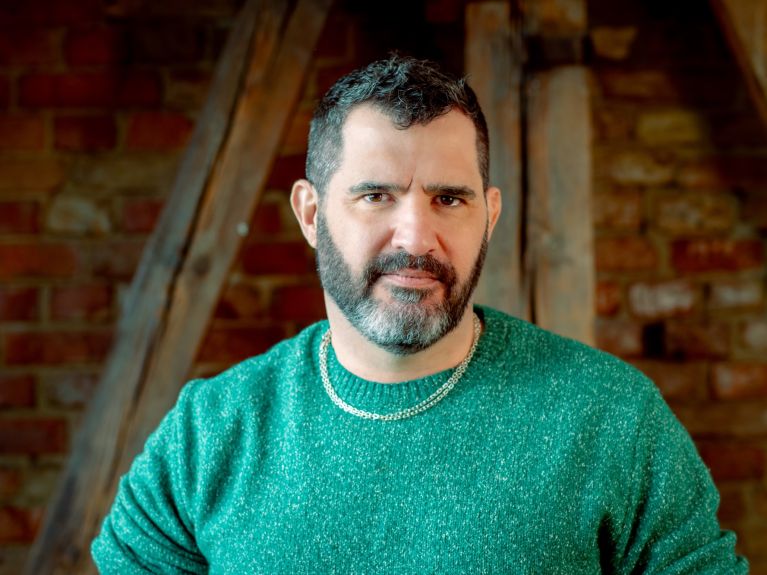
“Berlin has once again become a meeting place for Hebrew-speaking artists”
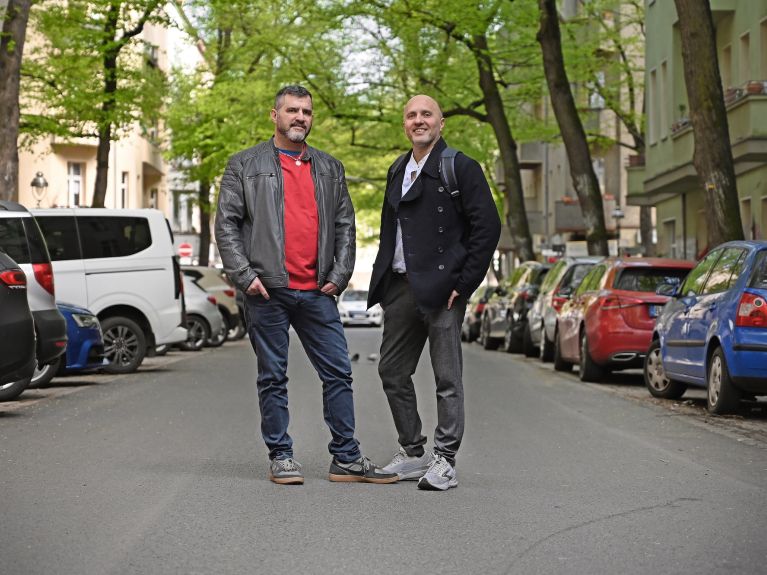
By establishing Altneuland Press, two Israeli writers are reviving Berlin’s Jewish literary heritage. Co-founder Dory Manor explains why the city is once again a special place for Hebrew literature.
 Stefanie Hardick
Hebrew literature from Berlin
- Israeli writers and publishers Dory Manor and Moshe Sakal founded Altneuland Press in Berlin in 2024.
- The independent, privately funded publishing house publishes fiction and non-fiction in German, Hebrew and English.
- Its focus is on Jewish and Hebrew literature from Israel and around the world.
Mr Manor, you founded a publishing house for Hebrew literature in Berlin. What makes Berlin such a good place for a Hebrew publishing house today?
In the 19th and 20th centuries, Berlin was one of the most important centres of modern Hebrew literature, alongside Odessa, Warsaw and Vienna. Our model is the publishing house Salman Schocken founded here in 1931. Today, Berlin has once again become a meeting place for Hebrew-speaking cultural figures. The city also supports authors who write in other languages. That would be unthinkable in Paris, where authors are expected to write in French.
Who do you hope to reach with your books?
More and more Hebrew speakers are living outside Israel. We want to establish a modern publishing house for them. At the same time, we want to create a European centre for Jewish literature, publishing secular, humanist books that speak to everyone. That’s why we also translate fiction and non-fiction from various languages into German.
You’re an author yourself and write in Hebrew and French. What’s special about Hebrew from your perspective?
It’s an ancient language, but as a modern medium for day-to-day communication it’s still very young. So for a writer, Hebrew offers the rare opportunity to combine ancient and modern registers. In French it’s almost impossible to find a poetic form that nobody has used before, but in Hebrew you can. At the same time, the language carries an enormous burden. For example, the words sécurité or Sicherheit feel as though they carry less weight than ביטחון (bitachon): it’s a word that instantly takes on political overtones.
Hebrew has more than one home, and Jewish culture has more than one possible future.
Yiddish is closely related to German. What role does this linguistic connection play for your publishing house?
The relationship between Yiddish and German shows how Jewish culture grows through encounters across languages and borders. As a poet and translator, I firmly believe that no state owns a language: indeed, its many homes are a source of freedom. Altneuland puts this belief into practice by creating a European centre for secular, humanist Jewish literature. Bringing Hebrew, Yiddish and German together in Berlin means building a Jewish future alongside the work of remembrance. Hebrew has more than one home, and Jewish culture has more than one possible future.
How has your publishing house been received internationally?
There’s a great deal of interest. At the Frankfurt Book Fair, too, we noticed that Altneuland is becoming better known. Many international publishers are wary of Israeli institutions, however. We often sense a certain relief when people realise that although we come from Israel and publish Hebrew books, we’re not official representatives of the Israeli state. If you include the titles announced in our current spring catalogue, our German-language list comprises 12 books. By the end of 2027, we’ll have published a total of 20 books in German. We’re still building our list, and I hope that in three to five years’ time our books will be able to speak for themselves.
Which books would you recommend as an introduction to modern Hebrew literature?
Bandit by Itamar Orlev, an Israeli author who lives in Berlin. His father was the well-known children’s author and Holocaust survivor Uri Orlev. The novel tells the story of a young man of Israeli-Polish descent who travels to Poland in the 1980s to meet his father – a man with an alcohol addiction. The book is due to be published in November. For anyone wanting to learn more about contemporary Israel, I recommend In the Belly of the Whale by Ruth Margalit. In it, she portrays figures from politics and culture across the political spectrum. The book was published simultaneously in Israel, the USA, Britain and Germany.


