Europe’s first energy island
Germany and Denmark are turning the Baltic Sea island of Bornholm into an electricity hub - with wind farms set to supply millions of households with electricity. Is it worth it?
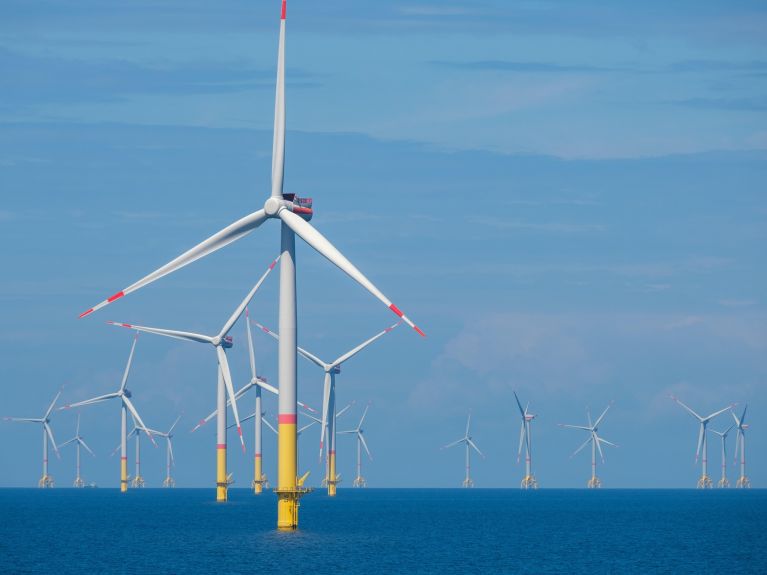
With forests and heathland sandwiched between rugged cliffs in the north and sandy beaches in the south, Bornholm is one of Denmark’s most popular holiday destinations. But now the island’s attracting energy firms as well as tourists. The “sunshine island” is reinventing itself as an “energy island”: electricity from three planned offshore wind farms will be pooled here and distributed to Germany and Denmark via submarine cables. Enough electricity will be produced to supply more than four million households.
At the beginning of this year, the two countries agreed on how to share the costs. So now the project, which will cost billions, can start. “A new era of interconnection and shared energy security,” is how Danish Energy Minister Lars Aagaard described the agreement. His German counterpart Katherina Reiche stressed the importance of the project for Europe’s sovereignty: “Cross-border projects such as this reduce critical dependencies, strengthen our strategic autonomy and make us more resilient against political and economic pressure.”
370 kilometres of submarine cables
For the first time, the electricity produced by wind turbines in the sea will not only be pooled at one point but also distributed directly to two countries. The advantage of this is that the energy can flow directly to wherever it is currently needed the most. And thanks to the interconnector on Bornholm, an additional international power route will be created, making the European electricity grid more resilient.
In technical terms, the new energy hub in the Baltic Sea will function as follows: the electricity from the three wind farms will be transported to Bornholm through alternating current cables. Converters and substations will be built there. The electricity will then be sent on at high voltage through direct current power lines that minimise losses. The submarine cables to Denmark’s main island of Zealand will be around 200 kilometres long, while those transporting the electricity to Mecklenburg-Western Pomerania in Germany will cross a distance of more than 170 kilometres. On the mainland, substations will bring the electricity down to the appropriate voltage for the national grids.
The lion’s share of the wind power will be sent to Germany, where it will help drive forward the energy transition. Last year, renewable energies accounted for a good 55 percent share of the electricity mix, according to the German Environment Agency. The German government believes that offshore wind is the best way to increase this figure. Installed capacity is to rise from just under ten gigawatts at present to 70 gigawatts by 2045. In Denmark, renewable energies already account for around 80 percent of electricity consumed - making the country an EU leader in this area.
European Union is promoting interconnection
The German electricity transmission system operator 50 Hertz, which will implement the project together with Energinet from Denmark, expects operations to begin in 2034. According to 50 Hertz, the project is likely to cost around seven billion euros. The EU is contributing 645 million euros. Currently, the bloc is investing a total of 1.25 billion euros in 41 cross-border energy infrastructure projects. This investment in greater interconnection aims to make Europe less dependent on energy imports in an era of growing geopolitical tensions.
The plans for Bornholm go beyond the electricity sector. There are also plans to build a facility on the island that will turn surplus wind power into hydrogen. Cross-border pipelines are also to be built. Germany in particular relies on gas-fired power plants to generate electricity when wind turbines and photovoltaic systems don’t supply enough. So far, natural gas has been the main fuel used for this purpose. Climate-neutral hydrogen can also be used in industry - such as in steel or chemical production.
Impetus for new jobs
The project as a whole is also expected to generate economic impetus. Numerous companies are involved. Siemens Energy for example has been contracted to build the converters and substations. NKT from Denmark has been commissioned to provide the cable connections on the Danish side. According to a report, 900 new jobs could be created on Bornholm alone. 50-Hertz CEO Stefan Kapferer talks of a “signal being sent for the offshore industry across Europe”.
In future, energy islands could also be artificially created. Denmark is planning one such island 80 kilometres off the Jutland coast in the North Sea. Other countries are expected to be involved in this project, too. Experts see the rougher North Sea as offering particularly great potential for wind power.
Seven countries in all border the North Sea. Together with other countries, they plan to build new offshore wind farms and make 100 gigawatts of power available via cross-border networks. By way of comparison: Bornholm is expected to produce around three gigawatts. Political commitment is intended to provide the industry with greater planning and investment certainty. At the North Sea Summit that took place in Hamburg in early 2026, which is also when final agreement was reached on the Bornholm energy island, the talk was of around 91,000 additional jobs.


