On the path to a green continent
Hydrogen will play a key role in supplying Europe with sustainable energy. Germany is helping with an initiative that combines research and industry.
 Verena Kern
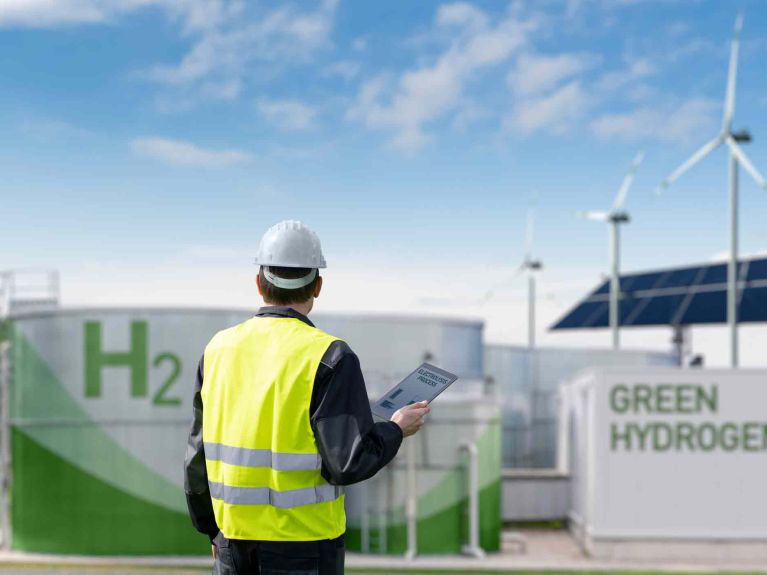
 It could hardly be cleaner: hydrogen, the simplest and most fundamental element in our universe, is produced from water, sun and wind. Hydrogen is to be at the heart of Europe’s energy transition – as a storage system and fuel, and as a link between industry, transport and electricity generation. Virtually no other energy source symbolises the vision of a green continent to a greater extent.
Germany is playing an important role in this. For hydrogen to become established as an energy source, a well-functioning infrastructure is needed to store and transport it. Launched in Berlin in early May 2025, the “TransHyDE 2.0” project, involving both research and industry, is intended to help. Mario Ragwitz, director of the Fraunhofer Research Institution for Energy Infrastructures and Geotechnologies IEG and a TransHyDE 2.0 management board member, says the plan is to “drive forward innovative applications” and “remove obstacles to implementation”. He envisages possible obstacles in terms of cost effectiveness, though also when it comes to the level of public acceptance and the legal framework conditions.
Mediating between industry and research
A physicist, Ragwitz was already one of the coordinators of the predecessor project “TransHyDE”, which was funded by the Federal Research Ministry and the European Union. Over the course of four years, more than 100 partners explored the various transport and storage options. They presented a roadmap when the project concluded in spring 2025. The conclusion was that a comprehensive nationwide transport and storage infrastructure - open to different types of technology - would be needed to ramp up the hydrogen economy.
This is the starting point for the follow-up project. “TransHyDE 2.0 is an invitation to industry to contribute to the project by outlining their specific needs for further development and by setting projects in motion,” says Ragwitz. The initiative intends to mediate between industry and research, provide an advisory platform for policy-makers, business and society and establish a network along the hydrogen value chain.
Stepping up the pace of the hydrogen ramp-up
“Through the Hydrogen Acceleration Act, we are now fundamentally simplifying and digitising processes and stepping up the pace,” says Katherina Reiche, Germany’s federal minister for economic affairs and energy. The Economics Ministry is no longer relying solely on green hydrogen but also wants to promote the use of “blue” hydrogen (made using natural gas and involving carbon capture) and “white” natural hydrogen. The latter is found in underground deposits and can be extracted by drilling for it. According to the ministry, however, the long-term objective is still “to switch to climate-neutral hydrogen based on a growing share of renewable energies produced in Germany or imported”.
9,000 kilometres of transport pipelines by 2032
The Federal Government wants to push forward with establishing a hydrogen core network. By 2032, the network is to cover around 9,000 kilometres, providing nationwide hydrogen transport and connecting Germany to the European hydrogen network. The core network will interlink key sites, such as generation regions, power plants, industrial centres and storage sites, as well as numerous border-crossing points and LNG terminals for gas import.
It is unclear as yet what will happen if individual consumers opt out of the network or if new consumers sign up who were not originally included in the plan. “TransHyDE 2.0” aims to allow quick and agile planning if anything changes within the system. How to fill hydrogen storage systems poses another challenge. Special compressors will need to be developed for this purpose. “This requires innovation,” stresses Mario Ragwitz. “We want to accelerate such innovations.”

