Greater responsibility, greater sovereignty
War in Europe, power politics instead of rules, and an unpredictable US president: Germany is redefining its security policy.
 Wolf Zinn
 The rule-based international order that Germany and many other countries have taken for granted for decades is coming apart at the seams. War has returned to Europe, international agreements are losing their binding force and are being replaced by aggressive strategic power politics. The threat posed by Russia in particular is calling the entire European security order into question. Germany is one of Ukraine’s biggest supporters. However, it has not been possible to repel the Russian army to date - losses are considerable on both sides and the situation is having devastating consequences for Ukraine’s civilian population. Diplomatic efforts to reach a ceasefire have failed so far. Putin is continuing to insist on his maximum demands.
The situation has worsened since US President Donald Trump took office in early 2025. His foreign and security policy is seen as erratic and he openly shows his disdain for multilateral institutions such as NATO, the United Nations and the European Union. Europe has been alarmed in particular by Trump’s blatant territorial claims to Greenland - a NATO partner.
For the first time, there are doubts over the reliability of the US as a protective force. At the World Economic Forum in Davos, Trump’s speech initially provoked enormous tension, and then relief. This is because a potential military conflict appears to be off the table for now on the Greenland issue - partly because the EU presented a united front and announced massive steps to counter Trump’s renewed tariff threats.
Germany rearms - and seeks new responses
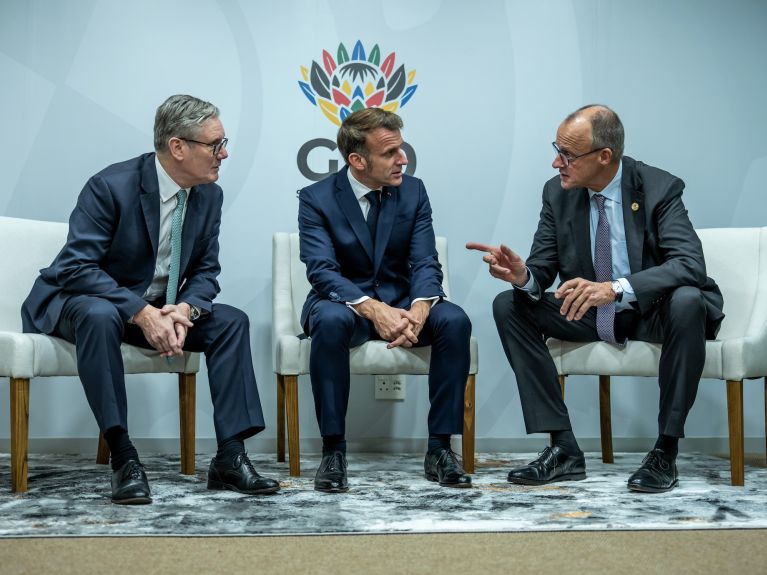
In this complicated situation, Germany - along with countries such as France, the UK, Poland and Italy - is seeking to assert and reposition itself in security policy terms. In late January 2026, Friedrich Merz called on his European alliance partners to act with resolve and self-confidence in the new world order. Europe will only be able to implement its ideas in the world “if we ourselves learn to speak the language of power politics, if we ourselves become a European power,” Merz said.
In this context, the issue of security has uppermost priority. Since the beginning of the Ukraine war, Germany has been rearming on a grand scale and plans to increase its NATO contribution to 3.5 percent of GDP by 2029 - and even to five percent including military infrastructure. The question of a nuclear deterrent is a particularly sensitive issue. France’s President Emmanuel Macron has long been advocating for a European approach - and the German government appears open to talks. Germany’s Foreign Minister Johann Wadephul has stressed that Europe will remain reliant on the US nuclear shield “for some considerable time yet”, and continues to pin his hopes on the German-American friendship, saying: “Our bond is solid as a rock”. At the same time, however, he admits that questions of strategic security need to be “openly discussed”.
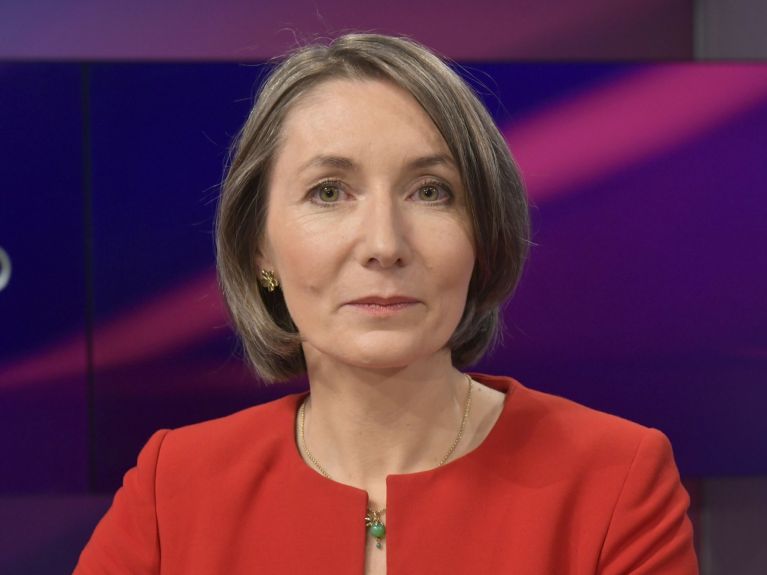
Numerous security experts have been warning for years that Europe cannot afford to postpone this debate any longer. Claudia Major from the German Marshall Fund sums the situation up as follows: “Europe is hardly capable of action without the US - but nonetheless we must start taking responsibility ourselves rather than continuing simply to outsource our security.” In an interview, renowned historian Timothy Snyder from the University of Toronto emphasised: “Germany is Europe’s largest fully functional democracy, and Europe is the biggest block of functioning democracies. Whether there will be democracies in the world depends on Europe, and Europe depends on Germany.”
Greater sovereignty - in military, economic and strategic terms
The reorientation of German security policy also involves reintroducing military service, initially on a voluntary basis. This is intended to increase the size of the Bundeswehr, Germany’s armed forces, and to raise awareness in society of the importance of national and alliance defence. Security has long been considered from a much broader perspective in Berlin, however. Along with its European partners, Germany also wants to become more economically independent – for example by concluding new free trade deals such as with the Mercosur countries or India. Trump’s unpredictable tariffs policy is acting as a turbo boost in this context. More attention is also being paid to critical infrastructure. The agreements to massively expand wind power that were reached at the North Sea Summit in Hamburg in January 2026 are a prime example of Europe’s intention to increase the resilience of its energy supply. One thing is certain: as Europe’s largest economy, Germany has a key role to play in European efforts to achieve greater sovereignty.


