How Germany is rearming
Missile defence, drones, artillery: Germany is racing to boost its defence capability with massive investments. An overview.
 Wolf Zinn
 Germany is investing massively in Bundeswehr personnel, equipment and technology - in a bid to counter the growing geopolitical threats. In 2026 alone, around 108 billion euros will be spent on national and alliance defence. A sum that will only increase: by 2029, expenditure is already set to reach 152 billion euros, which will probably see the NATO target of 3.5 percent of GDP achieved. In addition, the Bundestag passed a new law in January 2026 to accelerate the procurement of military hardware. Germany is opting for a combination of equipment produced at home and selected purchases from abroad to quickly plug the gaps in its defence capability. The Bundeswehr is drawing on US suppliers when it comes to certain key technologies, such as the F-35 stealth fighter jet, long-range Tomahawk cruise missiles and the Patriot air defence system.
Focusing on air defence
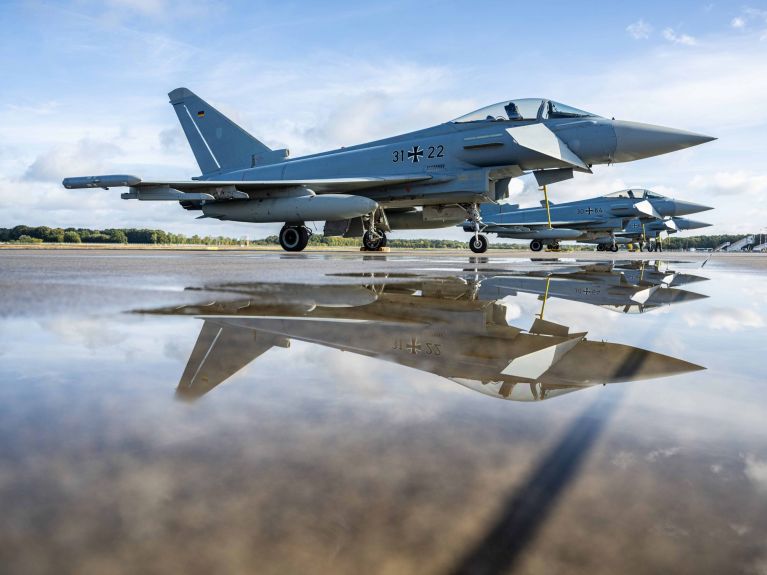
One major priority is to establish an efficient air defence infrastructure. The goal is to set up a layered air defence shield: the Arrow 3 defence system is designed to intercept ballistic missiles very early on - in some cases while they are still in space. The German-made ground-based IRIS-T SLM air defence system protects against fighter jets, helicopters, drones and cruise missiles at distances of up to 40 kilometres. Overall, the plan is to establish a strong defence network - closely coordinated with NATO partners - capable of combating threats at different altitudes and distances. In addition, the Bundeswehr has ordered 20 new Eurofighter jets.
Drones, reconnaissance and laser weapons
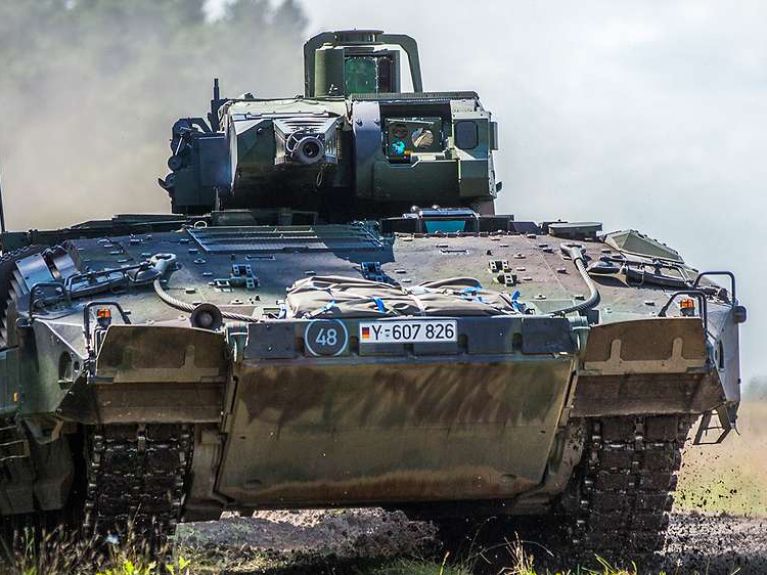
The drones being developed by German start-ups such as Helsing are the focus of particular attention. Among other things, loitering munition systems are being tested - also known as kamikaze drones, they are fitted with a warhead and loiter in the air above a particular area until a target to be attacked is designated. Trials are also underway with drone swarms featuring digitally networked reconnaissance, guidance and strike capabilities. New radar satellites will allow movements on the ground to be detected even at night or in bad weather. Another focus is on the Army: 200 additional German-made Puma infantry fighting vehicles have been ordered and steps are underway to modernise the artillery. Self-propelled howitzers will be able to cover greater distances. At sea, the Navy is increasing its range with new on-board helicopters and unmanned aerial vehicles that can monitor large areas of the sea and help with hunting submarines. Last but not least, the arms companies Rheinmetall and MBDA are also developing novel laser weapons - to defend against drones, for instance.


