On the home stretch towards increased free trade between India and the EU
Following lengthy negotiations, the EU and India are close to finalising a trade agreement that will benefit businesses from both regions.
The global trade environment has become rougher and more troublesome: market mechanisms are increasingly affected by tariffs, protectionism and security interests. Reliable trade relations are more important than ever before in this volatile situation. It is therefore of great significance that the European Union (EU) and India have been intensifying their talks, leading to a free trade agreement being within reach at long last, after years of negotiations. This development is particularly relevant to Germany as an export nation.
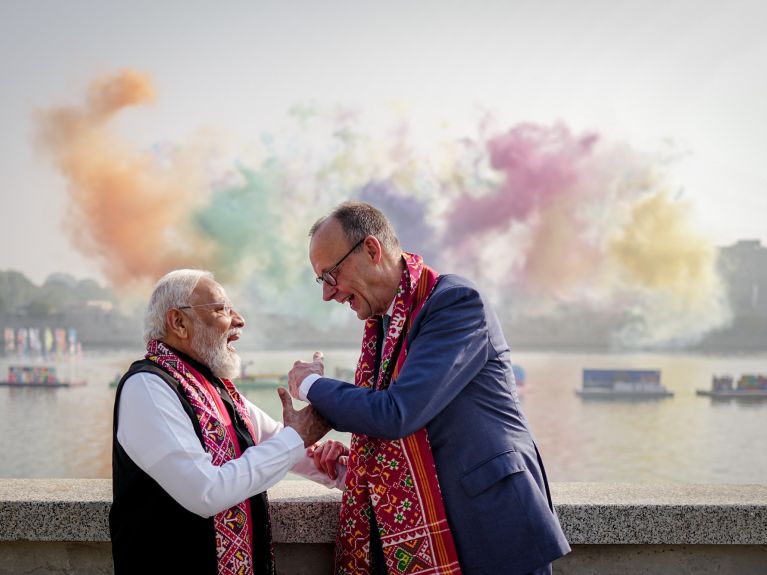
“India is a key partner for Germany,” said Federal Chancellor Friedrich Merz during his visit to India in January 2026. “Germany, as the most populous and economically powerful EU state, and India, as the world's largest democracy, are united by fundamental values,” Mr Merz stated. India’s Prime Minister Narendra Modi said that the Federal Chancellor’s visit brought “new momentum and trust” to German-Indian relations.
German enterprises are also hoping for new momentum: an increase in trade with India, the Mercosur states, Indonesia and other countries could lead to up to 0.5 percent growth for Germany’s economy, according to expert estimates. “New trade agreements cannot only compensate for the negative impact of Trump’s tariffs, but they might even exceed such compensation,” said Isabella Flach from the ifo Institute in Cologne.
High expectations of the business community
India with its around 1.5 billion people is the world’s most populous national economy. The country is currently about on par with Germany and Japan in terms of economic strength, surpassed only by the USA and China. What sets India apart is its rapid economic growth of some 6.5 percent. India’s government has realised comprehensive modernisation measures in recent years, and has reduced obstacles to market access for foreign companies, as well as facilitating investment. In the Global Innovation Index, India occupies a leading position in Central and Southern Asia. The EU is meanwhile among the most important foreign investors. Around 6,000 European companies are active in India, including some 2,000 German companies.
Expectations in connection with a trade agreement are therefore high. “The majority of German business representatives are in favour of an EU-India agreement that allows for better market access and a significant reduction of trade barriers,” said Volker Treier, Chief Executive of Foreign Trade at the German Chamber of Commerce and Industry (DIHK).
German investors appreciate the country’s political stability, as well as the availability of qualified skilled workers paired with comparably low labour costs. “Investment conditions have improved in recent years, even if India remains a complex business location,” Jan Nöther, Director General of the Indo-German Chamber of Commerce (IGCC), said. “Those who want to diversify their supply chains or open up new markets will find it hard to ignore India, owing to the sheer size of the market.”
Dieses YouTube-Video kann in einem neuen Tab abgespielt werden
YouTube öffnenThird party content
We use YouTube to embed content that may collect data about your activity. Please review the details and accept the service to see this content.
Open consent formSecure legal framework
German companies would appreciably benefit from a reduction of tariffs and regulations and easier market access. Tariffs on vehicles can be over 100 percent in India in some cases. In the area of mechanical engineering, export of machinery, industrial equipment and electrical components could be simplified through mutual recognition of technical standards and certifications. Medium-sized companies would also benefit from a simplification and digitisation of custom procedures and better investment protection, as this would enable them to establish local subsidiaries and production chains more quickly. One key aspect is the protection of intellectual property rights: pharmaceutical companies in particular need a reliable legal framework for patents if they wish to invest in clinical programmes and product upgrades.
India, too, has high hopes in connection with the agreement, as the country would like to reduce its dependency on China. Indian IT groups are hoping for improved access to the European service market, as well as simplified visa regulations. The pharmaceutical industry, the areas of mechanical and systems engineering, and also the textile and clothing industry that provides millions of jobs, would all benefit from lower tariffs.
“India is one of the most promising and most reliable investment locations for the next two or three decades, and our goal is to become an industrial nation by 2047,” Minister of Commerce and Industry Piyush Goyal wrote in a guest commentary for Frankfurter Allgemeine Zeitung. India’s rapid expansion in the field of renewable energy was a good match for Germany’s expertise, opening up opportunities for joint ventures, research and development, and also for technology transfer, for example concerning green hydrogen, he explained.
Sustainability as a disputed issue
Brussels has been aiming for a trade agreement with New Delhi since 2007. Despite an overall positive outlook, both sides are still struggling with details in 23 policy areas. The EU Carbon Border Adjustment Mechanism that has applied to Indian steel, aluminium and cement since 1 January 2026 is among the most disputed issues.
The 16th round of negotiations has meanwhile been completed. In early January 2026 Piyush Goyal visited Brussels to meet the European Commissioner for Trade and Economic Security Maroš Šefčovič. “We made good progress and provided strategic guidance to our negotiating teams & reaffirmed our strong political resolve to deliver a fair, balanced, & ambitious agreement,” Mr Goyal wrote on X following the meeting. Mr Šefčovič used the same channel to respond: “Open issues narrowing. Full steam ahead in the coming days.”
India recently concluded a number of contracts, for example with EFTA – Iceland, Norway and Switzerland – and the United Kingdom. The EU, too, has made progress in connection with concluding agreements with Mercosur and Indonesia. It showed that willingness to compromise has been increasing, precisely because of the global environment’s volatility.


