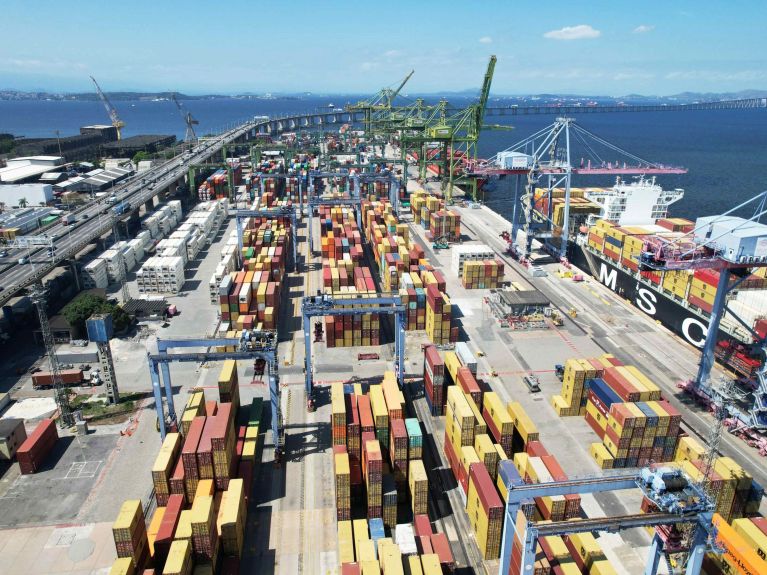
“A signal for free trade and against protectionism”
Following lengthy negotiations, the EU is paving the way for the agreement with the Mercosur states. Orlando Baquero from the Association for Latin America sees it as presenting political and economic opportunities for both sides.
 Interview: Helen Sibum
 Orlando Baquero is CEO of the Association for Latin America. The organisation was founded by Hamburg and Bremen merchants and politicians in 1916. Part of the Latin America Initiative for German Business, it supports German companies pursuing activities in Latin America and the Caribbean by providing advice and networking opportunities.
Why has it taken so long to negotiate the agreement?
It is a highly complex treaty that focuses not only on free trade but also encompasses many other components. Furthermore, for a long time there was no sense of urgency and little pressure from the European business world, for which Asia was the most important growth market. At the same time, both sides had other internal priorities: the EU was concentrating on its own enlargement, while the major Mercosur states of Argentina and Brazil were occupied with their changes of government. Last but not least, there had been widespread criticism in the EU of former Brazilian President Jair Bolsonaro. A path forward then became possible again when the current President Lula took over.
The agreement provides a stable foundation to do business across a large region.
US President Donald Trump’s tariff policy presumably increased the pressure.
Yes, it did. The US is no longer a reliable partner. The EU-Mercosur Agreement provides a stable foundation to do business across a large region. It is an international signal for free trade and against protectionism.
In which ways are German companies hoping to benefit specifically from the deal?
German firms currently pay tariffs when they sell goods in the Mercosur states: up to 20 percent on machines, 35 percent on cars and between 15 and 20 percent on chemicals and pharmaceuticals. These are our most important exports to the region. The deal will remove up to 90 percent of these tariffs. What is more, German companies will be able to take part in public tender invitations in the Mercosur countries. This will allow German engineering and technology firms to help advance modernisation there.
Could the agreement also prompt companies from the Mercosur countries to step up their investment activity in Germany?
Certainly. The Mercosur countries are much more advanced than Germany in many areas, such as Argentina in the agricultural sector and Brazil in finance – the world’s largest digital bank is Brazilian. These firms will turn their attention more to Europe.
I understand why people criticise the deal but don’t think this criticism is justified.
Critics of the agreement envisage risks in terms of the climate, species conservation and human rights. Can you understand this criticism?
I understand it but don’t think it is justified. The climate, species conservation and human rights are important issues, but negative developments in these areas don’t necessarily have anything to do with the agreement. You can’t sell anything if there is no demand for it. And the agreement won’t increase the demand. Rather, the agreement provides us with a platform to engage in dialogue and to work towards ensuring that local legislation prevents deforestation or disadvantaging indigenous peoples.
Another point of criticism is that the automotive and mechanical engineering industries in the Mercosur states could be damaged by the deal. Do you also see this as a risk?
Naturally, the deal will bring new technologies to the Mercosur countries. And of course, companies that still use outdated technologies and aren’t willing to change may be driven out of the market. As with any economic change, there will be winners and losers, but I believe the number of losers will be minimal.
- since 2000: with Mexico (modernisation about to be ratified)
- since 2003: with Chile (modernised version temporarily in force since 2025)
- since 2008: with the CARIFORUM states
- since 2012: with the Central American countries of Costa Rica, El Salvador, Guatemala, Honduras, Nicaragua, Panama
- since 2013: with Peru and Colombia, 2017: Ecuador joined
- since 2026: with the Mercosur states of Argentina, Brazil, Bolivia, Paraguay, Uruguay

