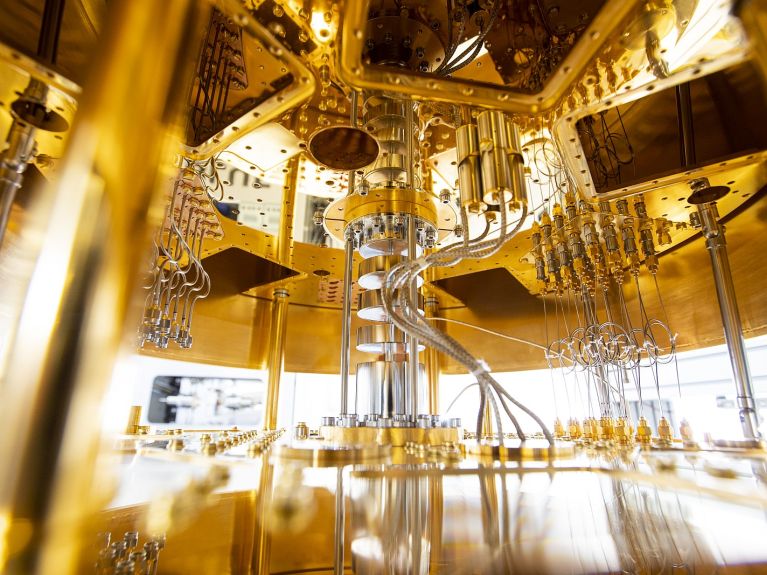
The unassuming wonder machine
One of the world’s most advanced quantum computers has been launched at Forschungszentrum Jülich. What tasks is it designed to perform, and just how good is it?
Tiny particles, enormous computing power – few machines illustrate this contrast as strikingly as the JION quantum computer, which startup Eleqtron put into operation at Forschungszentrum Jülich in September 2026. Computing structures at the atomic level provide maximum computing power.
The quantum computer is not a replacement for today’s supercomputers, but a specialised machine designed to perform particularly complex tasks much faster and more efficiently. JION consists of a quantum module and conventional computing systems. “Our vision is to combine quantum computers and high-performance computing (HPC). We integrate the two and assign the part of the problem that it can solve more efficiently to the quantum computer – the HPC system handles the rest,” says Kristel Michielsen, head of the Jülich Supercomputing Centre (JSC) at Forschungszentrum Jülich.

Quantum computers and supercomputers working together
JION marks an expansion of Jülich’s computing network. In addition to the four supercomputers Jupiter, Jureca, Juwels and Jusuf, researchers there have access to several quantum systems. Bringing together such a range of computing technologies is rare and makes Jülich one of Europe’s largest research centres for high-performance and quantum computing.
With its 70-year history, Forschungszentrum Jülich reflects the transformation of science in Germany. Initially, test and experimental reactors were built there for nuclear energy research, while later the focus was on developing the first supercomputers. Today, 7,700 people work in Jülich alongside more than 1,500 visiting researchers from 82 countries. They conduct research at 15 institutes on a wide range of topics – from energy and the bioeconomy to computer science.
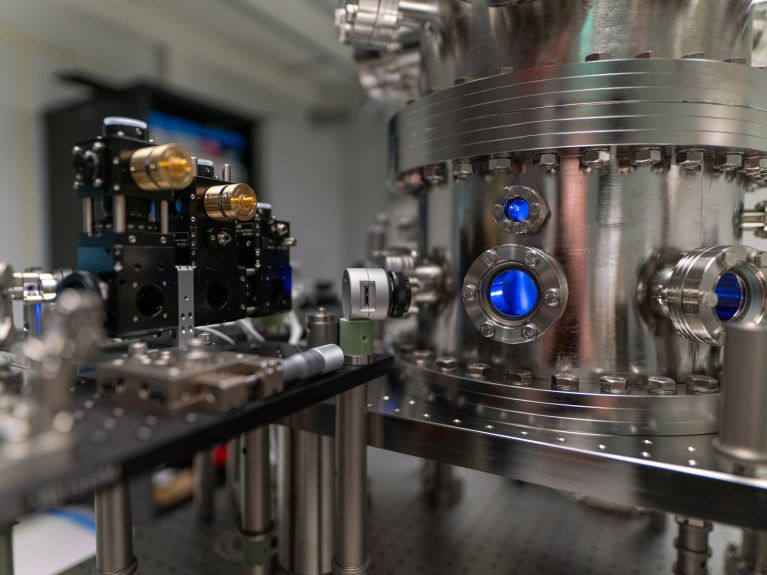
JION’s computing power – the name stands for “Jülich trapped-ION quantum computer” – is based in part on the fact that it does not rely solely on silicon chips, but uses ions of the metal ytterbium. In the quantum module, these charged atoms are held in place and precisely controlled using electromagnetic fields. They serve as what are known as qubits, the units of information in a quantum computer. Quantum computers can therefore perform complex calculations for applications including AI, cryptography, the pharmaceutical and medical sectors, and materials research.
Dieses YouTube-Video kann in einem neuen Tab abgespielt werden
YouTube öffnenThird party content
We use YouTube to embed content that may collect data about your activity. Please review the details and accept the service to see this content.
Open consent formFrom research project to future market
The computer was developed by Eleqtron, a startup founded in Siegen by Jan Leisse and Michael Johanning in 2020 that now employs around 90 people. In May 2026, the young company secured 57 million euros in growth financing to scale up industrial production of its quantum computers.

JION is in line with the Federal Government’s High-Tech Agenda, which identifies quantum technology as one of six key areas for growth in Germany. By 2030, Germany is to have at least two quantum computers that rank among Europe’s best. With its modular architecture, JION marks a major step towards achieving this goal.


