Have your doubts about human-caused climate change? Here are the facts
False claims about climate change can be very persistent. We debunk the most common myths about global warming.
 Kim Berg
The climate has always been changing - is human-caused climate change a lie?
No. Klaus Hasselmann, founding director of the Max Planck Institute for Meteorology, already proved human-caused climate change in 1995 - which won him the 2021 Nobel Prize in Physics. He developed models that he linked to weather and climate fluctuations and that were able to prove how human activity is influencing global warming.
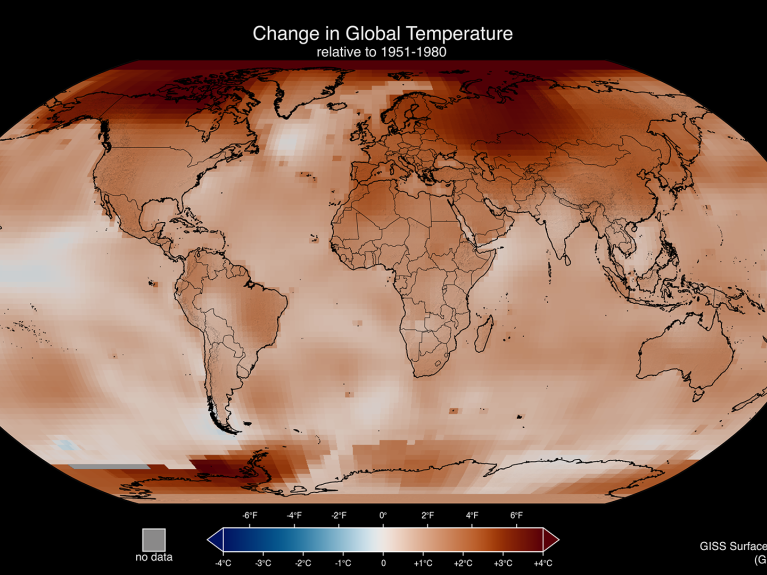
The concentration of carbon dioxide in the atmosphere has risen significantly as a result of human activity: it was roughly 280 ppm before industrialisation. The abbreviation stands for “parts per million” and means there are 280 molecules of carbon dioxide for every one million particles of air. The carbon dioxide concentration was above 420 ppm in 2025, as shown for example by measurements conducted by the German Environment Agency . During the same period, the global average temperature increased by around 1.4 degrees Celsius.
Weather forecasts are often wrong - does this mean climate models are unreliable?
No. Weather and climate forecasts focus on quite different things. Weather models calculate how the atmosphere will develop over the next few days, based on current measurement data. Climate models are complex computer programs that calculate future climatic trends on the basis of assumptions. Using the laws of physics, they can formulate hypotheses about climate change that will depend on changes in the atmosphere, cryosphere, land surface, biosphere and oceans.
The Deutscher Wetterdienst - Germany’s national meteorological service - and the Max Planck Institute for Meteorology use the ICON model for weather and climate predictions. For the weather report, ICON calculates how conditions will develop over the next few days. The predictions start to become unreliable after about a week. For climate forecasting, it analyses how the average temperature and frequency of heatwaves or heavy rainfall will be affected by a change in greenhouse gas emissions.
Why is it still cold in winter if there is global warming?
Sporadic cold winters do not contradict global warming because weather and climate are two different things. German research institutions like the Potsdam Institute for Climate Impact Research (PIK) and the GEOMAR Helmholtz Centre for Ocean Research have proven that global warming can actually help bring about extreme regional winter cold.
Back in 2010, Vladimir Petoukhov and his colleague Vladimir A. Semenov from PIK studied how shrinking sea ice in the Arctic could affect winters in Europe. In simulations, they observed how certain reductions in sea ice could alter air flows and route more cold air southwards. Under these model conditions, the probability of extreme cold in parts of Europe and northern Asia more than tripled in some cases.
