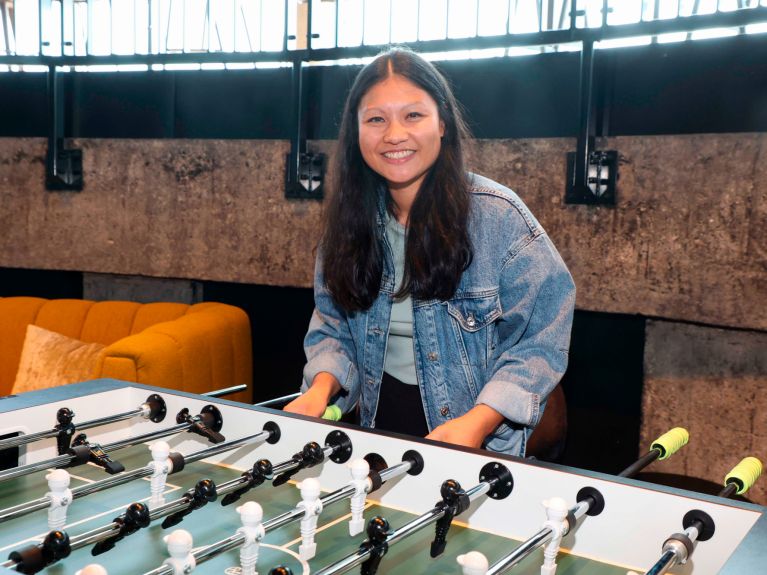
How Linh Tran learned to be proud of herself
The five-time table football world champion Linh Tran talks about pressure to perform, her Vietnamese roots and about finding the courage to give life a new direction.
A flick from her wrist and the little white ball crashes into the goal at full speed. “That was the snakeshot, one of my favourite techniques,” the five-time table football world champion Linh Tran says. “The sound of scoring a goal is the best moment in table football.” The 31-year-old is standing by a table football table in the Sidekick club house in Hamburg-Harburg. For ten years, she’d come here four to six times a week to train, often for up to eight hours a day, when she was preparing for important tournaments. “The Sidekick is my second home,” Linh Tran says. “Table football is so simple and so complex at the same time. Many people who only know the game from pubs would never guess.”
From chess to table football
In 2014, Linh Tran, who was born in Hesse, played table football for the first time at an Irish pub with Tobias Müller, who went on to become her husband and trainer. “I immediately enjoyed the proximity and tension between myself and my opponents. It reminded me of my time as a professional chess player.” Before taking up table football, Linh Tran had been a successful competitive chess player for almost ten years. She was the German under-16 vice champion and played in the women’s national chess league.
Soon after her first match at the pub, she joined a table football club. “In Hamburg, I felt free for the first time, when I sat at the Landungsbrücken, gazing into the distance, and I felt even freer when I stood at the football table. Table football allowed me to develop my personality without being constantly questioned.” Five years later, Linh Tran won her first world title.
Overcoming old credos
Her climb to the top of her sport is linked closely to her life story. “My parents grew up in absolute poverty in Vietnam. For them, to perform was literally about survival,” Linh Tran, who experienced strong pressure to perform as a child, recalls. One sentence her father would say played a particularly big role in her professional career. “He’d say to me: ‘You always have to fight in life.’ His words became my driving force and a part of my identity.” Despite winning five table football world cups, a European championship and nine German championships, Linh Tran was never able to stop wondering: “Am I good enough?” In 2024, she hit rock bottom and sought help from a mental coach and a psychotherapist. “It was only through this work and by writing my autobiography that I understood how the pressure to perform was linked to my self-esteem,” Linh Tran says. In her coaching sessions she was able to overcome the credo that she was only good if she performed, and to start enjoying her sport again.
German is my first language, but I still feel a sense of home when I speak Vietnamese.
Linh Tran reaches for her phone to show her wallpaper. “That’s me right after the final whistle at the 2025 table football world cup in Saragossa. It was the first time I was truly proud and able to cry tears of joy. I will never forget that.” In October 2026, she played her last match at the ITSF World Series in Saarbrücken. “There is so much about table football that I am grateful for: countless memories, medals and the amazing people I met. I always listen to my gut instincts, though, and it is time for something new, both personally and professionally.”
Finding her own roots
Linh Tran has been taking Vietnamese lessons for a while, to dive deeper into her parents’ language and explore her roots. “German is my first language, but I still feel a sense of home when I speak Vietnamese. Many people from the Vietnamese-German community got in touch with me because of my book, and I want to build on that exchange.” She also has new professional ambitions. Alongside her career as a professional athlete, she has been giving lectures on topics such as mental strength and pressure to perform. “I want to help others reach their goals in ways that are healthy, by sharing my experiences and knowledge in lectures and workshops.”
Encouraging girls and women, including in sports
Linh Tran would also like to work with young people and to encourage girls, in particular. She had to deal with gender stereotypes in both chess and table football herself. “As a woman you often get the feeling that you are not welcome in certain places. To this day, there are men who cannot handle losing against a woman,” she says. Linh Tran believes that female role models and sports associations can help girls and women to find their ways into male-dominated disciplines. She has a clear message: “Do not wait for circumstances to change. Just get started and take up space!”
Linh Tran is excited to find out what the future will bring. “I recently realised that I’ve really spent a lot of time indoors over the past twelve years. I am now looking forward to being outside more and discovering new things.”
Any questions? Search with our AI assistant
- How does the political system in Germany work?
- How much does it cost to study in Germany?
- Which traditions and festivals are typical of Germany?
- What is the best way to learn German?
- Who governs Germany?
- Which industries are particularly important to the German economy?
- Which political parties are there in Germany?
- Why is Germany considered a leading exporting nation?
- How do I apply to study in Germany?
- What opportunities does Germany offer international startups?
- How diverse is the German cultural scene, and what role do art, music and literature play?
- What cultural differences are there between Germany's regions?
- Which degree programs and universities are especially popular in Germany?
- How can I find a job in Germany as an international skilled worker?
- Why was Germany divided after World War II?
- What requirements do I need to meet to be allowed to work in Germany?
- Do I need to speak German to work in Germany?
- How high is the cost of living in Germany?
- How does the German healthcare system work?
- What should I keep in mind when moving to Germany?
- How did reunification come about?
- How does Germany deal with its National Socialist past?
- What level of German do I need to study in Germany?
- In which countries is German spoken?


