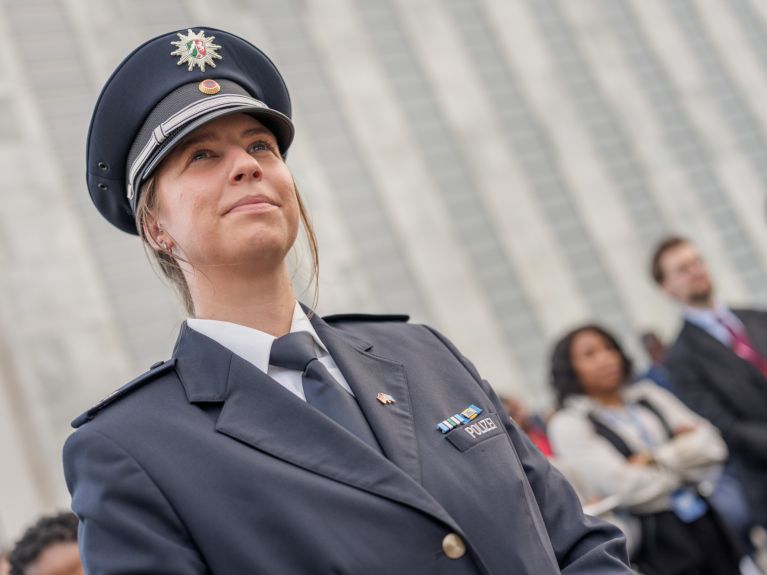
“A sense of hope”
During a major crisis, it’s the small successes that really count for “Woman Police Officer of the Year” Stephanie Königs from Germany.
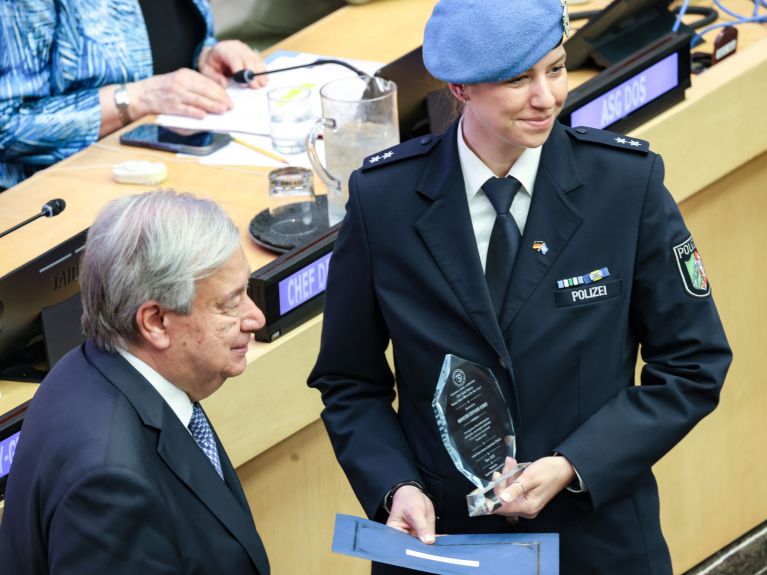
From September 2024 to March 2026, Police Inspector Stephanie Königs from the town of Grevenbroich in the west of Germany headed up a multinational patrol team in Juba, the capital of South Sudan, as part of the UN’s UNMISS peacekeeping mission. In recognition of her services, UN Secretary-General António Guterres named her “Woman Police Officer of the Year” in June 2026.
In our interview, Königs talks about her work in refugee camps, borderline situations that she personally faced in her daily work and how these experiences have changed the way she goes about her duties as a police officer in Germany.
Ms Königs, what’s the first thing you think of when you recall the time you spent working in South Sudan?
The hot weather and, despite the complex and fraught situation there, a sense of hope. I spoke to many highly motivated and dedicated people there who were determined to help their country advance. This atmosphere encouraged me in my work.
What were your duties in South Sudan?
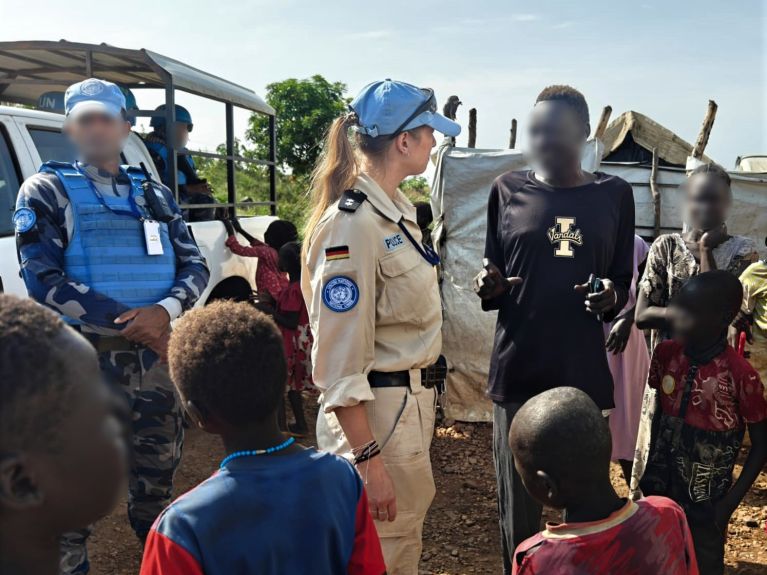
Essentially, the UNMISS mandate is to protect the civilian population. We would monitor the prevailing security situation, for example, gathering information on our patrols that would feed into the UNMISS early-warning system.
How did you come by this information?
My team was out and about in the patrol car every day. Looking out of the windows was the first important way of obtaining information. You can judge the current situation pretty well by watching how civilians and security forces are behaving. Talking directly to the local population is even more important.
In what sense?
The people on the ground know more about the security situation than we ever could. That’s why we, as an unarmed patrol team, always did our best to talk to people - both on the streets and in the camps for internally displaced persons. Communication and building trust formed an important part of our work.
I spoke to many highly motivated and dedicated people there who were determined to help their country advance. This atmosphere encouraged me in my work.
Dealing with people who had experienced war and life as a refugee was part and parcel of your everyday work. What do you feel was particularly important in this role?
It’s essential to be very patient and to ensure that you communicate with people on an equal footing. As someone without any experience of war or life as a refugee, I will never be able to fully grasp what that’s like, but I can at least try to understand the different realities people find themselves in. This attitude also helped me when I was dealing with the local military.
Are you thinking of any specific situations?
While I was in Juba, Vice President Riek Machar was on trial. The security situation was tense. Military checkpoints were set up in the city and we weren’t allowed through at first. So I negotiated with the soldiers. It was something of a balancing act, but I succeeded in communicating with them by showing respect, determination and empathy.
What role do female police officers play in peacekeeping missions?
In my experience, women in uniform can have a deescalating effect. Some of the women in my team also had special expertise in protecting victims and children. This is particularly valuable in countries affected by war. In many cases I was the only female team leader and, for some people, it was the first time they’d had a woman as a boss. Some were noticeably taken aback by this. That’s another reason why it’s so important for female leaders to become more visible.
How were you prepared for your role?
Ahead of the mission I spent many weeks doing different courses at the North Rhine-Westphalia police training centre, learning all the basics about the UN mandate for example or being taught the dynamics of local conflicts.
What were you not expecting despite all this preparation?
I still remember my first trip through a refugee camp as if it were yesterday. The only time I’d seen such appalling conditions previously was on television and during police training courses. But it’s an entirely different thing to see that level of suffering with your own eyes. Nobody can prepare you for that.
Is there a particular moment that you will never forget?
Yes, the mothers who would come to us in tears with their sick or injured children. On one day there were so many that they had to form a queue. It was very difficult to have to explain to these women that, as police officers, we were unable to provide any medical assistance - and that all we could do was register their concerns and pass them on to the competent authorities.
What did you manage to achieve in concrete terms on the ground?
Amid such complex crises, it’s the small successes that really matter. Like successfully negotiating our way past a checkpoint or getting a young woman to trust and talk to us despite her fear of the police.
Are there already plans for you to embark on your next deployment abroad?
Not for now, no. But I could certainly imagine doing something like that again in the future. It was impressive to experience how well the international community manages to work together and get things done - regardless of their different cultures, religions and backgrounds. That sends an important message, especially at times like these.
The United Nations Mission in the Republic of South Sudan (UNMISS) is a peacekeeping mission of the United Nations. Ever since the state of South Sudan was founded in 2011, UNMISS has been deployed in the country to help enforce peace agreements, protect the civilian population against armed conflicts and facilitate access to humanitarian aid. Around 70 percent of the population are reliant on humanitarian assistance. The current UNMISS mandate will expire on 30 April 2027. At present, more than 12,000 people are taking part in the mission, including military, police and civilian personnel. Germany is also involved in UNMISS, contributing military personnel and police officers.
Alongside the United Kingdom and the European Union, Germany is one of the biggest supporters of South Sudan in terms of development cooperation and humanitarian assistance. In 2025, the Federal Government provided 35 million euros in funding. This is spent primarily on food security, protecting the civilian population, education and measures to combat gender-based violence and improve the provision of water, sanitation and healthcare.


