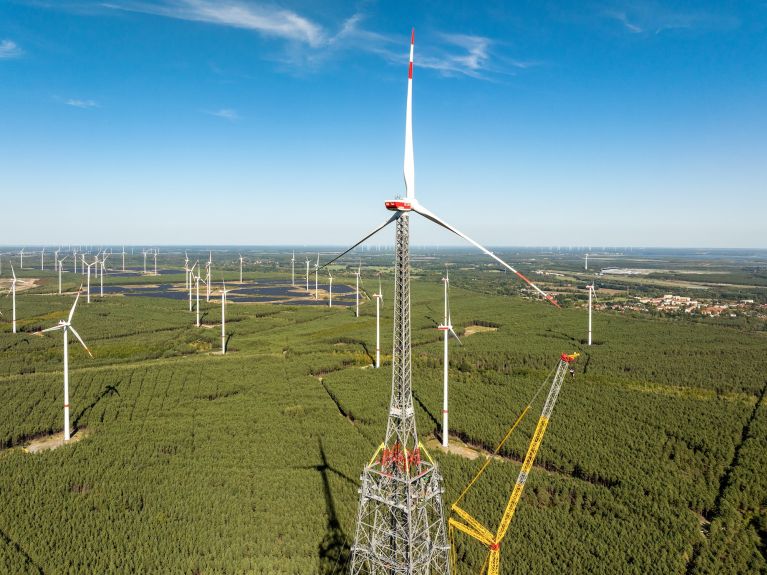
World’s tallest wind turbine is built in Germany
Standing at a whopping 365 metres, it is higher even than the Eiffel Tower. The high-altitude tower in Brandenburg will generate twice as much electricity as conventional wind turbines.
 Klaus Lüber (mit dpa)
 The world’s tallest wind turbine has reached its final height of 365 metres in the Brandenburg town of Schipkau in the lignite mining region of Lusatia. The wind turbine is now Germany’s second-highest structure. Only the television tower in Berlin is taller, at 368 metres. By way of comparison, the Eiffel Tower in Paris stands at 330 metres - including the antenna on top.
Headquartered in Dresden, the Gicon Group built the wind turbine on behalf of the 2019-founded Federal Agency for Disruptive Innovation (SPRIND) – based on an idea from East German engineer Horst Bendix, who died in 2023. In East Germany, Bendix designed huge lignite excavators and invented a special slewing ring bearing for his famous rotating sphere on the Berlin television tower.
The high-altitude wind turbine, as it is known, is significantly taller than conventional wind turbines, which stand at 150 to 250 metres. SPRIND sees them as offering two main advantages: by harnessing the power of strong and steady high-altitude winds, such turbines achieve twice the energy yield of conventional turbines with the same rotor diameter.
Dieses YouTube-Video kann in einem neuen Tab abgespielt werden
YouTube öffnenThird party content
We use YouTube to embed content that may collect data about your activity. Please review the details and accept the service to see this content.
Open consent formBig plans for the future
These high-altitude turbines could potentially also be added as a “second tier” to existing wind farms. Up to 4,000 such turbines could be retrofitted in existing wind farms without the need to develop new wind farm sites.
The high-altitude wind turbine in the former coal-mining region will generate electricity for up to 7,500 households in future. The goal is to begin series production as soon as possible. “This technology is intended to be deployed on a large scale in the coming years and make a substantial contribution to Germany’s energy security,” says SPRIND Innovation Manager Martin Chaumet, who is responsible for the project.

