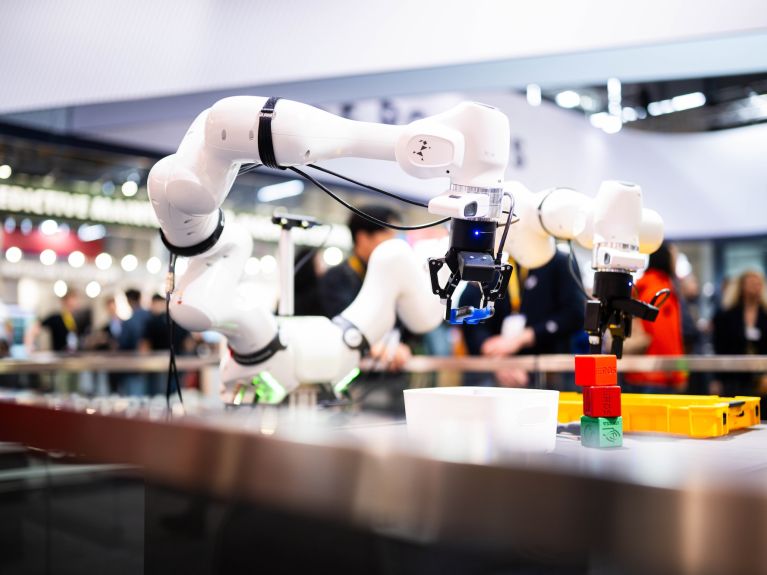
Innovation drives international success
Germany is a global leader in robotics because companies keep investing billions in automation and related technologies.
 Johannes Göbel
 Why is Germany considered one of the world’s leading centres of excellence in robotics?
Germany combines a strong research sector, innovative industry and targeted state funding, making it an attractive location on the international stage. “In Europe, Germany is destination number one for foreign direct investment in AI and robotics,” says Peggy Görlitz from Germany Trade & Invest (GTAI). The Robotics Institute Germany has set out to “shape the future of intelligent robotics around the world,” and is building stronger networks for Germany as a robotics hub.

Dieses YouTube-Video kann in einem neuen Tab abgespielt werden
YouTube öffnenThird party content
We use YouTube to embed content that may collect data about your activity. Please review the details and accept the service to see this content.
Open consent formHow is Germany funding robotics research?
Germany has chosen to emphasise close partnerships between industry, academia and policymakers. The Robotics Institute Germany (RIG) is funded by the Federal Ministry of Research, Technology and Space (BMFTR). It builds networks between 14 leading universities and research institutions, along with 20 leading partners including the German rescue robotics centre DRZ, and the Cyber Valley AI consortium. In addition, the BMFTR has produced an Action Plan for Robotics Research to support research, innovation and specialist training.
Where are robots at work in Germany?
The most common use for robots is in industry, such as in car manufacturing and assembling electronics. However, service robots are also becoming increasingly widespread in fields such as the food service industry and health and social care. There is an average of 449 robots for every 10,000 workers in Germany – the highest rate in Europe. On a global scale, Germany is behind only South Korea and Singapore. The market for service robots is growing, too: sales rose by 18% in Germany in 2025, twice the global average. The market is expected to grow by 27% from 2026 to 2028.
How is Germany investing in the robots of tomorrow?
Germany is investing in skilled professionals, research and transferring the latest technologies into practical applications. Robotics is on the curriculum in over 300 university study programmes. In a programme led by TUM Technical University of Munich and the firm NEURA Robotics, TUM RoboGym has emerged as the world’s largest robotics training and research centre. On top of this, the German Government’s High-Tech Agenda funds new “Robo Hubs” where scientists and entrepreneurs work together to develop solutions for use logistics, agriculture, construction and health and social care.
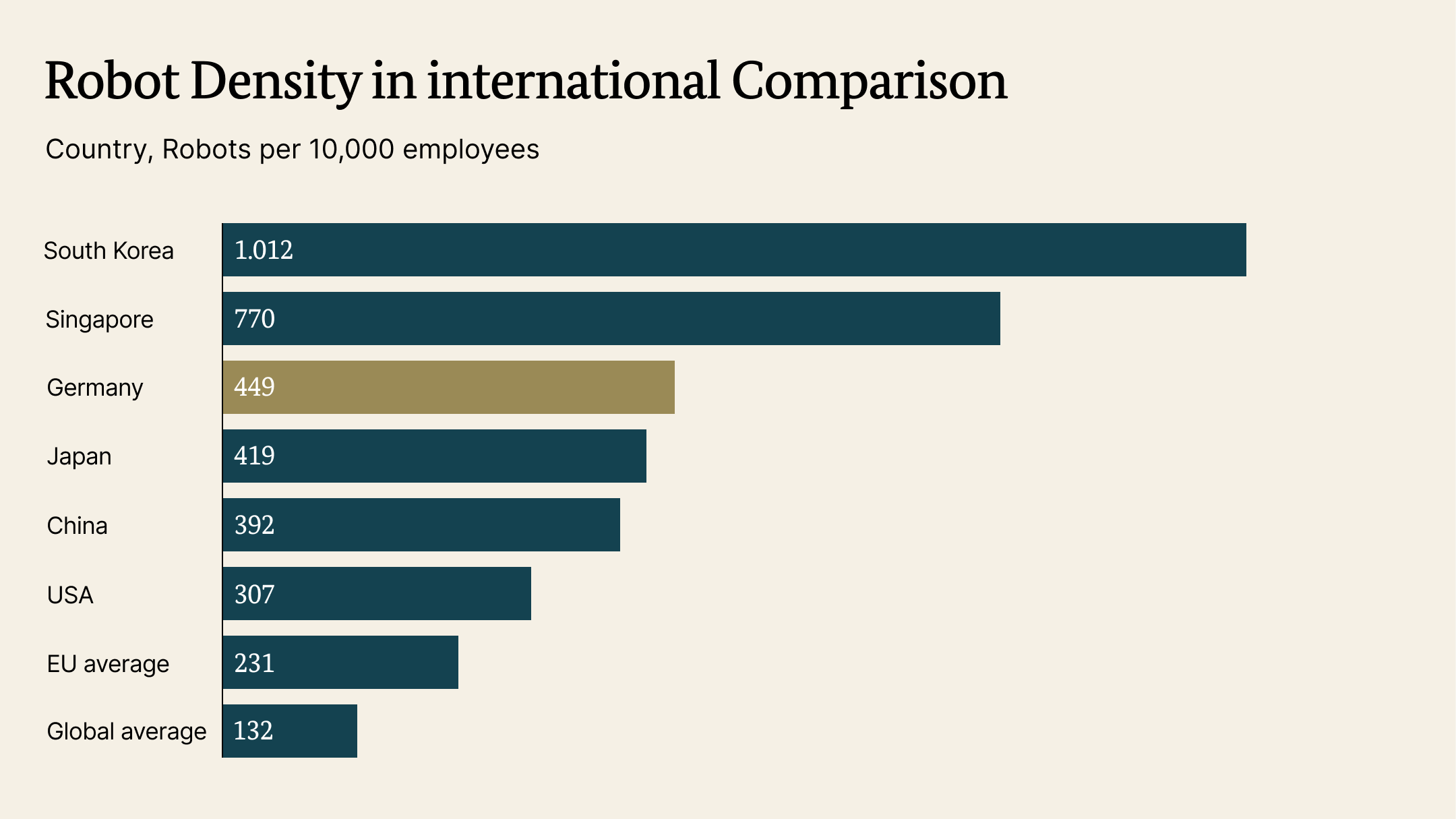
Source: IFR World Robotics 2025 Report


