AI that gets hands-on
Engineers want AI to do more than generate text and do calculations. It could also direct machines and humanoid robots, which would transform everyday life and industries.
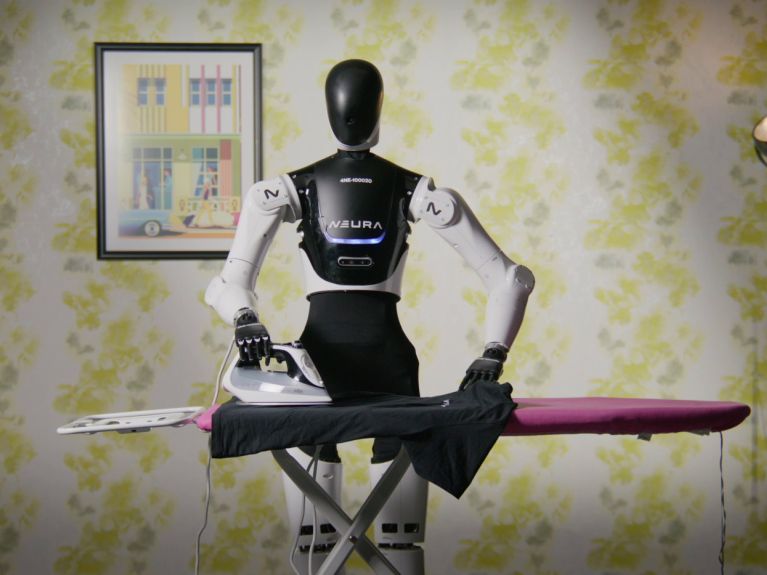
Where kitchens, sofas and dining tables were on display just a few years ago, visitors can now marvel at high-tech innovations: a former furniture store in Riederich near Metzingen now serves as the headquarters of the start-up Neura Robotics. The biggest eye-catcher among the desk clusters where young people work on laptops is a human-sized robot with a head, arms and legs. “Are you planning to take over the world?” founder and CEO David Reger asks the robot. Its answer sounds amused: that would be too exhausting, it says; it would rather help people.
Robots for households, care work and industry
According to Reger, there is plenty of work for the robot, which is called 4NE1 (“For Anyone”). Currently available as a pre-series model for 60,000 to 100,000 euros, the idea is that in the future it will be able to step in wherever skilled workers are lacking or tedious tasks are still being carried out manually. In households and in care work, for example – and above all in industry. Founded in 2019, the company is already making money in the industrial sector with what Reger calls “cognitive” robotic arms. Thanks to sensors and artificial intelligence, they can see, hear and feel – which means they can be trained more quickly. The technology is also used in the humanoid robot, which is to be even more flexible in its applications.
Dieses YouTube-Video kann in einem neuen Tab abgespielt werden
YouTube öffnenThird party content
We use YouTube to embed content that may collect data about your activity. Please review the details and accept the service to see this content.
Open consent formGerman companies leading in the use of Industrial AI
Intelligent robotic systems are regarded as an important pillar of Industrial AI – that is, the use of AI in industrial environments. In production facilities, the focus is less on generating texts, images or videos and more on optimising physical processes in production lines, logistics or energy systems. According to a recent study carried out by the IT company Cisco, the main goal is higher productivity at lower cost. According to the Cisco survey, German industrial companies are among the global leaders in the adoption of Industrial AI: the findings indicate that two thirds are already using AI in ongoing industrial processes.
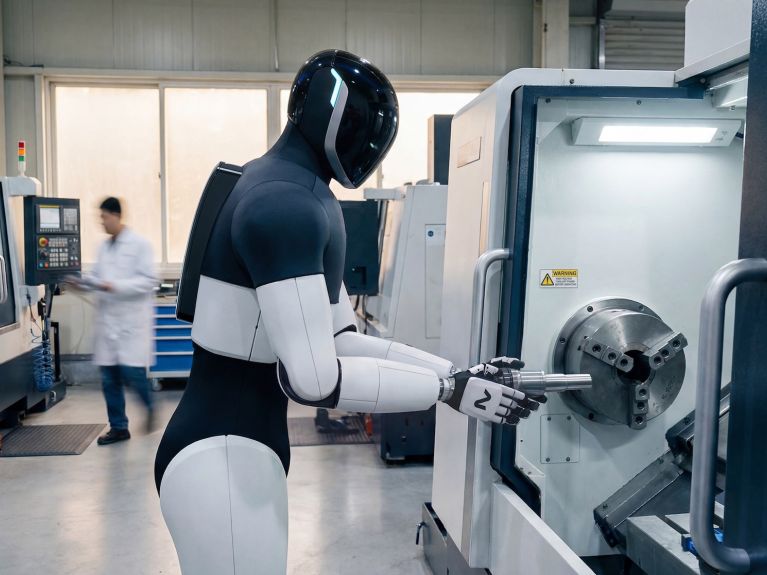
Start-ups such as Neura Robotics and its Munich-based competitor Agile Robots aim to ensure that Germany also achieves a leading position on the provider side – more specifically in the field of AI-supported robotics. This is entirely in line with the federal government’s objectives. Under the High-Tech Agenda, it has set the goal that by 2030, ten per cent of the country’s economic output is to be generated based on AI. Support for AI robotics is also envisaged.


