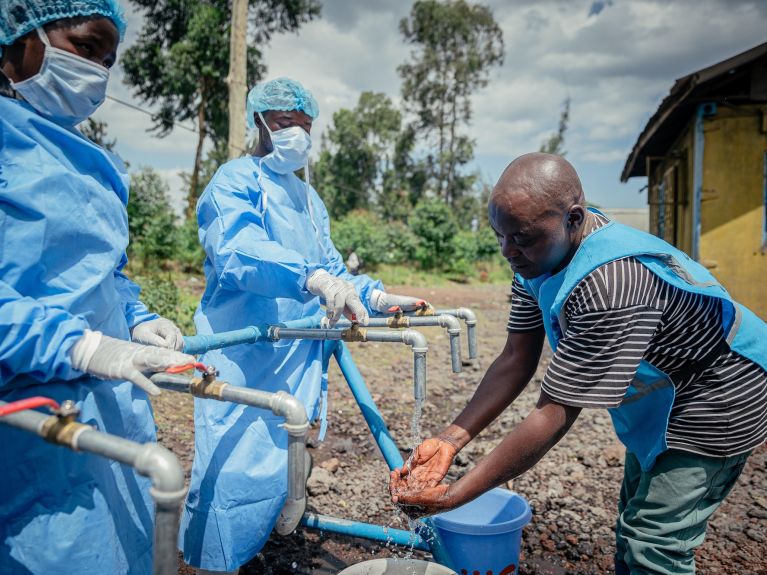
Fighting Ebola: how Germany is supporting people in eastern DR Congo
The Ebola virus is spreading in eastern DR Congo. There is currently no approved vaccine for this outbreak. Germany is providing support in cooperation with local partners and regional networks.
 Kim Berg
 The Ebola virus is spreading in the eastern Democratic Republic of the Congo (DR Congo), a region already affected by conflict, displacement and an overstretched healthcare system. According to the World Health Organization (WHO), 676 confirmed cases had been reported in DR Congo by 11 June 2026, with 136 deaths. At the same time, cases linked to the outbreak in DR Congo have been reported in Uganda. The WHO considers the situation particularly challenging because the outbreak is caused by the Bundibugyo virus strain of Ebola, for which there is currently no approved vaccine or specific standard treatment.
“The situation is extremely complex and remains highly dynamic,” says biologist Norman Nausch of the development agency Deutsche Gesellschaft für Internationale Zusammenarbeit (GIZ), who heads German Epidemic Preparedness Team (SEEG). The outbreak is compounded by a severe humanitarian crisis in eastern DR Congo. According to the United Nations, 1.2 million people in the region require assistance, many of them internally displaced. Cholera, measles and diarrhoeal diseases are widespread and are placing additional strain on the healthcare system.
Support based on a clear principle
In outbreaks such as Ebola, speed is crucial. Equally important, however, is avoiding duplication of effort and directing support to where gaps emerge. Overall coordination of the response is led by a team convened by the WHO and the African health authorities. Organisations such as the SEEG implement measures together with local partners.
“The SEEG helps emerging and developing countries respond more quickly and effectively to health crises and infectious disease outbreaks,” says Nausch. The group of experts was established following the Ebola outbreak in West Africa in 2014–2015 and includes a range of specialist German institutions, including the Robert Koch Institute, Charité – Universitätsmedizin Berlin and, in the field of animal health, the Friedrich Loeffler Institute and the Bernhard Nocht Institute for Tropical Medicine. GIZ implements the deployments and provides technical support for them on behalf of the German government.
“Our core expertise lies in establishing diagnostic capacity so that diseases can be detected in the first place,” says Nausch. Early detection is particularly important in order to identify symptoms correctly and prevent further transmission. “We’re also building these capacities in neighbouring regions to help prevent the disease from spreading further.”
75 deployments in 40 countries
The SEEG operates through short-term deployments, with teams of four to eight experts providing targeted support for local partners based on their specific needs. SEEG teams have carried out a total of 75 deployments in 40 countries to date. In the current Ebola outbreak, however, deploying international specialists is proving difficult. “At present, no German experts are deployed in eastern DR Congo,” says Nausch: the security situation in the region remains too fragile. As a result, the SEEG is providing support from Germany and neighbouring countries. “Through GIZ we also have access to a large network that enables us to implement measures effectively and sustainably, in close cooperation with local communities,” says Nausch.
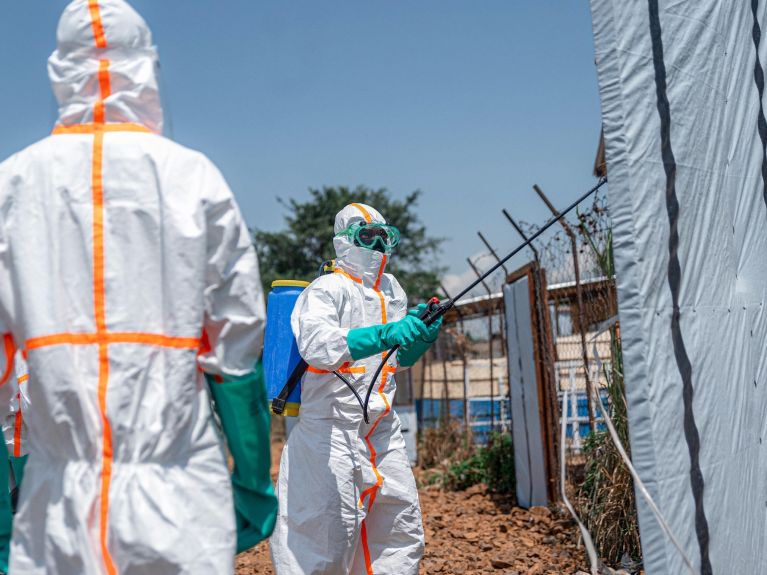
Misinformation and myths are common during outbreaks of infectious diseases.
In the case of Ebola, protecting nurses, doctors and laboratory staff is a central element of every containment strategy. “One of the main problems during the Ebola outbreak in 2015 was that large numbers of healthcare workers became infected and died during the early stages of the outbreak. That naturally made the situation much worse,” says Nausch.
Protecting doctors, nurses and laboratory staff is therefore particularly important. The SEEG is providing protective equipment to health authorities and healthcare facilities in the affected regions of eastern DR Congo, including facilities operated by Caritas.
Through specialised training programmes for church organisations and community leaders, the SEEG is also helping to raise awareness among both the public and healthcare professionals about how to deal with Ebola infections. “Misinformation and myths are common during outbreaks of infectious diseases,” says Nausch. The SEEG seeks to counter these through information and awareness campaigns. The organisation also conducts training and preparedness activities in countries that could potentially be affected by the virus, including Uganda, Kenya and Tanzania.


