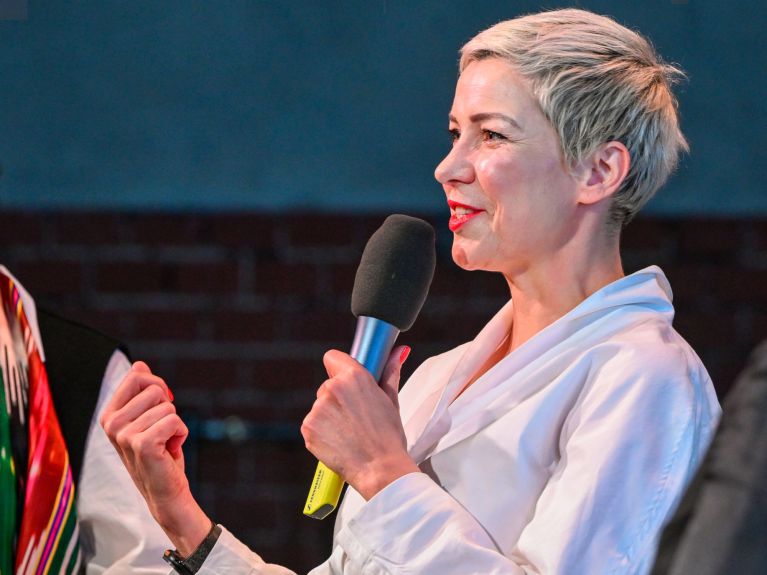
“Art is stronger than death”
Belarusian opposition leader Maria Kalesnikava talks about her exile in Germany, the power of art and culture and the fight for Europe’s future.
 Interview: Johannes Göbel
 Maria Kalesnikava, born in Minsk in 1982, joined the 2020 election race against President Alexander Lukashenko, who has ruled Belarus since 1994, when she stepped into the shoes of opposition politician Viktar Babaryka following his arrest. The Belarusian opposition leader spent five years in prison in her home country - under extreme conditions and for the most part in solitary confinement. The country’s authoritarian leader Lukashenko pardoned Kalesnikava and 122 other political prisoners in December 2025 in return for a relaxation of US sanctions; the flautist was then given refuge in Germany.
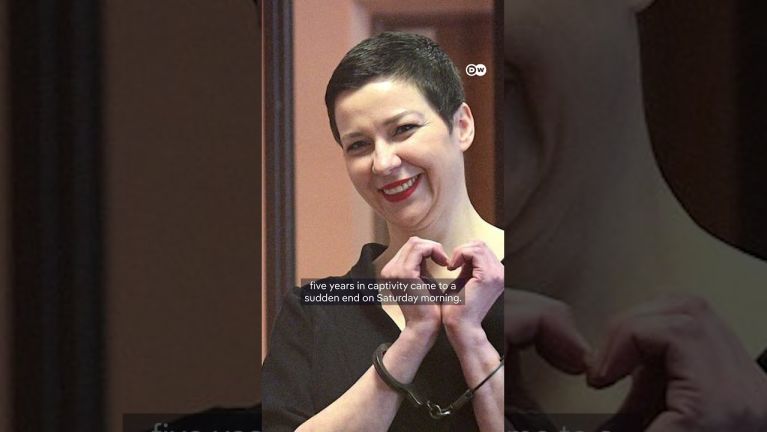
Dieses YouTube-Video kann in einem neuen Tab abgespielt werden
YouTube öffnenThird party content
We use YouTube to embed content that may collect data about your activity. Please review the details and accept the service to see this content.
Open consent formMs Kalesnikava, what does exile in Germany mean to you?
I feel safe in Germany. I get support from numerous people and am grateful for the German government’s invitation - also because I have a special bond with Germany. Before my arrest in Belarus, I had already lived for a total of 13 years in Germany. That left its mark on me.
You came to study Old and New Music at Stuttgart University of Music and the Performing Arts and then initially remained in Germany after graduating in 2012.
Yes, I played in various ensembles and began working in cultural management. In 2017 I co-founded the initiative InterAKT that brings artists from different fields together to work on interdisciplinary projects. The initiative enables people to work creatively in diverse ways. I’ve learnt a lot in Germany - not only about music and art, but also about the values of pluralism and democracy.
How are these values evident, in your view?
Germany protects freedom of expression. Different opinions have their place here, as do diverse lifestyles. People have many opportunities for personal and professional development, in the cultural sector, politics or business. These freedoms should by no means be taken for granted. This became particularly clear to me during my time in prison in Belarus - and I believe that people in Germany could also become more aware of these freedoms. Even if times are difficult in political and economic terms, German society has already accomplished a lot and can look with optimism towards the future.
Optimism is also the message conveyed by your performance #freemaria, which you staged for the first time in Berlin in the spring of 2026. In it, you reflect on your time in prison, play the flute and make it clear how important literature was to you during your solitary confinement. What is the significance of art and culture against the backdrop of political oppression?
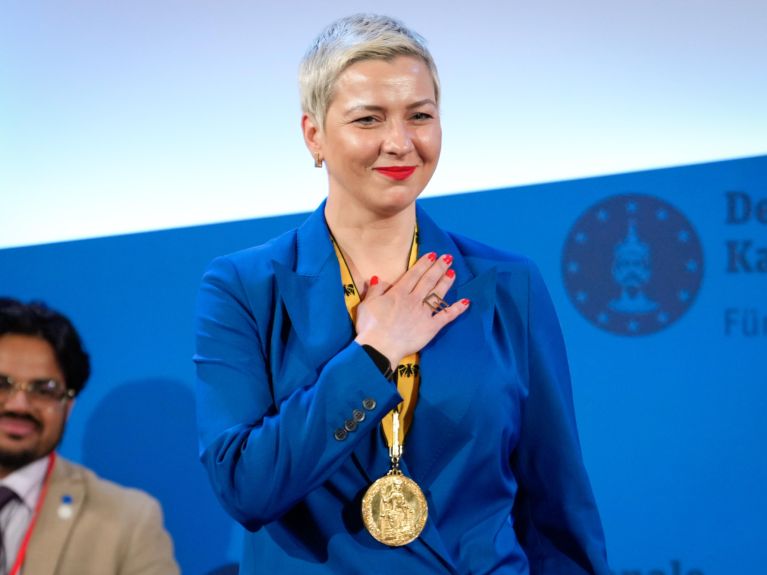
Art and culture are what set us apart as civilisations. They are stronger than death and stand the test of time. And yet it’s not about aesthetic qualities alone: art and culture are synonymous with human development and achievements. They symbolise values that unite us as a community of Europeans. Its diversity of cultures and languages is what makes Europe strong and powerful. I was honoured to be awarded the European Charlemagne Prize in 2022 - and was then able to receive it in person in 2026 after my release from prison. I feel connected to the community of Charlemagne Prize laureates, and also to Mario Draghi, the 2026 laureate and for many years the president of the European Central Bank. He’s an economist, I’m an artist - but we are both connected by our commitment to the future of Europe.
How important is it for this future that European states offer refuge to those seeking exile from Belarus, Ukraine and Russia?
Granting them exile is crucial for them to be able to continue working in freedom and exerting influence. Their children can also enjoy this freedom, can go to school and university. Belarus is cut off from free Europe and heavily influenced by Russian propaganda. It is becoming increasingly difficult for young Belarusians to learn about European values such as democracy. One shouldn’t give up on Belarus and abandon it to the influence of Lukashenko and Putin. It continues to be important for the future of a free Europe to seek exchange with Belarusian civil society, working together with those in exile.


