Russian manipulation – “a fatal distortion of reality”
Disinformation, cyberattacks, AI propaganda – CeMAS researcher Julia Smirnova explains how Russia conducts information warfare and how Germany can protect itself.
 Interview: Johannes Göbel
 In a new report on Russian concepts of information warfare, the not-for-profit Center for Monitoring, Analysis, and Strategy (CeMAS) turns its attention to a key area of present-day conflicts. The report’s author, Julia Smirnova, told deutschland.de about Russian disinformation strategies and the measures needed to deal with them.
Frau Smirnova, in December 2025 the German government officially identified the Russian regime as being behind a major cyber attack and a disinformation campaign in the last national parliamentary elections. What is the significance of this attribution?
On the one hand, it should be acknowledged that Russian disinformation campaigns are nothing new. In the run-up to the Bundestag elections, for example, CeMAS documented multiple Russian campaigns, including the “Storm-1516” campaign which levelled far-fetched falsifications at German politicians in democratic parties. False claims of election fraud were spread immediately before the election, including the use of fake videos. In terms of public communications, the decision by the Federal Government to officially classify these actions is another major step. Providing information and explaining what has happened help to create transparency and to protect the public against attempted Russian manipulation.
What are the characteristics of Russian information warfare?
It covers an extremely broad spectrum. In addition to disinformation campaigns, it includes attacks on information systems and communication infrastructure, espionage against points of vulnerability in these systems, and also the placing of propaganda messages. The Russian regime has a very extensive conception of the information space: it is not just about politics in a narrow sense, but also about questions of religion, culture and values. In this context, Russia presents itself as the victim of an information war which is merely responding to the spread of so-called “western”, “socially liberal” values.
What are Russia’s aims here?
For the Russian leadership, what matters above all else is the security of their own regime. Any form of opposition and the dissemination of ideas which do not align with the official Kremlin view are defined as threatening, foreign influence. According to this logic, the Russian information space must be tightly controlled. In addition to this, divergent values in other states are defined as a threat to the regime’s own authority, particularly in former Soviet states where the Kremlin does not accept their full autonomy. This attitude was influencing Russia’s actions even before its attacks on Ukraine in 2014 and 2022, doubtlessly as a form of premature justification for its own aggression. That said, we cannot rule out the possibility that some elements of Russia’s elites did actually see themselves as victims. On another level, these attacks are also aimed at restoring Russia’s status as a major power and destabilising Western countries.
How can Germany respond to Russian information warfare?
Our finding that Russia is pursuing a wide-ranging strategy should prompt corresponding countermeasures. It will not be enough merely to protect political actors against Russian disinformation and cyber attacks. Preventative action must be taken to strengthen protections for a wide range of areas of society. This includes doing more than just reacting and deleting accounts and posts when campaigns are already underway. State offices, along with numerous other stakeholders, hosting providers, IT companies, and social media platforms must strengthen their systems to prevent their abuse by Russian influence, which includes the creation of swarms of bot accounts and disinformation websites. Investigations into financial links to politicians and other influence networks should be improved. People from all age groups should be informed about the tactics and techniques of Russian actors – such as in the field of artificial intelligence.
What needs particular attention in that area?
It is clearly the case that Russia’s newest strategies include attempts to disseminate disinformation so widely that it makes its way into training data sets for large language models. Several studies have shown that some AI chatbots repeat Russian propaganda in their answers.
With regard to the consequences of Russian information warfare, what do you see as particularly dangerous?
Democratic institutions and independent journalism are being discredited. We’re talking about a fatal distortion of reality, where, according to Russian narratives, the so-called “Western” media are under state control, and there is no real freedom of speech in those countries. The aim is to destabilise democracies and sow chaos and mistrust. Even in supposed times of peace, Russia was manipulating information in neighbouring countries such as Ukraine and Georgia before it came to military conflict. The information war is often the first stage of aggression which goes on to threaten people’s independence and even their lives.
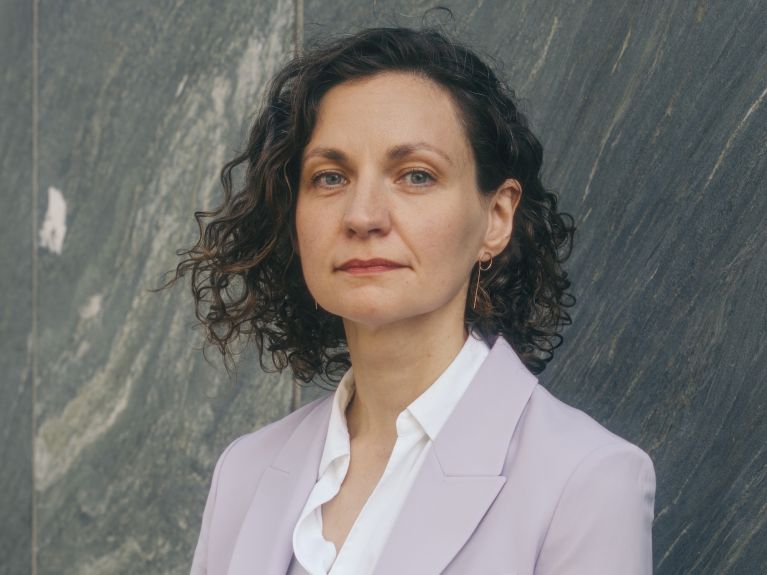
Julia Smirnova is a senior researcher at CeMAS, an interdisciplinary centre which studies conspiracy ideologies, disinformation, antisemitism and far-right extremism. She focuses on how authoritarian states use digital technology to manipulate public opinion.


