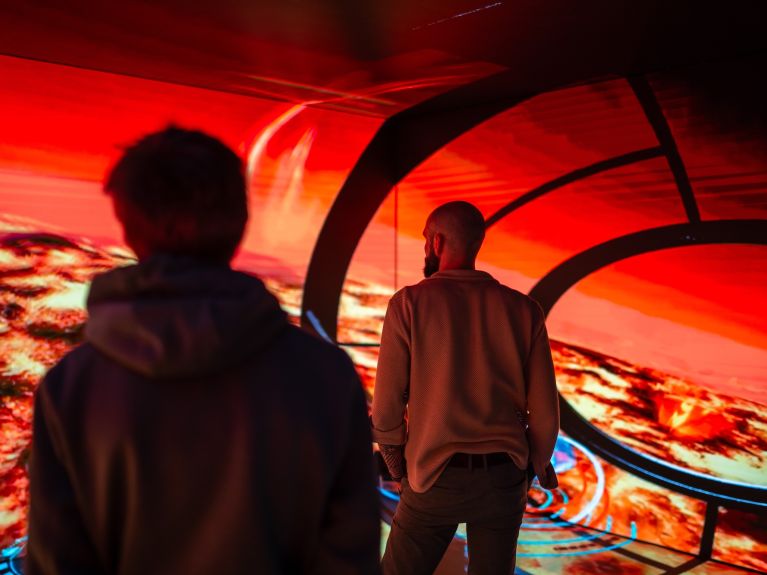
A trip into outer space
Dresden University of Technology is exploring virtual worlds in its new research lab. The Holodeck opens up all kinds of scientific opportunities.
 Klaus Lüber
Just popping off to explore a distant sun, then diving down to the ocean depths, standing at an operating theatre table or putting a brand new car through its paces - all of this has recently become possible at the Dresden University of Technology (TU Dresden). In May 2026, a virtual reality research lab opened there - equipped with LED screens on its walls, ceilings and even the floor.
Cliffs, streams and forests made of light
In the Holodeck, as it is named in reference to the cult series “Star Trek”, research is to be conducted into how people perceive immersive digital scenarios, and how they behave and interact in such situations. The crew of the fictional Starship Enterprise were able to stroll through projected landscapes as if the cliffs, streams and forests they could see were real. The screenplay writers used holographic light projections and special force fields to create the illusion.
That may still be science fiction, but the “real-life” Holodeck that opened in Dresden in May 2026 aims to replicate its movie counterpart as closely as possible. Rather than using projectors or VR headsets, the room is entirely lined with high-resolution LED screens that show film material in 2D. Equipping it cost around 1.5 million euros. This gives multiple people barrier-free access to a shared immersive experience of real-time visualisations. Though no holograms are generated and virtual objects cannot yet be touched in the Holodeck, the plan is to incorporate interactive systems and augmented reality glasses in future to make such experiences possible.
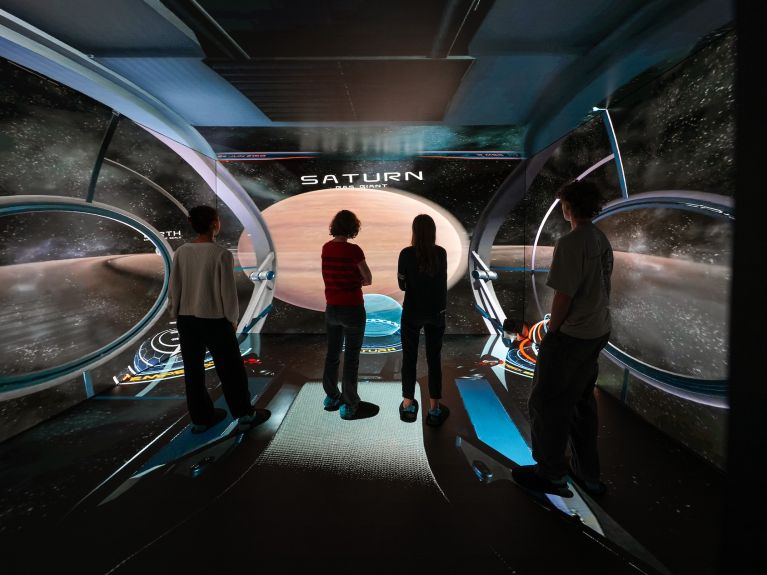
What makes the TU Dresden Holodeck so special?
Unlike VR headsets, which transport individual users into virtual environments, the Holodeck in Dresden creates a shared space that facilitates collaboration and discussion. Researchers believe that its greatest potential lies in education. “A five-year-old would understand immediately what we are doing here. They are familiar with virtual realities from their games,” says Frank Fitzek, holder of the Deutsche Telekom Chair of Communication Networks and spokesperson for the TU Dresden cluster of excellence. “When one sees how quickly young people create virtual worlds in a game like Minecraft but how reluctant they are to engage with Pythagoras’ theorem - then all one has to do is include Pythagoras’ theorem in their virtual world and tell them that that’s exactly what you need it for.”
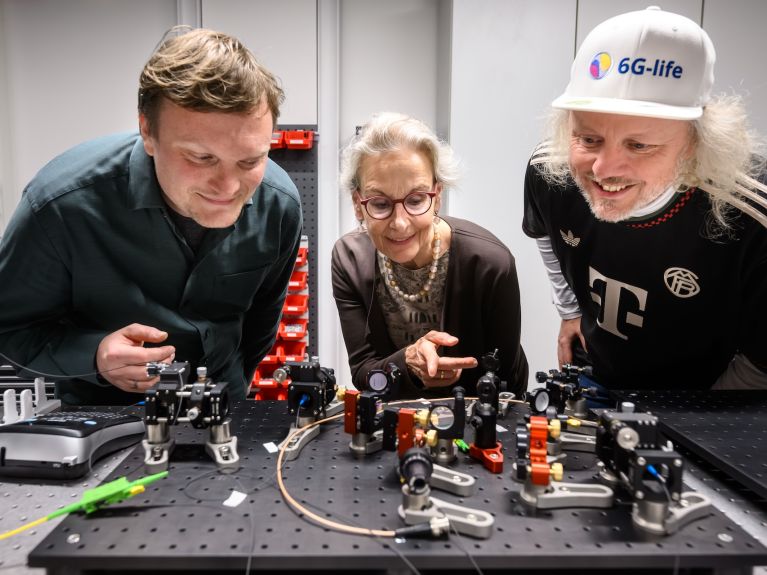
Remote surgery with a data glove
One of the main objectives of the research at the Dresden Holodeck is to reduce data delay to the point where remote surgery can be conducted in telemedicine or complex industrial maintenance can be performed without any time lag. To this end, data gloves that detect contact with virtual objects could be used in future. The Holodeck is situated at the Centre for Tactile Internet (CeTI), a cluster of excellence at TU Dresden. One central research question is how humans can interact with robots and machines in real time - in both the real and virtual worlds. “We can train humans and robots in the Holodeck and interconnect them worldwide,” says Fitzek. “The robots learn from the humans, and vice versa.”
Another focus at TU Dresden is research into bug-proof communication systems. For this purpose, it has opened - at the same time as the Holodeck - the Quantum Communication, Computing and Sensing Lab. At the lab, TU Dresden will apply research findings in the field of quantum technology directly to existing 5G networks. One of the goals is to better protect critical infrastructure such as electricity grids or hospitals against hackers in future.
Any questions? Search with our AI assistant
- How does the political system in Germany work?
- How much does it cost to study in Germany?
- Which traditions and festivals are typical of Germany?
- What is the best way to learn German?
- Who governs Germany?
- Which industries are particularly important to the German economy?
- Which political parties are there in Germany?
- Why is Germany considered a leading exporting nation?
- How do I apply to study in Germany?
- What opportunities does Germany offer international startups?
- How diverse is the German cultural scene, and what role do art, music and literature play?
- What cultural differences are there between Germany's regions?
- Which degree programs and universities are especially popular in Germany?
- How can I find a job in Germany as an international skilled worker?
- Why was Germany divided after World War II?
- What requirements do I need to meet to be allowed to work in Germany?
- Do I need to speak German to work in Germany?
- How high is the cost of living in Germany?
- How does the German healthcare system work?
- What should I keep in mind when moving to Germany?
- How did reunification come about?
- How does Germany deal with its National Socialist past?
- What level of German do I need to study in Germany?
- In which countries is German spoken?


