Germany flies the flag in North America
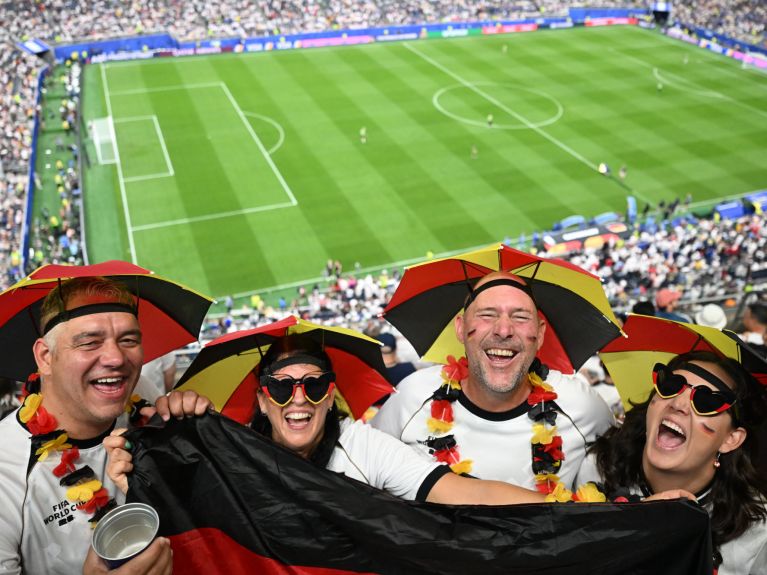
Thousands of German football fans have travelled to Canada, Mexico and the US to cheer on their national team in the World Cup - or were there already.
Jubilant scenes when the final whistle blows: on 20 June 2026, Germany beat Côte d’Ivoire 2:1 in the Canadian city of Toronto. Having come top of their group, they will now advance to the next round of World Cup 2026. Though there were a few moments when spectators held their breath, the match ended well for Germany. The enthusiasm of the fans was probably one of the reasons. “Pretty much the whole stadium was Germany. I don’t think the fans even realise how much this means to us and how much strength it gives us,” Nadiem Amiri, one of the players on the German team, told the Sportschau TV programme after the match. Head coach Julian Nagelsmann also praised the fans for the great atmosphere in the stadium: “This energy and power are incredibly important.”
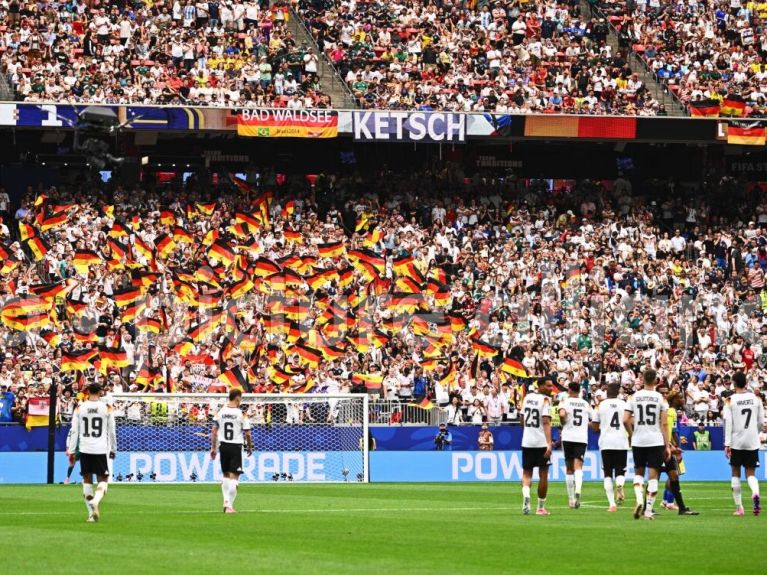
The German fans had already made for an impressive backdrop when Germany thrashed Curaçao 7:1 a few days earlier in Houston. The big win was celebrated by thousands of jubilant Germans, some of whom live in the USA, while others had come over especially from Germany. Among them was Claudia Hoffmann, who had travelled to the US along with six other fans from Hagen Fan Club: “The atmosphere was amazing, it was a real experience.” Her partner Marcus Winkler agrees: “What I found remarkable was how many Americans and Mexicans wearing Germany jerseys were in the crowd, singing and cheering along with us - it was fascinating.”
A tournament of superlatives
The 2026 FIFA World Cup in the USA, Canada and Mexico is breaking all the records: 48 teams, with 104 matches in 16 stadiums - never before have there been so many venues during a World Cup tournament. And many fans from Germany are in the US to support their team live and in person. According to the German Football Association (DFB), the matches in Toronto and Houston were attended by 2,452 and 4,307 fans from Germany respectively - extremely vocal in their support, they brought German fan culture to the stadiums.
These days, the fans who come to the US will encounter a growing football scene there. It’s a sport that was long overshadowed by American football, basketball and baseball. The 2014 World Cup in Brazil changed all that. These days, more than one in four adult Americans describe themselves as fans of professional football.
Thanks to the success of the US team, the sport could see its popularity surge even further. A 2:0 victory over Australia secured a place for the United States at the top of its group - just like Germany. Theoretically, the two teams could even meet in the knockout stage.
Close football ties between the US and Germany
The ties between footballing nation Germany and the US are close. Well-known US national squad players such as Christian Pulisic, Weston McKennie and Ricardo Pepi have played in Germany - Pulisic for BVB Dortmund, McKennie for FC Schalke 04 and Pepi for FC Augsburg. The big German clubs cultivate a massive network: FC Bayern Munich boasts around 200 fan clubs in North America, while Borussia Dortmund has around 40.
For this year’s World Cup, other clubs like “Die Mannschaft Southwest Florida” and “Kitchener/Waterloo Deutsches FanHaus” are mobilising their members to create a unique World Cup atmosphere.
All across the country, fan zones and FIFA fan festivals are giving people the chance to watch the matches and join in the excitement. Offering huge screens, international flair, street food and live entertainment, “watch parties” are ensuring upbeat vibes even outside the stadiums. For many German fans, the atmosphere is reminiscent of the “summer fairy tale” - when the World Cup was hosted by Germany in 2006.
German House of Soccer in New York
In New York, the DFB is inviting fans to the German House of Soccer. Watch parties there see fans from all over the world come together to celebrate, share in the excitement and cheer on their teams. Typical German dishes such as spätzle (noodles) and sausages are served - and at ten dollars, a beer is even relatively inexpensive by New York’s standards. In addition, there are film screenings and panel discussions with celebrities such as Mario Götze, Jürgen Klinsmann, Thomas Müller and Benedikt Höwedes. An exhibition presents German football culture - especially women’s football, which is extremely popular in the US - and the fan culture of the country’s clubs.
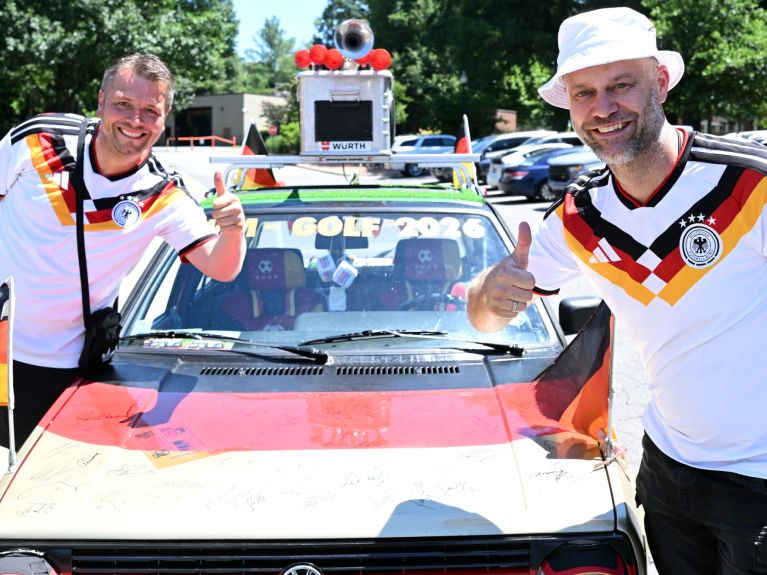
Some fans show just how crazy they are about football by travelling to the tournament in unusual ways: for instance, Steffen Kurz and Fabian Bergmann from the small town of Künzelsau in Baden-Württemberg came to the US with their black, red and gold “World Cup Golf”. The old car has been autographed by dozens of former German football greats – including Franz Beckenbauer, Sepp Maier and Uli Hoeness.
Jakob Alberti certainly demonstrated his athletic endurance: in August 2024, the 26-year-old set off on his bike from his home city of Karlsruhe. Alberti spent 21 months pedalling east - after cycling more than 26,000 kilometres through 28 countries on four continents, he arrived bang on time for his team’s first match in Houston. “It’s all for the fifth star. We’ll be World Cup champions!”, he announces euphorically on his Instagram account following the victory over Curaçao.
However, the famous piece of football wisdom imparted decades ago by Sepp Herberger, Germany’s head coach at the time, still holds true: “The next opponent is always the hardest.” On 25 June 2026, Germany will be taking on Ecuador in New York. At the latest when the knockout round begins in early July, it will become clear whether the tidal wave of support from the fans will be sufficient to carry the German squad through to the final stages of the tournament.


