
German roots: Why Americans are tracing their origins
“Where do I come from?” Many Americans are interested in their German ancestors. Coming face to face with their own history often evokes strong emotions.
When Ann and David Schwartz stand in the Protestant church in Müsen, a small town in the state of North Rhine-Westphalia, they feel they have come full circle. In front of them is the church register containing an entry from 1692: the baptism of Johann Kemper, David’s eighth-generation ancestor. Twenty years later, the young blacksmith left his homeland and emigrated to Virginia as one of the first German settlers. “Visiting Müsen was a life-changing experience for us,” says Ann Schwartz. “It really strengthened our connection to our past.”
The couple’s journey from South Carolina is far from unique. More and more Americans are taking an interest in their German ancestors. DNA tests, digitised church records and online genealogy platforms are making it easier for people to trace their roots. At the same time, growing numbers of Americans want to do more than research their family history from afar: they want to visit the historic places themselves.
Around 45 million Americans have German roots
Germany has a special role to play in all this. People of German descent have helped shape US history – prominent examples include William Edward Boeing, Dwight D. Eisenhower, John D. Rockefeller and Elvis Presley. An estimated 45 million Americans have German ancestors.
One organisation that turns the desire to learn more about your roots into real-life encounters is the Historic Germanna Foundation in the US state of Virginia. Since it was founded in 1956, the foundation has researched the history of the German settlers who began arriving in the Virginia colony in 1714. This historical research has given rise to an extraordinary project: “The foundation brings descendants of the emigrants together with the places their ancestors came from in Germany,” says Barbara Price, who has served on the foundation’s board since 1998.
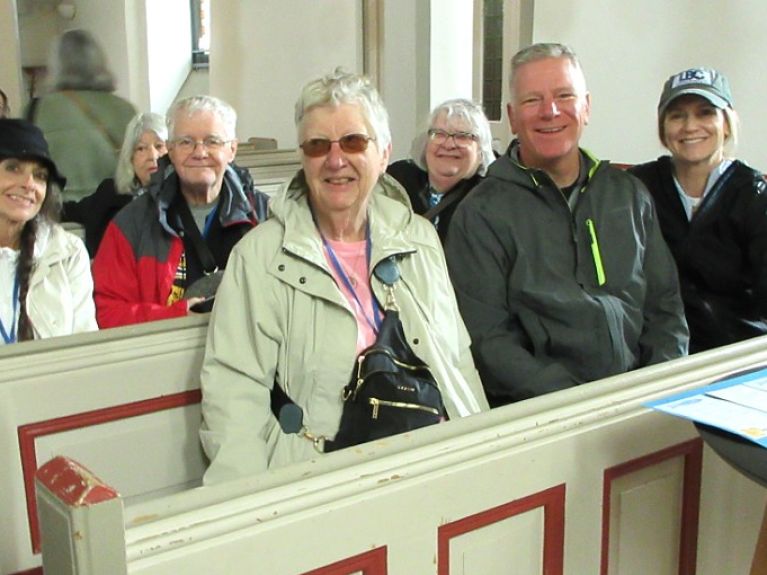
Since 2003, the foundation has regularly organised trips to Siegerland, the Palatinate and Baden-Württemberg, regions where many of the early settlers came from. Around 25 people take part each year, some more than once. It is far more than a sightseeing trip: participants visit their ancestors’ home towns and churches, see original baptismal registers or meet people who still bear the same family name today. Barbara Price has seen time and again just how emotional it can be to come face to face with your own history. She knows this from her own experience too: “I myself am descended from a family that emigrated to Virginia in 1714.”
Bringing the distant past close
Why does tracing their roots resonate so deeply with Americans in particular? “Most North Americans know that their story began somewhere else. Unlike many Europeans, we don’t see where we come from every day. The larger story lies on another continent,” says Mari Frith. Like David Schwartz, she is a descendant of Johann Kemper from Müsen, as well as of the Op den Graeff family from Krefeld, whose ancestors emigrated to Pennsylvania as early as 1683. Frith travelled to Germany in 2026: “My admiration for Johann Kemper knows no bounds. I am overwhelmed with gratitude for his courage,” she said after returning home.
This need for a sense of identity is reflected in numerous surveys. According to a survey by the Conner Prairie Museum in the US state of Indiana, 96 per cent of Americans believe history is important when it comes to understanding the future. 87 per cent believe that genealogy helps them better understand their own identity and life story.
Interest in family history began to grow as early as the 1970s, while Alex Haley’s bestseller “Roots” made the subject even more popular. Later, DNA tests from providers such as Ancestry and 23andMe made it possible to use a saliva sample to identify the regions their ancestors came from. The digitisation of millions of church and immigration records has also made the process much easier.
Genealogy has also long since spawned a travel market worth billions – known as “roots travel” or “heritage tourism”. More and more countries are offering trips designed to help people discover the places their ancestors came from. The German National Tourist Board specifically targets Americans with German roots. Its website provides information on genealogy, emigration routes and historic places, as well as suggested itineraries.

Dieses YouTube-Video kann in einem neuen Tab abgespielt werden
YouTube öffnenThird party content
We use YouTube to embed content that may collect data about your activity. Please review the details and accept the service to see this content.
Open consent formConnection and appreciation
For Ann and David Schwartz, the focus was not on a spectacular holiday experience but on something far more personal. “When we saw our ancestor’s baptismal register,” says Ann, “it gave us a profound sense of connection. It also gave us a deep appreciation of his adventurous spirit and perseverance.”
Connection and appreciation – for Norman Burns, head of the Conner Prairie Museum, these feelings reflect broader social phenomena: “At a time when our nation increasingly sees itself as isolated and divided, it is encouraging to see so many Americans looking to our past to shape our future.”


