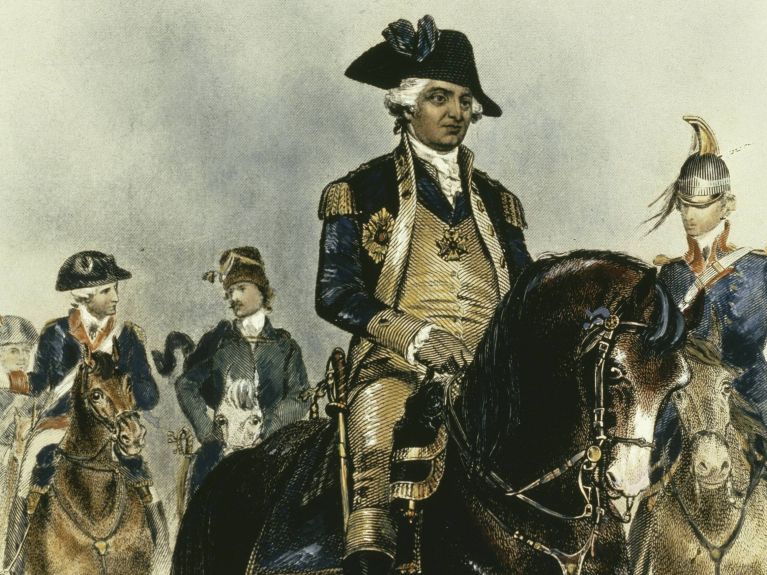
The Prussian who drilled America’s army
250 years after the Declaration of Independence: what influence did German immigrants such as Friedrich Wilhelm von Steuben have during the founding period of the United States?
 Wolf Zinn
 A tense atmosphere hung over Philadelphia in the first days of July 1776. The Continental Congress adopted the Declaration of Independence in the Pennsylvania State House on 4 July – and now those words had to become reality. The revolution depended on paper, and the printing presses worked around the clock. The printer John Henry Miller was born in Hesse as Johann Henrich Müller: he was the first to report the news on 5 July 1776 in his German-language newspaper. The full text of the Declaration of Independence appeared in German on 9 July. Around 2.5 million people were living in the British colonies at the time, roughly ten per cent of whom were of German origin. Pennsylvania was a key hub of German immigration, alongside communities in New York, New Jersey, Delaware, Maryland and Virginia.
The revolution was to spread – also to places where English was still a foreign language. In this way, the great Enlightenment ideals of life, liberty and the pursuit of happiness reached the homes, barns and communities of German immigrants, where they were truly understood. The story that German almost became an official language of the United States is a myth. What is true, however, is that there was a debate over whether laws should also be printed in German – an indication of just how large and influential the German-speaking population was at the time.
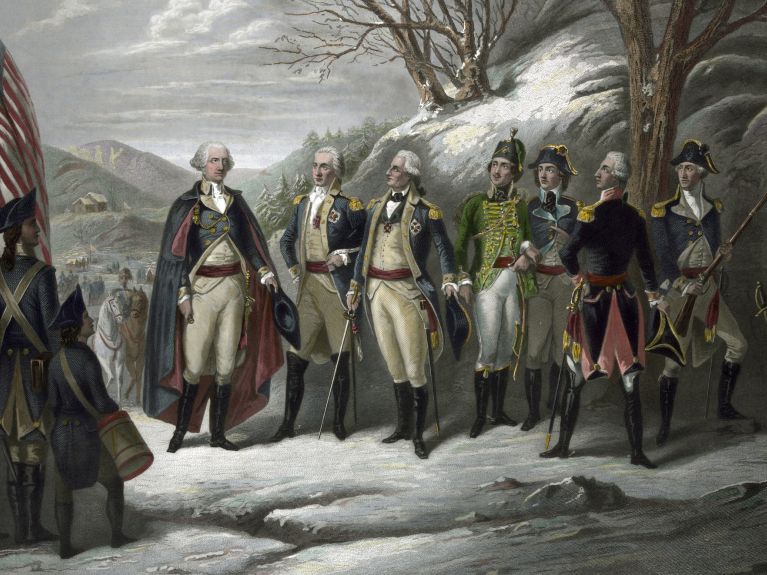
Friedrich Wilhelm von Steuben: turning rebels into soldiers
Valley Forge near Philadelphia, winter 1777/78: cold, snow and disease were taking a heavy toll on the Continental Army. The men were poorly equipped, organisation was fragile and discipline lacking. The commander-in-chief and later the first president of the United States, George Washington was leading an army that was politically significant but militarily weak.
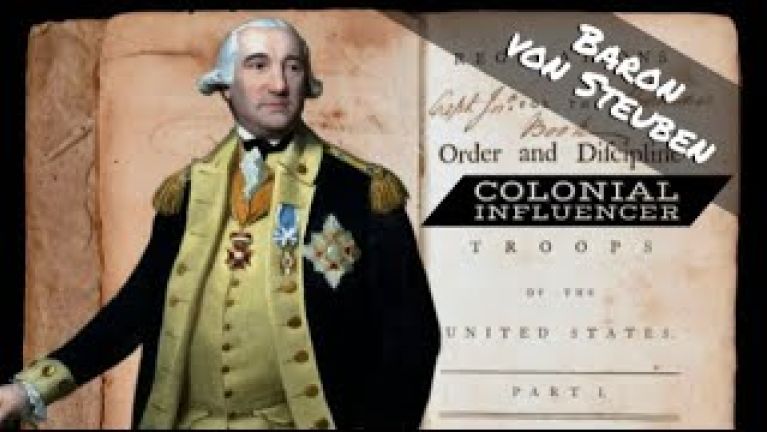
Friedrich Wilhelm von Steuben arrived at the camp in February 1778. The Prussian officer had been recommended by Benjamin Franklin, one of the Revolution’s best-known figures who was seeking support in Paris at the time as the American envoy. Washington appointed von Steuben Inspector General, and the latter started from scratch: drills, formations, clear chains of command, discipline and hygiene. He trained a model company, systematically spreading what had been learned throughout the camp.
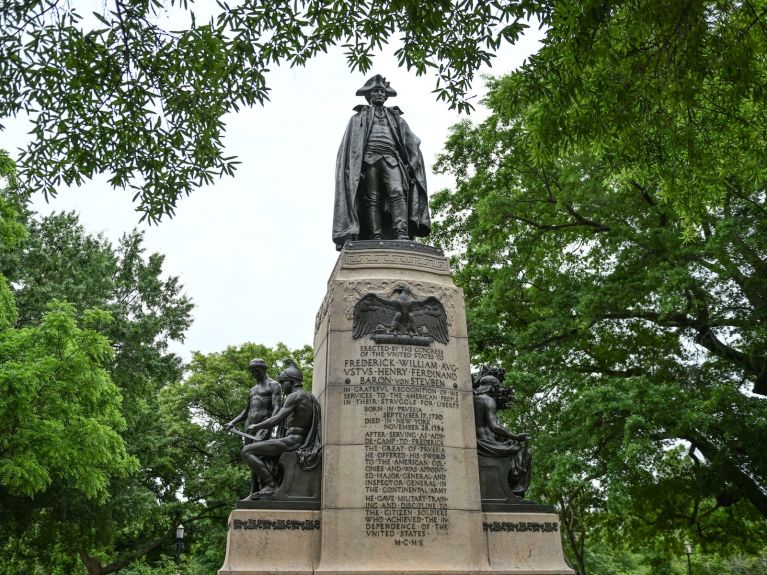
It is said that von Steuben hardly spoke any English at first, but that he used powerful language nonetheless. He would swear in a chaotic mixture of German, French and broken English, and his frequently repeated “God-dam!” became shorthand for the harsh training methods of the Prussian “drill master”. And these methods were effective: in the battles of 1778 – Monmouth was considered the key test – the troops withstood enormous pressure far better than before.
Von Steuben recorded his strategy in the “Blue Book”, the “Regulations for the Order and Discipline of the Troops of the United States”, published in 1779. This was the first official training and organisational manual of the recently established US Army, and it was to remain influential for many years.
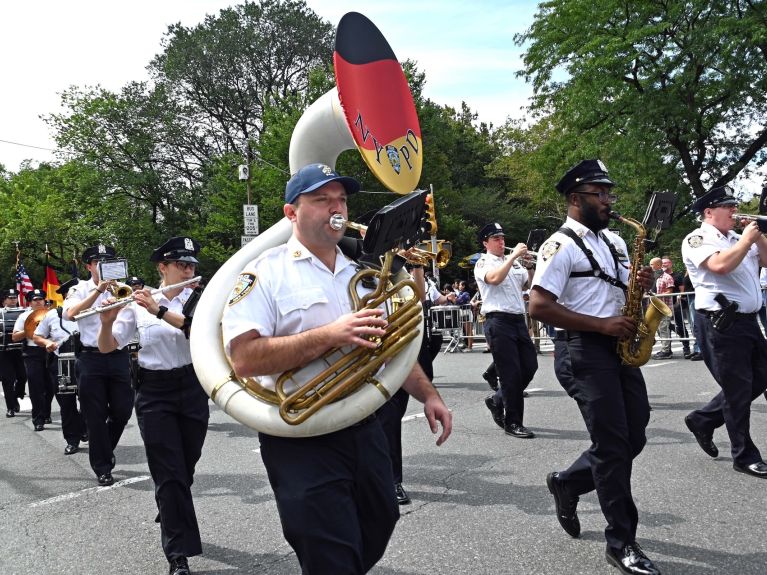
Part of von Steuben’s legacy is also a long-running and somewhat bizarre debate over the fact that he may have been homosexual. Some sections of the LGBT+ movement have elevated him into a queer icon, while certain conservatives struggle with their former hero. The historical evidence remains in dispute. What is undisputed, however, is von Steuben’s enormous influence on the training and structure of the Continental Army. And this is still commemorated every September in New York with the Steuben Parade – a tradition of German-American self-affirmation.
Dieses YouTube-Video kann in einem neuen Tab abgespielt werden
YouTube öffnenThird party content
We use YouTube to embed content that may collect data about your activity. Please review the details and accept the service to see this content.
Open consent formBetween military camp and Capitol: Peter and Frederick Muhlenberg
The importance of German heritage during the founding period of the United States is also reflected in the careers of the brothers Peter and Frederick Muhlenberg (originally Mühlenberg), sons of a Lutheran theologian who had immigrated from the Electorate of Brunswick-Lüneburg. First serving as a pastor in Virginia, Peter recruited a regiment for the Continental Army in 1776 and rose to the rank of major general. His brother Frederick embodied the new beginning in institutional terms: in 1789, he became the first Speaker of the US House of Representatives and signed the proposed constitutional amendments which later became famous as the Bill of Rights. As such, the brothers embody two aspects of German-American participation in the founding of the United States: Peter stands for mobilisation during the War of Independence, while Frederick was a leading figure when it came to establishing parliamentary democracy, legislative procedure and constitutional order.
“The Hessians”: Germans on the other side
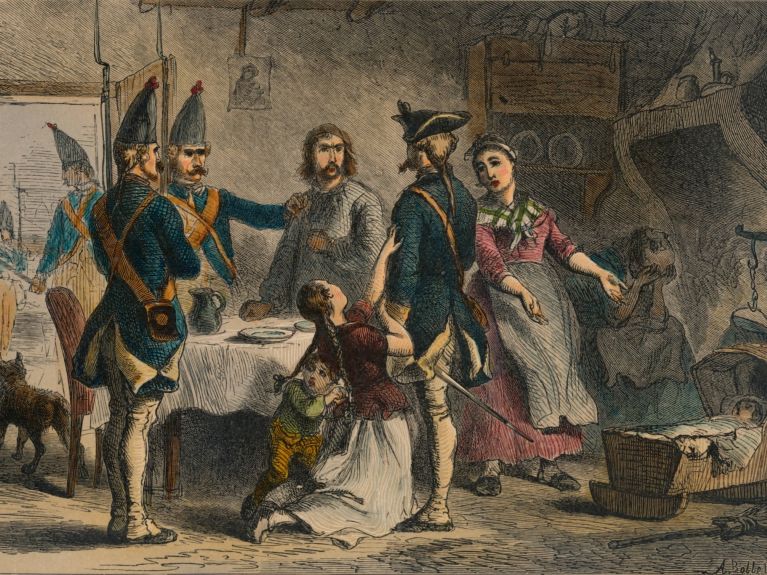
Not every German voice in the war was in favour of the Revolution. On the British side, there were some 30,000 soldiers from German territories in total, collectively referred to as the “Hessians”. Many of these troops were from Hesse-Kassel, though there were others from other German principalities whose rulers mostly conscripted soldiers by force and leased them to the British Crown. In June 2022, the remains of at least 13 individuals thought to be “Hessians” were discovered during an archaeological excavation in Gloucester County, New Jersey, at the site of the Battle of Red Bank, which was fought on 22 October 1777.


