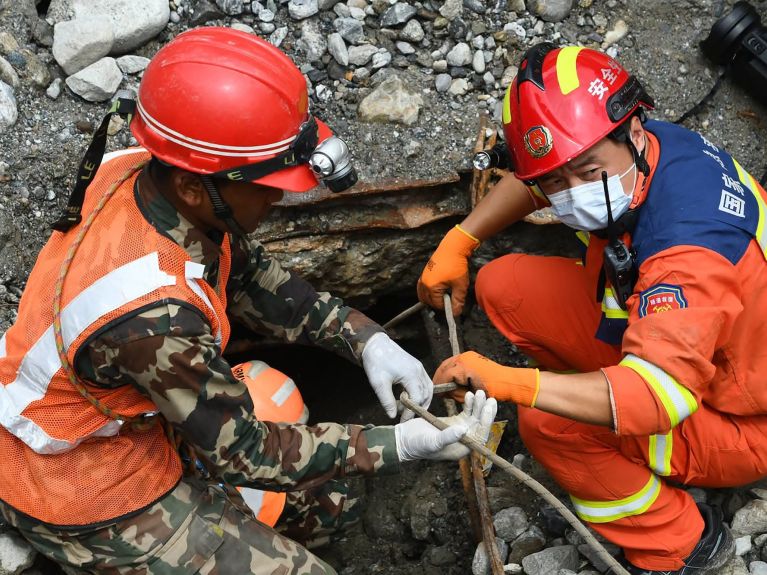
Germany’s support for Nepal
Following the flash flood, Germany has been providing humanitarian assistance to Nepal. The aid supplies delivered include water filters and mosquito nets.
 Sarah Kanning
 At the end of August, a flash flood of water, ice, snow and rubble swept through the Trishuli and Bhote Koshi valley. It devastated villages, bridges and power plants in the border region of Nepal and the Tibet Autonomous Region (China). More than 1,400 people were killed and another around 4,500 were still reported missing in early September. It is now key to quickly help those affected, not least to prevent epidemics, the World Health Organization (WHO) cautioned. At least 65,000 people are in urgent need of support.
Germany is sending aid supplies worth 500,000 euros to Nepal. “We are delivering tarpaulins, water filters and mosquito nets immediately, and are making contributions to ensuring that people in the disaster area have access to clean drinking water, temporary shelter and other things,” a spokesperson of the Federal Foreign Office in Berlin said. Thuringia has contributed more than 100 collapsible camp beds, and the German Life-Saving Association (DLRG) is providing lifejackets.
Reconstruction is expected to cost around five billion US dollars (4.3 billion euros). Germany is also involved in enabling humanitarian assistance through its membership in two funds. On the day of the disaster, the Nepalese Red Cross, for example, received 1 million CHF (1.1 million euros) via the International Federation of Red Cross and Red Crescent Societies’ (IFRC) Disaster Response Emergency Fund that is based in Geneva. This immediate aid was meant to help the organisation address the most urgent needs, to assess the extent of the destruction, and to identify those communities that require assistance most urgently. Germany has contributed a total of two million euros to this fund in 2026.
2.5 million US dollars were made available from the United Nations’ Central Emergency Response Fund (CERF). Germany has been among the biggest donors of the CERF for many years and has contributed 41 million US dollars in 2026 to date. The German Embassy Kathmandu is currently preparing a foreign mission project worth 100,000 euros, together with local partner organisations.
The fact that the flood has damaged infrastructure and bridges is a particularly hard blow for Nepal, as most of the country’s electricity is generated from hydropower. A total of eleven hydroelectric power plants and one solar energy system were hit by the torrents of water and debris. Hundreds of employees are among those missing, and thousands of households are without electricity.


