
Digital innovations save lives
Innovative technologies such as AI and blockchain help to deliver humanitarian aid to people in remote locations.
 Anja Leuschner
 Semi-autonomous vehicles bring help to hazardous regions
Destroyed roads, rough terrain and the risk of attacks can make it difficult to deliver humanitarian assistance and can endanger the lives of aid workers. This is where the semi-autonomous SHERP all-terrain vehicle, developed by the German Aerospace Center (DLR), is set to be deployed: because it can be controlled remotely, it can transport aid supplies across difficult to access terrain without the need for a human driver. “In situations where aid workers are exposed to direct risk, remote-operated robots are a good way of delivering aid and disaster protection from a safe distance,” says Armin Wedler of the DLR-Institute of Robotics and Mechatronics. The United Nations World Food Programme is already deploying conventional SHERP vehicles - in Mozambique and South Sudan, for example. The vehicles being used there are not controlled remotely, however - they have drivers on board.

Dieses YouTube-Video kann in einem neuen Tab abgespielt werden
YouTube öffnenThird party content
We use YouTube to embed content that may collect data about your activity. Please review the details and accept the service to see this content.
Open consent formAI plans the route for aid supplies
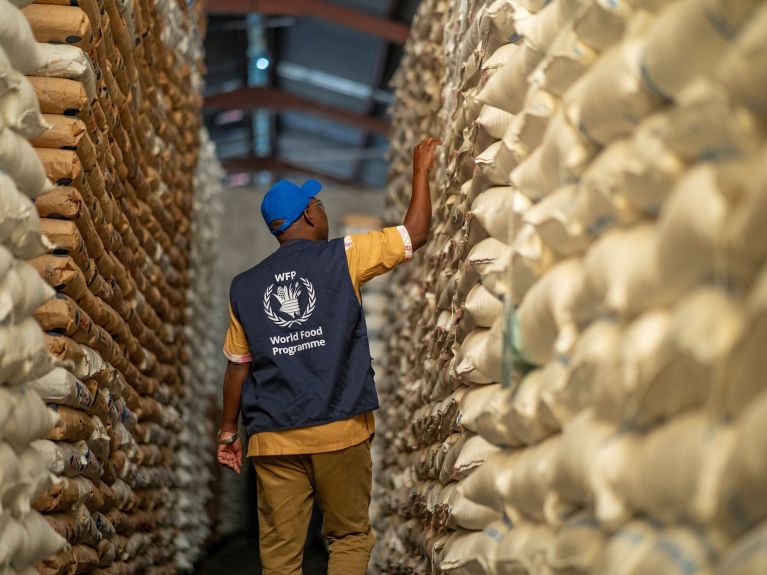
Where should food for aid deliveries be bought, transported and stored? To save costs and optimise the way food is delivered to people on the ground, the World Food Programme (WFP) of the United Nations is using SCOUT, an AI tool, to streamline supply chain planning. It makes it easier to plan purchases and select storage locations and is used for example in various regions across Africa. Thanks to SCOUT, costs were cut by 6.2 million US dollars in the space of 18 months. This meant that aid could be provided to significantly more people without the need for increased resources.
Blockchain coordinates the provision of aid
In crisis situations, several organisations often provide aid at the same time. Since they cannot always coordinate their activities, some people end up receiving support from multiple aid organisations, while others get too little help. “Building Blocks”, a blockchain programme used by the UN (WFP), interlinks aid organisations, allowing them to see who has already received support and enabling them to coordinate their aid delivery accordingly. In 2025, 159 organisations used the platform in Ukraine, Syria and Palestine to dovetail their humanitarian activities and improve transparency.
With the support of Germany’s Federal Foreign Office and Federal Ministry for Economic Cooperation and Development, among others, the WFP Innovation Accelerator was set up by the United Nations World Food Programme in 2015 to promote ideas and projects aimed at ending hunger worldwide. In 2025 alone, the innovations it funds helped a total of 132.5 million people. These innovations include the SCOUT and Building Blocks projects mentioned in the article.

