“We are able to foresee crises”
The guiding idea of anticipatory humanitarian action is to act before disaster strikes. It can help to protect people from the impacts of El Niño.
 Anja Leuschner
 The idea behind anticipatory humanitarian action is to get involved before disaster strikes. The German Red Cross (GRC) has been exploring this approach since 2013, and in 2014 the Federal Foreign Office became the first humanitarian donor in this area.
Stefanie Lux, who is in charge of the GRC’s anticipatory humanitarian action programmes, uses an example to explain the concept: a family that lost livestock worth the equivalent of two annual incomes due to drought would then require support for several months, she says. “This costs a lot more than providing resources for food and medication for the animals before the crisis occurs,” Ms Lux explains.

Current challenges in connection with El Niño
Anticipatory humanitarian action relies on forecasts for extreme events. Right now, there is not only El Niño causing extreme weather events such as drought and flooding, but existing conflicts are likely to escalate further, for example, in Mali, Sudan and Somalia. Humanitarian aid provided proactively can make a big difference here. In a drought caused by El Niño in southern Africa in 2023/24, it showed that aid provided early on was around 30 percent more effective than emergency action taken once the crisis has emerged.
Quick facts
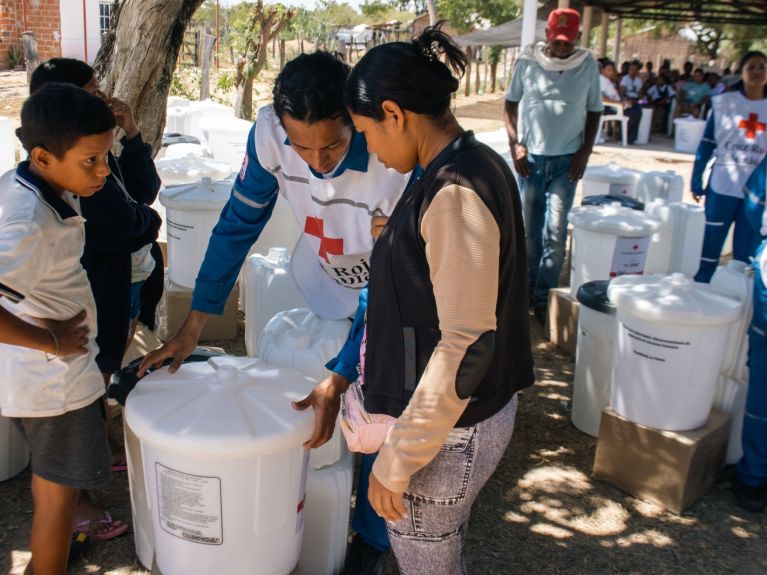
El Niño is expected to cause drought in Guatemala, El Salvador and Colombia, too. In addition to water shortages, this is likely to lead to crop losses, a lack of supply for feeding livestock and greater risk of disease. Anticipatory humanitarian action in this context includes handing out water filters and mineral licks for livestock, as well as special granules that help to retain the water in the soil and therefore to keep plants alive for longer. “The specific measures are chosen and implemented by our local partners, such as the Colombian Red Cross,” Stefanie Lux explains.
Germany plays an internationally pioneering role when it comes to anticipatory humanitarian action. 9.6 million people in 54 countries were protected against the effects of extreme events in 2025. The GRK’s Anticipation Hub is the leading platform for knowledge sharing and networking in connection with anticipatory humanitarian action and is used by over 170 partner organisations. (Source: GRK)


