Sudan conference: billions pledged and calls for ceasefire
Three years of civil war, millions displaced: in Berlin, 61 countries pledge billions in aid – and call for a humanitarian ceasefire.
 Klaus Lüber
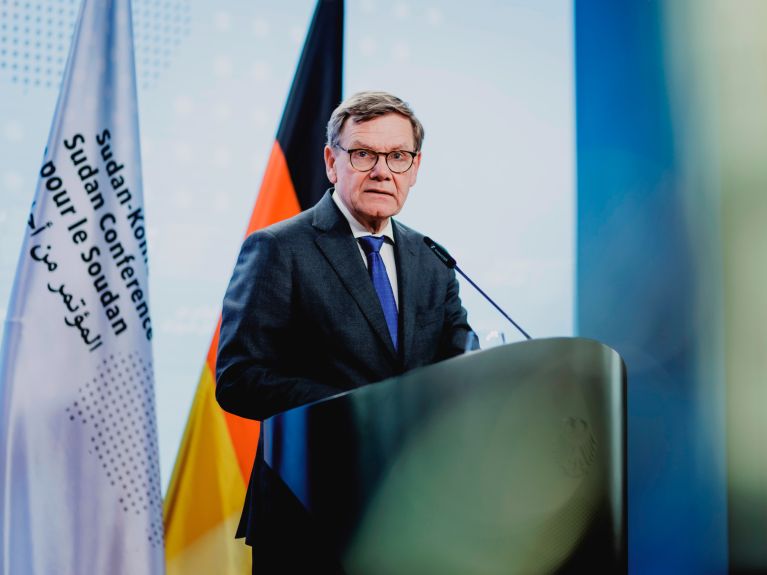
 The third international Sudan conference ended with a clear signal. Representatives of 61 countries pledged around 1.5 billion euros in Berlin for the war-torn country. The funds are primarily intended to benefit humanitarian organisations providing aid on the ground. Germany is increasing its aid to Sudan by more than 230 million euros, making it one of the largest donors.
“We must stand by the people of Sudan as well as the humanitarian organisations on the ground and worldwide that are working tirelessly under extremely difficult conditions to help them,” said Foreign Minister Johann Wadephul. The Federal Government hosted the conference jointly with the United Kingdom, France, the United States, the EU and the African Union – following earlier meetings in Paris and London. In Paris, pledges of around 2 billion euros were made, and in London around 1 billion euros.
“Laboratory of horrors”
The United Nations describe the current situation in Sudan as the “worst humanitarian crisis in the world”. For exactly three years, the Sudanese armed forces have been fighting the paramilitary Rapid Support Forces (RSF). When the city of El Fasher fell into RSF hands last October after 18 months under siege, satellite images showed vast pools of blood and piles of bodies. “This nightmare must end,” UN Secretary-General António Guterres said in a video message to conference participants. Tom Fletcher, head of the UN Office for the Coordination of Humanitarian Affairs (OCHA), spoke of a “laboratory of horrors”.
Two thirds of Sudan’s population depend on humanitarian aid, eleven million people are displaced, and twelve million women and children are experiencing sexualised violence. Drones are terrorising the civilian population – the United Nations has documented 700 deaths since the start of the year alone.
Flow of weapons from abroad
In this situation, building political pressure remains difficult – not least because external arms supplies are keeping the conflict alive. When Volker Türk, UN High Commissioner for Human Rights, visited the country in January, he saw only state-of-the-art weapons systems. “There are currently no weapons in Sudan that are produced there. This we know for certain,” said Türk, adding that an arms embargo would therefore be an essential step towards peace. Tom Fletcher noted that many “people are being killed from the air by drones – drones that are supplied internationally”. He said the population was frustrated, angry and desperate.
Dieses YouTube-Video kann in einem neuen Tab abgespielt werden
YouTube öffnenThird party content
We use YouTube to embed content that may collect data about your activity. Please review the details and accept the service to see this content.
Open consent formCall for a humanitarian ceasefire
Alongside an arms embargo, another demand was at the centre of the conference: people urgently need a pause in the fighting in order to secure at least the bare essentials. Only a humanitarian ceasefire can provide that. Such a measure had already been proposed in the QUAD statement of 12 September 2025 by the foreign ministers of the United States, the UAE, Saudi Arabia and Egypt. The RSF agreed to the proposal at the time – but the Sudanese army rejected it, and the ceasefire never came into force. Such a ceasefire is now more urgent than ever, said Massad Boulos, US Special Envoy for Arab and African Affairs, in Berlin. “It’s the only way we can ensure the unhindered flow of humanitarian aid into cities and provinces.”
Involving the civilian population
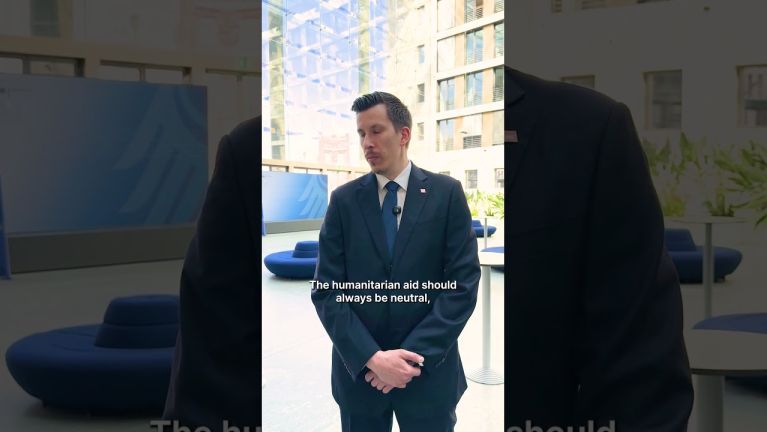
Several aid organisations at the conference called for greater involvement of Sudanese civil society. The conference provided around 40 representatives of local organisations with a platform for exchange. “Its vital that as much funding as possible flows precisely to them,” said Damjan Vinko of the Norwegian Refugee Council (NRC). “These aid workers act as so-called first responders directly on the front line and, unfortunately, are increasingly becoming targets themselves.” NRC operates in around 40 countries worldwide and provides emergency shelter, water supply, sanitation and food.
Alain Délétroz, director of the Swiss NGO Geneva Call, hopes for the political influence of host country Germany. “I know that the Federal Government is pushing hard for a ceasefire. That would be ideal for us, of course. At the moment, each of the parties to the conflict has all kinds of reasons not to allow our humanitarian aid to reach the people who urgently need it. That has to change – and fast. And I believe Germany has a powerful voice here.”


