3d printing, drones and supersonic tech for the Bundeswehr
To boost Germany defence capacities, a new innovation centre will fast implement good ideas expressed by troops, researchers and start-up companies
 Wolf Zinn
 The Bundeswehr - Germany’s armed forces - wants to make new technical solutions available to service personnel more quickly in future. To this end, Defence Minister Boris Pistorius opened the Bundeswehr’s innovation centre in the Bavarian town of Erding in February 2026. “Innovation is at the heart of credible deterrence,” said Pistorius. Major long-term rearmament projects alone were not enough, he added, explaining that it was vital to ensure that new technologies were made quickly available to service personnel.
Speed is the key
To this end, the innovation centre brings actors from the ranks of the armed forces together with scientists and the defence industry. “Creativity and speed are the main priority,” says Flotilla Admiral Christian Bock, the centre’s head. It’s about testing out ideas, for example from young start-ups, acquiring new knowledge and adapting developments accordingly. At the same time, Bock advocates flexibility and the courage to embrace the risk that an incomplete solution might possibly entail rather than always striving for perfection: “It is better to have eighty-percent solutions than nothing at all.” Many new systems will be based on a “fight tonight” approach, i.e. be ready for rapid deployment, skipping the lengthy, bureaucratic and expensive development and testing processes that have been commonplace until now. For Bock, failure is part of the learning curve: “A failed experiment is also a success.”
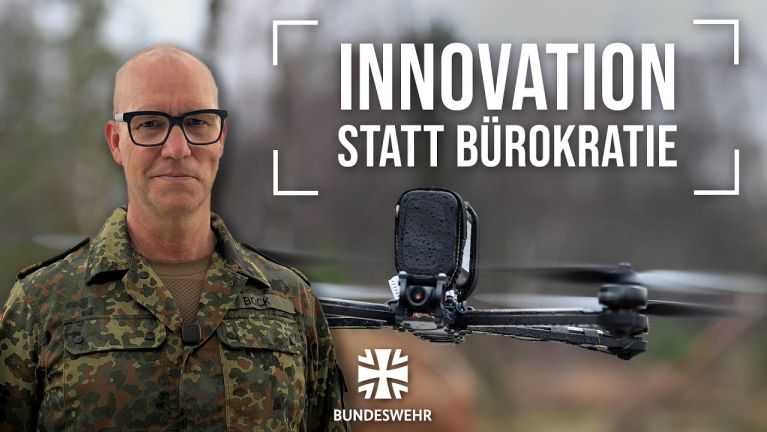
Dieses YouTube-Video kann in einem neuen Tab abgespielt werden
YouTube öffnenThird party content
We use YouTube to embed content that may collect data about your activity. Please review the details and accept the service to see this content.
Open consent formAreas of focus: ultrasonic technology, satellites and drones
The innovation centre works in many different fields at once, including 3D printing technologies for mobile use, ultrasonic technology and the possible use of microsatellites for reconnaissance purposes. One particular focus is on drone development and defence. For example, suitable commercially available systems to accompany and protect land forces against unmanned aerial vehicles are to be identified - that is to say solutions that are mobile and quick enough to follow their own troops and also protect them while on the move.
According to Bock, drone defence will also be further developed in partnership with established companies and start-ups and then rolled out as quickly as possible. He says that the technology needed for this is characterised by an “incredible pace of development”. It’s clear that failing to keep pace with these short development cycles is tantamount to buying equipment for the past. Bock sums up the logic behind this in a sentence that leaves little room for doubt: “Deterrence only functions when one develops capabilities that are so vastly superior to those of one’s enemy that the enemy is deterred from attacking in the first place.”


