“They were just two mothers sharing the same pain”
Mutual understanding, not prejudice: In their Middle East podcast, school students talk to historians, trauma researchers and survivors - and learn how to listen.
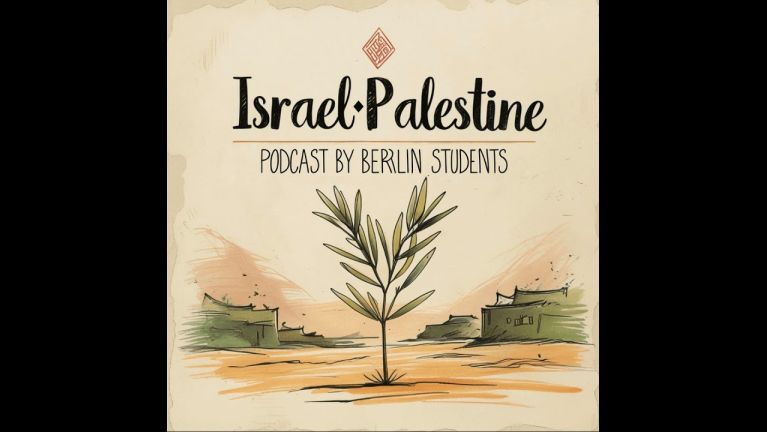
“Are you ready for the discomfort of learning?” This is the question that five sixth-form students from Berlin ask listeners at the start of their podcast about Israel and Palestine. The project was initiated in the wake of 7 October 2023. Ever since, the Hamas terrorist attack on Israel, the war in Gaza and its consequences have been the subject of almost constant debate - at school, among their friends, on social media. As part of the Berlin Oberstufenforum (sixth-form forum) of the Katholische Akademie (Catholic academy in Berlin), which brings young adults together with researchers and social actors, the students created the “Israel/Palestine Podcast by Berlin Students”. In 51 episodes, they thoroughly explored and analysed one of the most complex conflicts of the present day.
After 7 October: questions, not slogans
“We wanted to understand the reasons behind the conflict before forming our own opinion,” says Yusuf, one of the students involved. Consequently, the podcast topics were extremely varied - ranging from the historic origins of the conflict and relevant questions of international law to highly personal experiences. The youngsters looked into the psychological consequences of war and violence, the culture of remembrance and peace work, and the question of how understanding can be achieved at all in a reality dominated by violence. To do so, they interviewed nearly 60 experts and survivors from Israel and Palestine.
Dieses YouTube-Video kann in einem neuen Tab abgespielt werden
YouTube öffnenThird party content
We use YouTube to embed content that may collect data about your activity. Please review the details and accept the service to see this content.
Open consent formOver time, this gave rise to an exceptional series of conversations: the guests included renowned historians such as Gudrun Krämer, the leading international law expert Claus Kress, who is special adviser to the International Criminal Court in The Hague, and Yael Danieli, a pioneer of trauma research and victim rights. “The conflict is more than just politics or history,” says Efe. “It’s important to realise that it is about human beings, first and foremost.” She explains that human rights and international law were the framework within which the group were able to discuss different positions.
United in grief: stories from the Parents Circle
Meeting members of the Parents Circle Families Forum made a particular impression on the young students. An Israeli-Palestinian initiative, it brings people together who have lost family members in the conflict but are nonetheless committed to peace and understanding. Alexandria still remembers some of their stories exactly to this day.
“Mai told us about his grandfather Haim Perry, an Israeli peace activist who had organised transport for sick children from Gaza and was taken hostage on 7 October and later murdered,” she says. Sima talked about her 14-year-old brother Mahmoud, who was shot and killed in the West Bank, and about how her Palestinian mother didn’t initially want to have any contact with Israelis after losing her son. Her view changed only when she met an Israeli mother who had likewise lost a child. “At that moment my mother realised that there is no such thing as Israeli pain and Palestinian pain. They were just two mothers sharing the same pain,” says the young woman in the podcast.
Accepting contradictions: the tough discipline of listening
Time and again, the young people encountered people whose view of the conflict differed from their own. Some statements surprised them, others challenged them. For Yusuf, that’s precisely one of the key things the project has taught him. “Listening is in fact a skill you have to actively learn,” he says. He explains that the challenge was to accept contradictions and allow questions to go unanswered.
Despite the fact that every question had been prepared in great detail: working with an educationist, the group already studied the conflict intensively half a year before making the first recording. The individual episodes were also prepared together with the expert and then discussed afterwards.
International response: a project with a ripple effect
The seriousness with which the youngsters pursued the project did not go unnoticed. “We were overwhelmed by the positive response from international experts from universities,” says Yusuf. The project also met with considerable acclaim from teachers and other schools. The students were particularly pleased by the attention the project received from civic education institutions – including Germany’s Federal Agency for Civic Education, the Berlin State Agency for Civic Education and the antisemitism prevention newsletter published by Berlin’s education authority.
For Alexandria, there’s one takeaway that particularly stands out: “One can have entirely different views of the same conflict but still talk to one another about it,” she says. “These encounters made it clear to me how important it is to remain inquisitive and not to reduce people to their attitude to a political topic.”


