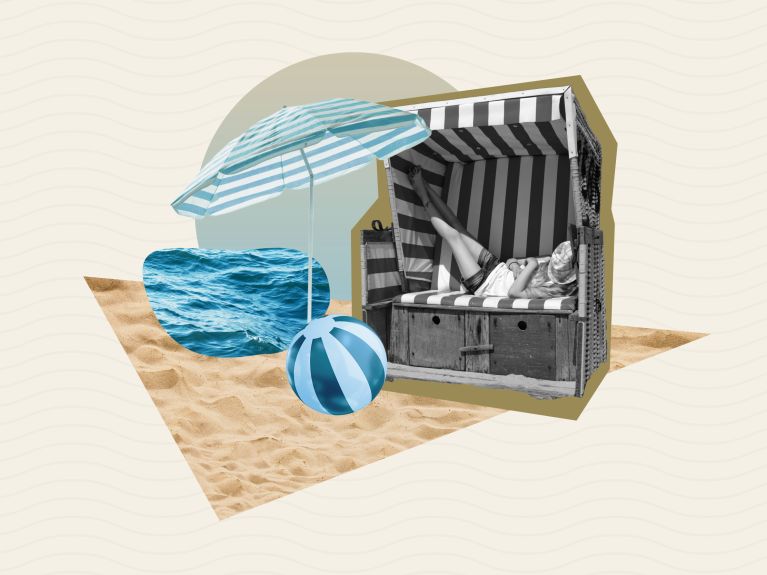


Adventure? Yes – but only in moderation!
A place by the sea – with a hood, side panels and a surprising amount of comfort. What the Strandkorb reveals about the Germans.
 Nora Lessing
 Germans enjoy spending their summer holidays by the sea every bit as much as the Dutch or the British. Yet – perhaps unsurprisingly for a nation renowned for its love of order – they are reluctant to do without privacy, security and structure. Woven from wicker, upholstered in blue-and-white or red-and-white stripes, as heavy as a piece of living-room furniture and usually available only for daily hire, the Strandkorb is one of the defining features of Germany’s beaches.
This sheltered beach seat was invented in 1882 by Wilhelm Bartelmann, court basket-maker in the city of Rostock. His fellow Germans quickly took to it, booking Bartelmann’s beach chairs for weeks at a time. Whether in the angular North Sea style or the curved Baltic style: to this day, there is hardly a beach on Germany’s coasts without Strandkörbe. In neighbouring countries, by contrast, they are largely nowhere to be found.
Perhaps the reason lies in their remarkable versatility. The Strandkorb combines a sense of adventure with security, fresh sea air with a touch of the living room. Usually designed for two, it offers space for your favourite person – while keeping the rest of the world at a comfortable distance. Its hood and side panels provide shelter from the sun, the wind and prying eyes. Footrests, armrests and small folding tables provide a surprising level of comfort.
Some are large enough to accommodate a family of five, complete with cool bag, towels, balls, buckets, spades, rain jackets and an inflatable crocodile. In the end, fitting everything in is less a question of space than of determination – until someone anxiously asks: were’s Fluffy, the wire-haired dachshund?
In the past, holidaymakers even built small sand embankments around their Strandkorb so as to be able to enjoy some real privacy on the beach. That custom has largely disappeared today. What remains is the Strandkorb – perhaps the most German way to spend a holiday: surrounded by nature, yet with a sheltered space all to yourself.


