The Dhenuki Cinema Project, India
A cinema-based outreach and education project conceived by Lightcube Film Society.
Dieses YouTube-Video kann in einem neuen Tab abgespielt werden
YouTube öffnenThird party content
We use YouTube to embed content that may collect data about your activity. Please review the details and accept the service to see this content.
Open consent formProject name: The Dhenuki Cinema Project
Project location: India
Website: http://thedhenukiproject.com/
Facebook: https://www.facebook.com/thedhenukiproject/?ref=br_rs
https://www.facebook.com/lightcubefilmsociety/
Instagram: https://www.instagram.com/thedhenukicinemaproject/
https://www.instagram.com/lightcubefilmsociety/
Twitter: https://twitter.com/suraj__prasad
https://twitter.com/lightcubefilm
Project description:
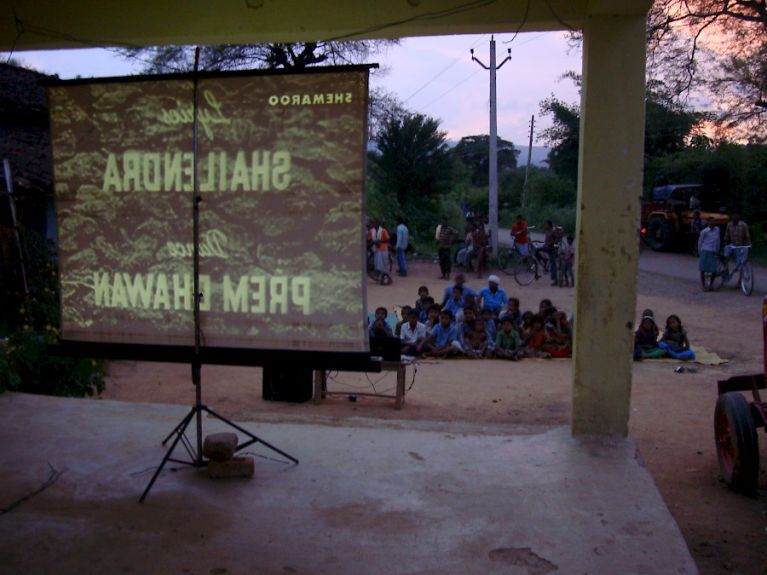
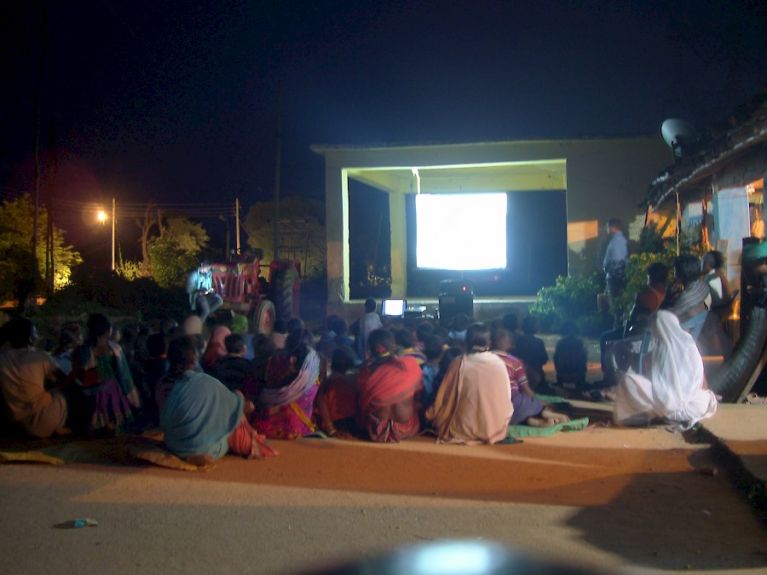
The Dhenuki Cinema Project is a cinema-based outreach and education project conceived by Lightcube Film Society. As part of its affairs, the Society enlists various volunteers and cine-activists to visit villages and smaller towns in different parts of the country to organise film screenings. The project uses an intricate method of identifying villages, training volunteers for field work, conducting focused discussions with various communities living in these villages and monitoring or studying the impact of the project over the course of time when the project is executed in three phases.
Phase One
The first phase of the program shall last for 3 months and consist of introducing the villages to cinema. A number of villages shall be targeted based upon research and referrals. A team of cinema activists shall be actively involved with the following tasks.
- Cinema Activist reaches a village, bonds with the locals, discusses & plans the schedule, starts gathering resources locally.
- The cinema activists announces and conducts a series of film screenings for the said three months period wherein they shall screen around 45 films and conduct discussions around them
- Daily reports other digital media to be reported via the website after every screening.
- Train the local Local Volunteer (LV) to conduct not just the screenings but also the documentation and correspondence methods for the project.
- The documentary material submitted by the activists will then be studied to aid in further programming and executions, as also, collated and uploaded on the project website, thedhenukiproject.com
Phase Two
The second phase of Dhenuki Cinema Project will run for a duration of 6 months. This phase will be focussed around making it work from within.
- The Local Volunteers trained in the first phase will receive literature and information about next set of screenings along with DVDs or other media.
- Initiation of screening at a frequency of around 10 films a month. The screening pattern to be decided locally as per the local calendar.
- The local cinema volunteer shall also write and communicate with the headquarters regularly to know about upcoming program schedules and report with documentation of events.
Phase Three
This phase shall consist of revisiting and providing these villages of a physical infrastructure to enable them to have a regular and fully functional film club of their own.
- #A piece of land allotted by the local authorities (state or village administration, etc.) shall be used to build the physical infrastructure that can house a projection system and accommodate roughly 80-100 people.
- The structure shall be built with locally available materials which are readily available and cost-effective. It shall also function as an office for the Local Cinema Volunteer (LCV) and a library that would have specific magazines/newspapers / books and DVDs that can be borrowed by the villagers for their information. All these materials shall be organised by the headquarters.
- Once functional this infrastructure could also lend itself to more activities and could function as a hub for information and education of the community of villagers by a non-formal method.
The focus states for the year 2017-18 are Chhattisgarh, Bihar, Jharkhand, Nagaland and Assam. We have conducted several pilot projects that have been documented on the website. 24 volunteers will be sent to 10 villages, as nominated through the website and spend 3 months there. They will screen films programmed specifically for the population and document local reactions through various mediums viz. video, audio, text etc. So far, we have been able to screen 350 films in various parts of the country, sometimes in places which are hard to reach or have no proper electricity. This has exposed about two lakh people directly to cinema in small proportions. For us, cinema is also the most effective way of documenting and archiving information, both geographic and cultural, and to help facilitate a mutual appreciation of the varied cultures that together form this landmass we call India.
Goal and purpose of the project:
- Enhance Primary Education & Supplement Secondary Education in schools which lie in the identified areas by organising related film screenings.
- Health, Nutrition & Sanitary Awareness for young population, thereby inculcating good practices at an early age.
- Women Empowerment through promotion of gender equality by showing films focussed towards the same.
- A film club in every village that brings people together to have conversations about subjects that are not easy to discuss. These conversations, we believe are the initiation or larger solutions.
- To enable them to introspect their own, individual roles in building the larger mythology and identity of the region of which they are residents.
- To reach 5 states, 10 villages through 24 volunteers over a period of two years in phase 1, 2 and 3 and to a target audience of 5 lakh people.
Motivation of the applicant / applicant team:
As an individual and as an organisation, we believe images have shaped our sense of reality in the last century. We understand that images are at the heart of conversations that then result in either peace, resolution and prosperity or conflict, strife and war. Images, therefore, are the key elements in all our activities as a film society.
Lightcube is a cultural initiative based out of New Delhi. Its efforts revolve around the shaping and examination of prevalent discourse around various forms of moving images. The group remains devoted to the diagnosis of contemporary methods of film exhibition and to the dissemination of culture beyond its mainstream-specified boundaries and metropolitan focus. To pursue this ambition, Lightcube has organised close to three hundred and fifty screenings across ten states in the four years of its existence.
The society has devoted itself in finding the sociological relevance of an art form like cinema, that traverses landscapes and cultures easily. It is also one of the most consumed mediums of the last century. Therefore it is also our medium of choice if we need to have a larger sociological dialogue.
We all have our origins in these villages, and it is important that we communicate with the population there and try to connect back with our roots and identities. With the project, we intend to create bridges between the urban and rural perceptions and our distinct yet similar lifestyles. To be able to comprehend each other’s daily rituals is all we need to be more compassionate and united. It will be easier for people to collaborate both within the village and outside to work together for a positive, inclusive and compassionate future.
Use of prize money:
The prize money would be utilised in arranging equipment and resources for organising film screenings in these locations. The standard set of equipment's include a projector, a set of speakers with amplifiers, a screen that is often a bed sheet. We have identified manufacturers of these equipments and have also chosen some really effective and durable products.
The other significant part of the expenses is the films and screening fees. We have established content partnerships with the premier film bodies of the country including PSBT, NFDC, NETPAC and CMS Vatavaran, who have waived off the screening fees for any film from within their respective catalogues. This has been very helpful.
The third component of the expenses are personnel based and includes stipends and travel allowances paid to the volunteers.