“I have faith in our civil society”
She fled the genocide in Rwanda and now campaigns for equality in Germany. Elisabeth Kaneza on setbacks and reasons for optimism.
 Miriam Hoffmeyer
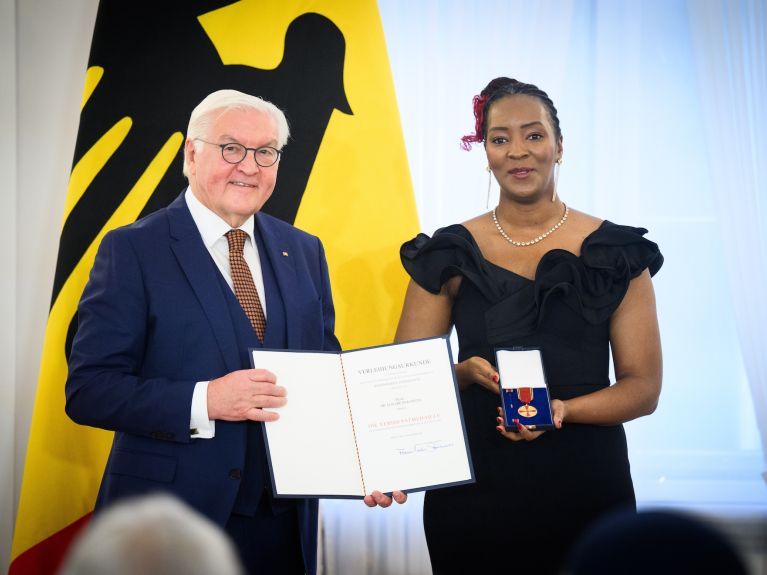
 Dr. Elisabeth Kaneza came to Germany as a child in 1994, seeking refuge from the genocide in Rwanda. She completed her master’s degree at Alice Salomon University of Applied Sciences (ASH) in Berlin. Kaneza has worked for such institutions as the Rwandan Embassy, the Bundestag and the Office of the UN High Commissioner for Human Rights in Geneva and Brussels. Today, she is Chair of the Kaneza Foundation, which she founded herself, and she also works as a policy adviser at Amnesty International in Berlin. In 2025, she was awarded the Order of Merit of the Federal Republic of Germany for her longstanding commitment to combating racism and promoting equality.
Ms Kaneza, what impact did your experience of fleeing Rwanda and your early years in Germany have on you?
When my family and I arrived in Aachen after several months on the run, I was seven years old. After those traumatic experiences, I imagined Germany as the epitome of happiness and security. But at primary school and in society in general, I was seen as foreign and different and had to contend with prejudice.
What helped you develop self-confidence?
My parents were important in that regard. At secondary school, there were more children from migrant backgrounds and teachers who encouraged me. From Year 5 onwards, I was involved as a class representative and later in the student council as well. I also founded and ran a hip-hop group at our school that won awards. That group was an important space of empowerment for me and other pupils with similar backgrounds. All of that really boosted my self-confidence. Even so, I still experienced discrimination from some teachers and in everyday life. As a result, I sometimes doubted myself and had to keep finding ways to regain my confidence.
How important is education for participation in society?
Education is an important key to overcoming barriers such as poverty and exclusion because it enables social mobility and participation. People with a migration background often fail to fulfil their potential because they face discrimination. It is my own experience of this that motivates my commitment to human rights: I could not and cannot accept a society in which only some people have equal opportunities. Even as a school student, I volunteered as a youth leader and coach in various integration projects and in my community in Aachen, and continued this work during my bachelor’s degree at Maastricht University.
You completed your master’s degree at Alice Salomon University of Applied Sciences (ASH) in Berlin. You’ve worked at institutions such as the Rwandan Embassy, the Bundestag and the Office of the UN High Commissioner for Human Rights in Geneva and Brussels. In 2016, you founded the Kaneza Foundation for Dialogue and Empowerment e.V. What are the organisation’s objectives?
We work in three areas: political and legal advice on human rights and anti-racism, educational activities such as talks and workshops, and mentoring and support for people affected by racism and discrimination. We also provide human rights training for activists. At the political level, we’ve been supporting the implementation of the UN International Decade for People of African Descent for more than ten years.
Where does Germany stand on racism today?
A number of things have improved in Germany over the past few decades. Today, there is at least a broad consensus across society that racism exists and is unacceptable. But the major challenge is still eliminating the systemic disadvantages faced by certain groups in society, including in education, the labour and housing markets and the actions of the state. In my doctoral thesis, which I completed at the University of Potsdam’s Faculty of Law in 2022, I examined structural discrimination against Black people and the political and legal means of achieving equality. What concerns me is that, for some time now, the social and political trend has been moving in the opposite direction again and important measures are being rolled back. Nevertheless, I remain optimistic because Germany is a country fundamentally committed to human rights. I also have faith in our civil society, which has already achieved a great deal in this area.
You have received several awards for your social commitment. What does the Order of Merit of the Federal Republic of Germany mean to you?
A great deal – to me, it is a major recognition of my achievements, including the obstacles I have had to overcome. It also reinforces my commitment. I want to help create a society in which everyone has an equal opportunity to fulfil their potential. Receiving the Order of Merit has shown me that the state aspires to this, too, and is making a clear statement in support of it. I see that as a positive sign. Racism remains a challenge for society as a whole, however, and one that we can only overcome together. I want to continue doing my part.


