Jugend forscht: How does an hourglass tick?
What do hourglasses, peptides and vacuum tweezers have in common? They are all things that the prize winners of the “Jugend forscht” competition for young scientists explored in their impressive projects.
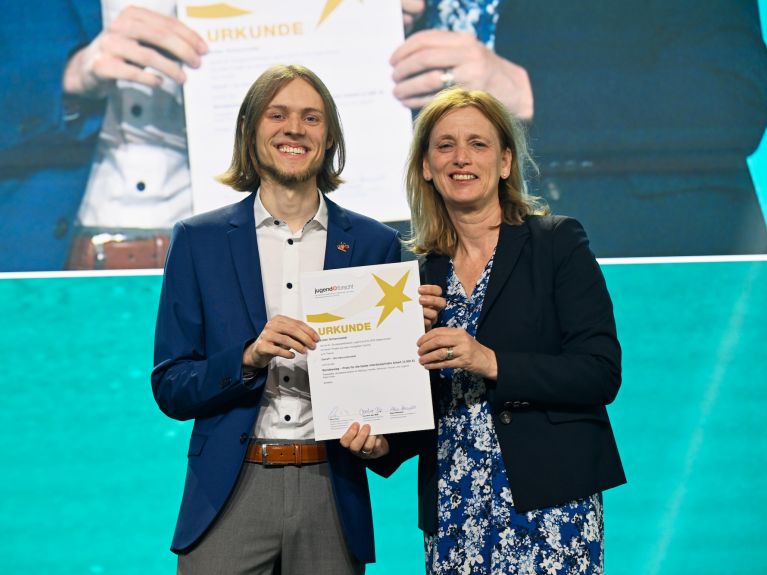
Herzogenaurach (dpa) – The winners of the 61st national final of the youth science competition “Jugend forscht” were announced. At the ceremony in Herzogenaurach, prizes were awarded to Germany’s top young talents in the STEM disciplines (science, technology, engineering, mathematics). Minister of Education Karin Prien was among those who presented the awards.
Viyona Singh (14) and Aarav Singh (14) from the German International School of Silicon Valley in Mountain View in the US received the Federal President’s special award. In their project in the area of biology they explored mirror-image proteins.
18-year-old Tim Kammel from North Rhine-Westphalia received the Federal Chancellor’s special prize. In his project titled “How does an hourglass tick?” he analysed the physical properties of hourglasses and the ways in which their neck width, funnel shape and the amount of sand impacts the flow behaviour of the sand.
Julian Scharnowski (20, from Baden-Württemberg) was awarded the Minister of Education’s special prize. He designed low-cost vacuum tweezers for precise positioning of tiny electronic components on circuit boards.


