“I think about every tiny little atom of the sounds”
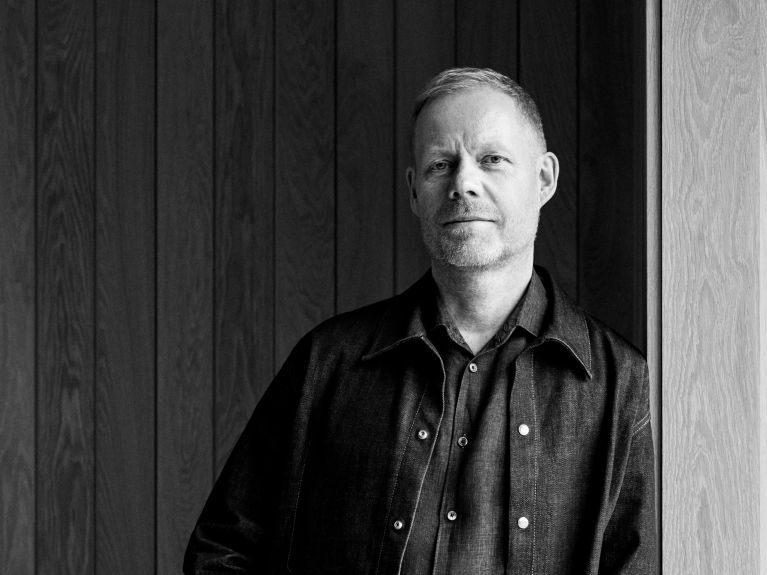
Max Richter is one of most noteworthy film composers. He was honored with the Berlinale Camera, among other awards, and was nominated for an Oscar.
Some film music aims to overwhelm with huge drama and acoustic spectacle. Max Richter’s music is different, it moves us through vulnerability. Richter knows how to “hold the tension in the liminal space between ‘to be’ and ‘not to be’”. He also reminds us of what it felt like “when we were just vibrating particles from the big bang”. This is how the Chinese director Chloé Zhao described Max Richter’s work in her very poetic laudatory speech she delivered at this year’s Berlinale.
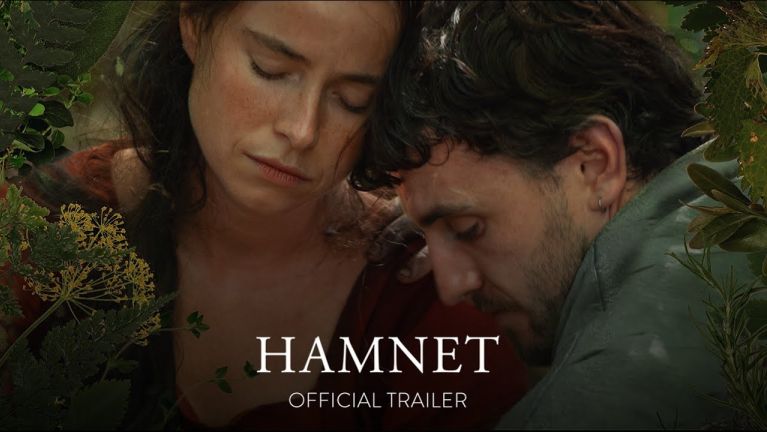
The composer that was born in Germany in 1966 and lives in Britain, was awarded the Berlinale Camera in Berlin. In addition to that, he was nominated for an Oscar in March 2026 for his soundtrack to Chloé Zhao’s celebrated new film Hamnet that has already won a Golden Globe and an Outstanding British Film Award.
Dieses YouTube-Video kann in einem neuen Tab abgespielt werden
YouTube öffnenThird party content
We use YouTube to embed content that may collect data about your activity. Please review the details and accept the service to see this content.
Open consent formFame thanks to Waltz with Bashir
Max Richter has played in various different ensembles and has published numerous solo albums that are best described as neoclassical. He became more widely known in 2009, thanks to his soundtrack for the animated documentary Waltz with Bashir. The 59-year-old has since written music for many other films, such as Never Look Away (2018) and the Grammy-nominated film Ad Astra (2019). Richter’s music has also been played at fashion shows, as well as during dance theatre performances and Olympic figure skating.
The composer who is originally from Hameln in Lower Saxony, grew up in Bedford in England and studied classical composition and piano at the University of Edinburgh and the Royal Academy of Music. However, he had his first formative experience related to music when he was still in Germany. At the Berlinale award ceremony he said that he was less than three years old at the time. He was playing in the living room, and a record of a Johann Sebastian Bach concert was playing, while the sun was slanting down through the window. Max Richter describes the way in which the two things fused together into a hybrid sensation as an “overwhelming emotional experience”. Even as a child he recognised a “logic” behind the sounds.
The role of film music
What happens when he hears his own music? It made him think “about every tiny little atom of the sounds” and about whether the sounds “are presented in the best way that they can be,” Mr Richter said in Berlin. He continued by explaining that he asked himself: “Are they telling the story most intensively and directly? Are they communicating as powerfully as they can? Do they feel inevitable?” The music was only right if these criteria were met, Richter stated. When asked about the role of film music, Max Richter said that it had to speak to the subject matter of a film or a scene in more than one way. He went on to explain this based on scenes from Hamnet and Ad Astra.
Ghosts from the past
There is a scene in Hamnet in which William Shakespeare and his future wife Agnes meet for the first time. Shakespeare tells Agnes the famous story of Orpheus and Eurydice. A harp can be heard in the scene, because Orpheus plays a lyre, which is a small harp. However, you could also hear a “steady rhythmic structure” that helped people follow the dialogue, Max Richter said, adding that this was continued up to the point where Agnes signals her interest in William through an eye movement. The music then changed to feature acoustic elements from the Elizabethan period that are, however, transformed electronically to sound like “ghosts,” Richter said. The film is also about a ghost, after all: the ghost of Hamnet, William and Agnes’ son whose death they have to deal with.
Dieses YouTube-Video kann in einem neuen Tab abgespielt werden
YouTube öffnenThird party content
We use YouTube to embed content that may collect data about your activity. Please review the details and accept the service to see this content.
Open consent formWhat does space sound like?
The film Ad Astra is about an astronaut who flies to Neptune. In his music, Max Richter used electromagnetic data that had been recorded near Neptune by the Voyager probes. The audience does not know and cannot hear this, but it is typical of the multi-layered nature of the composer’s work. A combination of sampling, electronic and analogue instruments is also typical of the music Richter composes beyond his film music. Much of this music is created in the woods somewhere in Oxfordshire, where he and his partner Yulia Mahr have set up a studio on an old farm.
Space for feeling
Max Richter’s most ambitious project to date is called Sleep. The eight-hour listening experience premiered in Berlin in 2015 and is also available as an album and as an app. The close to 30 performances to date took place between midnight and eight o’clock in the morning, and the audience was encouraged to experience it while sleeping in beds. The idea behind this is to create a kind of “alternative reality” based on neuro-scientific research, that allows people to recover from the information overload of the mobile phone era. A reality in which “space for feeling” is created, to quote Chloé Zhao. She points out that Richter does not tell us what exactly we should be feeling. Maybe that’s the very thing that makes good film music.


