Does the world even exist?
Fields of meaning, New Realism, AI ethics: Rethinking the world, Markus Gabriel draws surprising conclusions about life with artificial intelligence.
 Klaus Lüber
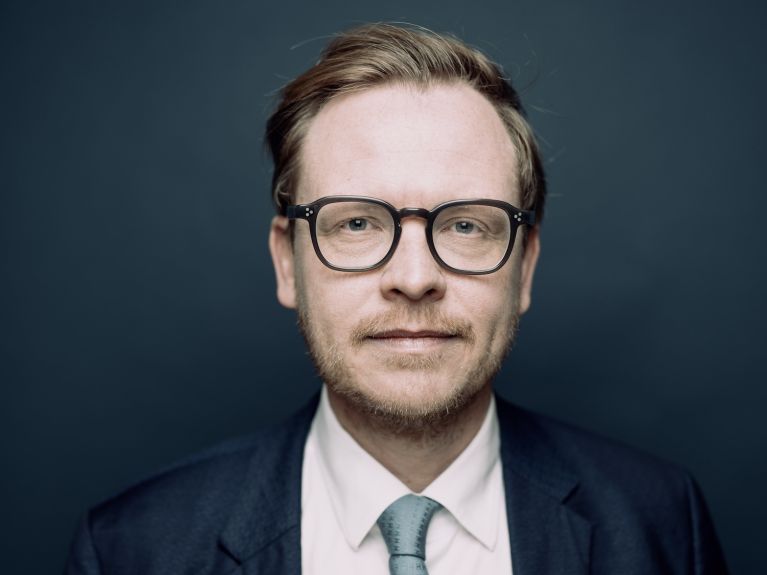
 He has been described by the media as a wunderkind in the field of philosophy: Markus Gabriel, who was born in 1980, was appointed to a professorship in his field at the age of just 29. His inaugural lecture at the renowned University of Bonn was about nothing less than the “meaning of the whole”. And the crux of his argument is that the world doesn’t exist.
More specifically, he means the world as a totality that encompasses everything in existence. He argues that, if “the world” really contained everything, it would also have to contain itself. For Gabriel, this is a paradox. Instead, he believes that things - objects, thoughts, ideas - exist not as one large entity but in many different domains that he calls “fields of sense”.
Gabriel explains this as follows: a unicorn exists in the field of sense of literature and mythology, but not in the field of sense of zoology. A mathematical equation exists in the field of sense of mathematics - but not in the field of sense of a breakfast table. There is in other words not one single world, but many fields in which things are real in their own respective ways.
We see this huge cosmos and believe that we are meaningless ants.
Because of this theory, Gabriel is regarded as one of the founders of New Realism – a philosophical approach that does not reduce reality to a single perspective. “We see this huge cosmos and believe that we are meaningless ants.” According to Gabriel, detaching ourselves from the notion of an all-encompassing “totality” opens up space for other forms of reality. He argues that this is why art, ethics and religion are not mere gimmicks but could provide us with orientation in our lives.
Gabriel also believes that ordering the world according to fields of sense can help us better understand artificial intelligence. When modern AI models process a book, they do not read it line by line but apprehend it in its entirety by converting it into a mathematically describable “space of meaning”. This enables them to identify patterns and analogies that go beyond the mere facts themselves. He says this makes them capable of emotional intelligence. Language models, believes Gabriel, do not simply predict words - they read in our language who we are.
He therefore sees the most important development as being the transition from a conversation tool to an emotional AI that amplifies and mirrors human behaviour. Rather than an “ethics of AI”, Gabriel advocates for an “ethics with AI” - an ongoing conversation between human and machine intelligence. In his 2026 book “Ethische Intelligenz” (Ethical Intelligence), he writes: “The artificial intelligence of the future will not resemble robots from action films but a dialogical atmospheric machine, embedded in our daily lives and incessantly reflecting, correcting and expanding us.”
Markus Gabriel, born in Remagen in 1980, is a professor of epistemology and modern and contemporary philosophy at the University of Bonn, where he heads the International Centre for Philosophy. He also teaches in Paris and Kyoto, among other places.
www.markus-gabriel.com


