How to fight right-wing extremism
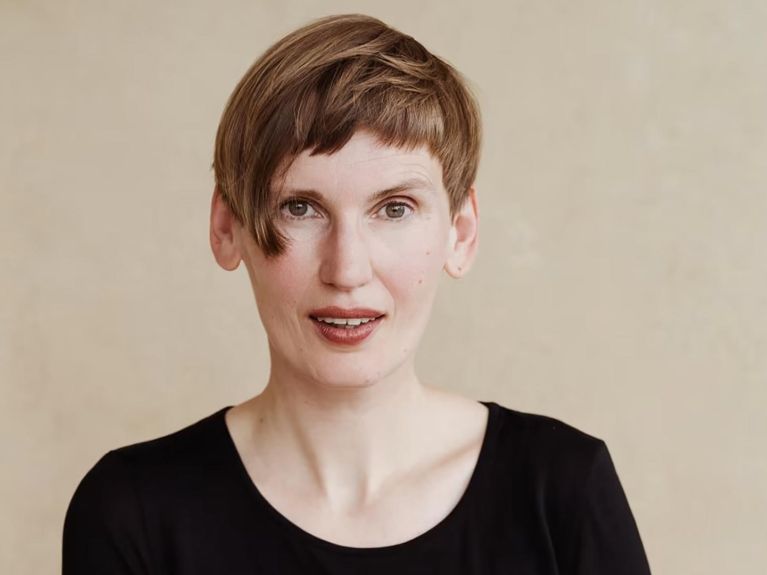
Eva von Redecker examines what causes right-wing extremism today. She is rethinking freedom, democracy and social cohesion.
 Klaus Lüber
 What should be done to counter the global shift to the right? This is a question of very concrete relevance to the philosopher Eva von Redecker. She lives in rural Brandenburg, a German state where nearly 40 percent vote for the largely right-wing extremist Alternative for Germany (AfD) party. It takes courage to adopt a clear contrary stance in this environment. Redecker has no illusions: “I admire all of the people who live in villages in eastern Germany and do not vote AfD.”
Redecker believes that one first needs to understand how modern-day fascism functions if one wishes to do anything to counter the trend. In her 2026 book “Dieser Drang nach Härte” (Entitlement and the Urge to Destroy), she coins the term “phantom possession”: a claim of ownership of goods or privileges to which one is not entitled but that one ruthlessly defends nonetheless. Right-wing extremists use the same rhetoric to politicise all of these phenomena. “They create the impression that people are being robbed. After all, theft makes violence appear legitimate self-defence. Contemporary fascism acts in this mode of self-defence,” she says.
Right-wing extremists create the impression that people are being robbed.
Unlike conventional fascism, the form it takes today is no longer based first and foremost on mass movements, explains von Redecker. Instead, individuals form loose alliances - on social media, for example. “These days, we have to deal with trolls who form a mob but nonetheless remain detached.” One key feature is the inclination to destroy, she says. In a world in which the climate crisis and the precariousness of our current situation are threatening our very future, sovereignty is often expressed only as the right to destroy. “People want to be allowed at least to break something in order to have a sense once more of their own freedom.”
She sees capitalism as providing fertile soil for such attitudes because it forces people to compete and - like nature - divides them into that which is usable and that which is worthless “waste”. To counter this, von Redecker offers a vision of “reparative democracy“. Her response to fascism is public luxury. If everyone felt well provided for, if living were affordable, if trains ran on time and doctors had enough time for their patients, hiding behind phantom possession would lose its appeal.
Freedom, according to the theory she puts forward in her 2023 book “Bleibefreiheit” (The Freedom to Stay), is not only spatial in the sense of the possibility to move around. It is also temporal: the possibility to stay, to preserve the basic prerequisites for life, to take responsibility for a place. She says that antifascism means offering a better reality - one that promises genuine security rather than mere compensation.
Eva von Redecker, born in Kiel, Germany, in 1982, is a philosopher and freelance author. She has conducted research at Humboldt-Universität zu Berlin and as a visiting scholar in Cambridge and New York. These days she lives in rural Brandenburg. www.evredecker.net


