Learning from the stars
The world’s largest radio telescope is being built in South Africa and Australia. Germany and South Africa are collaborating to find answers to the big questions of the universe.
 Christina Henning
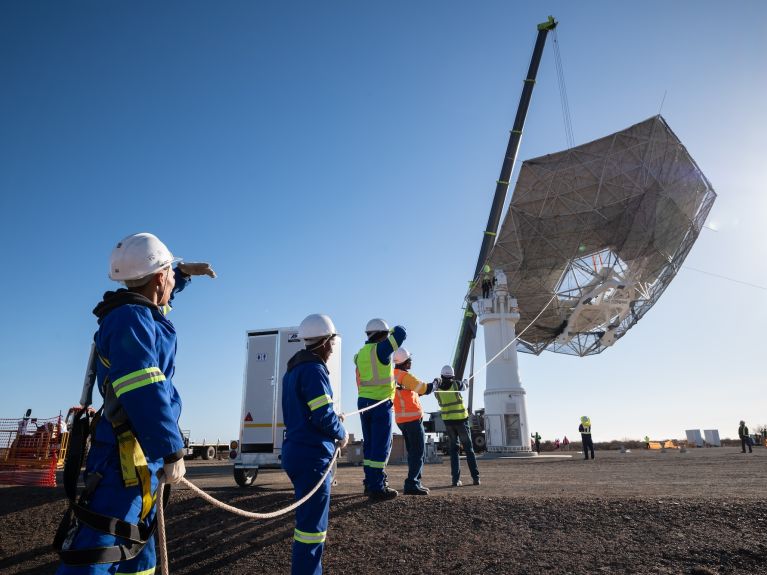
 How old is the universe? Do extraterrestrial life forms exist? And how did life evolve in the first place? It is possible that answers to questions like these will be found soon, as an international project is currently building the world’s largest radio telescope: the Square Kilometre Array (SKA). 197 individual telescopes are to be set up in the middle of South Africa’s Karoo semi-desert by 2030 - far away from any electromagnetic interference.
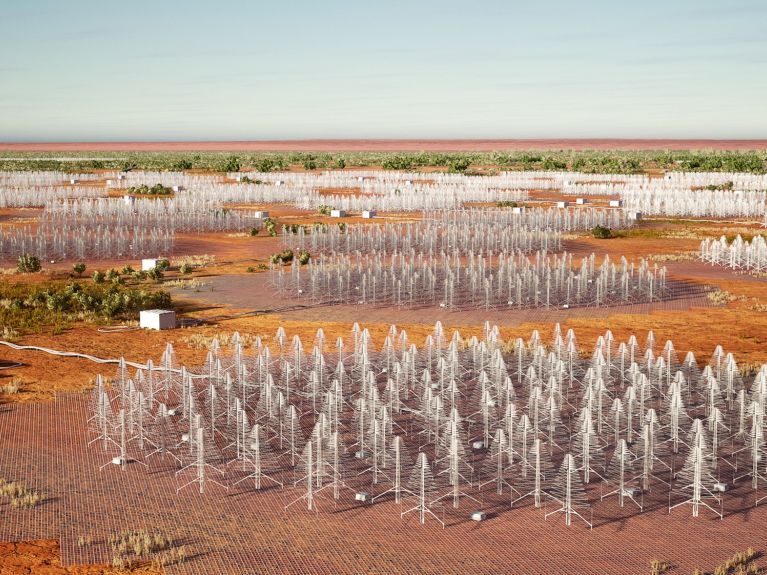
The project involves organisations from 13 countries, an international consortium that is building the world’s largest telescope array, the SKA Observatory (SKAO). The SKAO is headquartered in the UK, and Germany has been an official member since 2024. In Australia, one of the partner countries, the second part of the SKA is being set up - around 130,000 antennas that look a bit like Christmas trees in a desert.
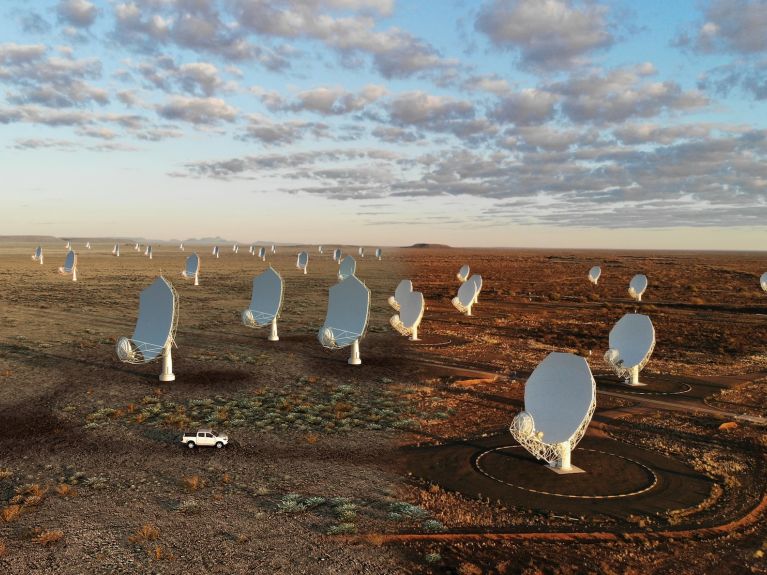
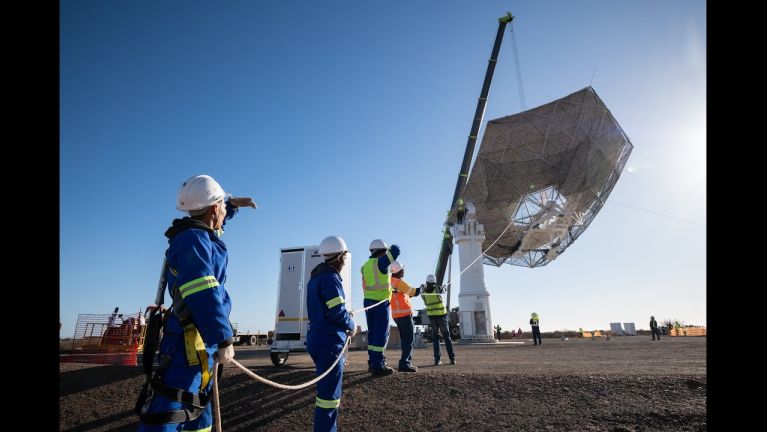
The nearly 200 radio telescopes being built in South Africa will cover a huge area. The biggest distance between two telescopes there will be more than 150 kilometres. Each dish has a diameter of 15 metres. The remote region is still a building site, with nearly half of the planned installation in place so far. The telescopes detect electromagnetic waves from space, which astrophysicists analyse.
Data from space: from South Africa to Germany
By no means all the work is done in the desert: the signals from space are transmitted to Germany via high-performance networks - namely to the German Centre for Astrophysics (DZA) in Görlitz in the east of the country. The volumes of data that are generated are enormous. “The SKA as a whole generates more data than there was on the entire internet in 2022,” says Stefan Wagner from German Centre for Astrophysics.

The team in Görlitz is currently working on developing ways to efficiently process the SKA data, programming algorithms and setting up the requisite research infrastructure. The first step is to reduce the “massive data stream to manageable quantities” without any information losses. To meet these requirements, the DZA is using artificial intelligence and novel technologies. Its aim is to establish itself as an “engine for technological innovation in the area of data science” and to demonstrate the benefits for society that the strategies it is developing for huge data streams can have.
Alongside the DZA in Görlitz, there will be other data centres around the world. “It is a pilot project involving international cooperation,” says Wagner. In which the DZA in Görlitz is playing an active role. In the summer of 2025, the centre hosted the SKAO Science Meeting, with more than 600 participants. It was the world’s largest radio astronomy conference to date.

Dieses YouTube-Video kann in einem neuen Tab abgespielt werden
YouTube öffnenThird party content
We use YouTube to embed content that may collect data about your activity. Please review the details and accept the service to see this content.
Open consent formSpace research in South Africa
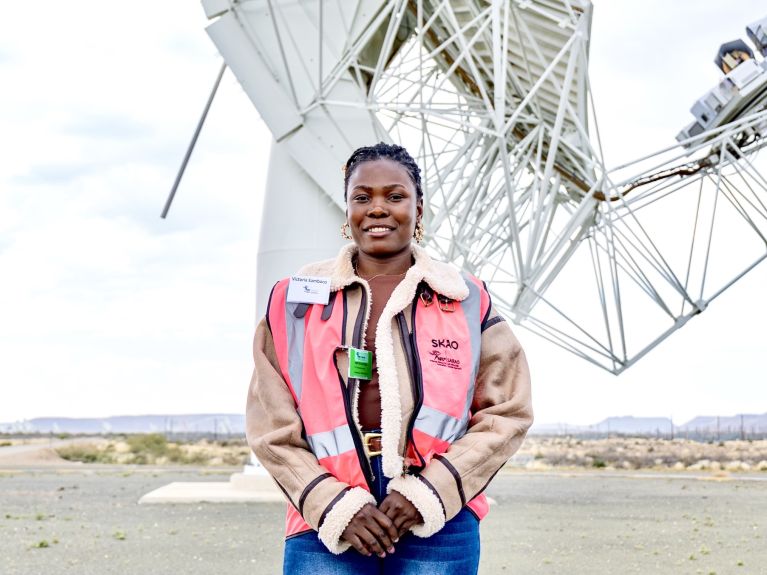
Victoria Samboco was amongst those who came to Görlitz. An astrophysicist from Mozambique, she is doing her PhD at Rhodes University and is vice president of the Mozambican Astronomical Society. Her method of reducing solar interference in radio astronomy observations is used worldwide and also of relevance to the SKA.
“It is exciting to be part of the generation that will witness the breakthrough science coming from the SKA and to see South Africa at the forefront of this effort,” says Samboco.
Dieses YouTube-Video kann in einem neuen Tab abgespielt werden
YouTube öffnenThird party content
We use YouTube to embed content that may collect data about your activity. Please review the details and accept the service to see this content.
Open consent formTo this end, the South African government is providing funding to specifically support space research and training. Stefan Wagner recalls that there were only a handful of South African astrophysicists when the project began, but now there are several hundred. The SKAO won’t only be providing answers to the big questions of the universe. With targeted school and academic funding programmes, the project is already influencing education in the STEM subjects in South Africa and creating new jobs.
“As someone who has benefited directly from funding opportunities, I can say that this support has changed my life in many ways,” says Samboco. “It has allowed me to contribute to a truly global project, travel internationally, and build professional networks with experts and leaders in the field, opportunities that would not have been accessible to me otherwise.”
How Germany and South Africa are collaborating
Germany has been an official member of the SKAO since 2024. When it joined the international research project, 14 antennas were made available, supplied by German firm OHB Digital Connect in cooperation with the DZA and the Max Planck Institute for Radio Astronomy. Germany’s involvement was further stepped up in late 2025: the SKAO commissioned OHB Digital Connect to supply 86 highly sensitive receivers for the South African radio telescope.
For a researcher like me, this cooperation feels like a global classroom.
“Germany’s contributions in areas such as receiver technology, high-performance computing and software development are vital to the success of the SKA. For a researcher like me, this cooperation feels like a global classroom,” says Samboco. The doctoral student values the knowledge sharing “where South African innovation in big-data science meets German engineering excellence”. This cooperative approach ensures that the SKA constitutes a joint scientific accomplishment for the international community, she explains.
Answers to questions that have not yet been asked
There will probably be some new insights into the big questions of the universe: “We anticipate a whole host of discoveries,” says Wagner. For example about the processes that dictate the extremely efficient conversion of energy in black holes, or about what causes particularly high-energy lightning or violent explosions in the universe. “Some discoveries will be exactly those that we have been hoping for. Others will relate to things we cannot even imagine just now. That’s what makes astrophysics so exciting.”


