Conservation works: what the snow leopard tells us about biodiversity
195 countries working to protect biodiversity: how COP17 in Yerevan is promoting conservation and what role Germany is playing.
 Clara Krug
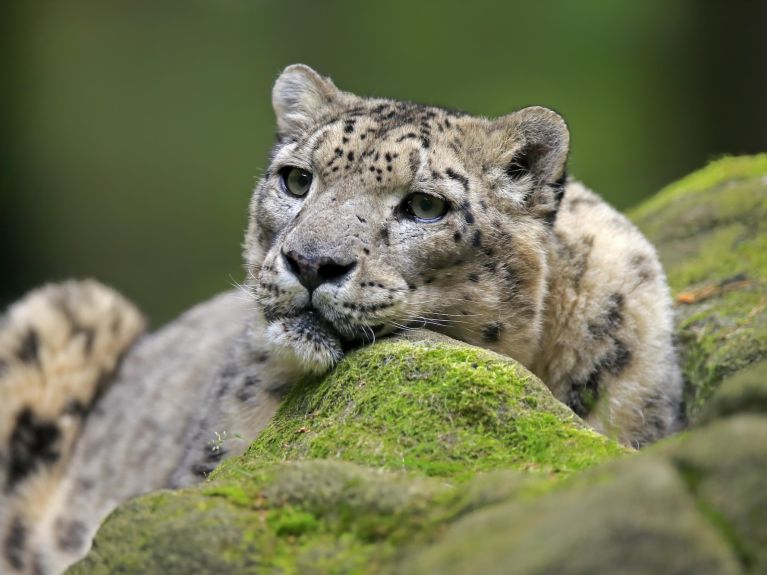
It is the middle of the night when a camera trap is triggered in the mountains of Kyrgyzstan. For a moment, a snow leopard fills the frame. Then it disappears again. The image is part of a systematic survey in which researchers in Kyrgyzstan set up 875 camera traps across more than 125,000 square kilometres and documented over 335 sightings. The Kyrgyzstan office of the German Nature and Biodiversity Conservation Union (NABU) also contributed to the study, published in 2025. Snow leopards are among the world’s most endangered big cats, threatened by habitat loss and poaching. That makes the good news from the study all the more important: protected areas and cross-border cooperation are making a difference. With an average population of 285 adult animals, numbers in Kyrgyzstan have risen since reaching a low point of 150 to 200 in 2000.
What are the objectives of COP17?
According to the Intergovernmental Science-Policy Platform on Biodiversity and Ecosystem Services (IPBES), one million of the estimated eight to ten million animal and plant species face extinction. Without healthy biodiversity, there can be no secure basis for life, so protecting it is a shared responsibility. That is precisely the focus of the UN Biodiversity Conference (COP17) in the Armenian capital, Yerevan. From 19 to 30 October 2026, the 196 parties – 195 countries, including Germany, and the European Union – will meet there.
The conference aims to ensure that decisions made at previous conferences continue to be implemented. In 2022, COP15 adopted the Kunming-Montreal Global Biodiversity Framework. The best-known of its 23 targets is the 30×30 target, which calls for 30 per cent of the Earth’s surface to be protected by 2030. In 2024 and 2025, the international community agreed further measures, including a stronger role for Indigenous peoples.
How is Germany helping to protect biodiversity?
In December 2024, the Federal Government adopted the National Biodiversity Strategy 2030, covering 21 areas of action, with 64 objectives and around 250 measures to be implemented by 2027. Germany also supports biodiversity projects in the Global South through its International Climate Initiative. So far, this has involved more than 1,100 projects in around 150 partner countries, with total funding of almost eight billion euros.
What is the COP?
COP stands for “Conference of the Parties”, a meeting of the parties to an international agreement. The first World Biodiversity Conference took place in the Bahamas in 1994. Since then, the member states have met approximately every two years.
What is the CBD?
The UN Convention on Biological Diversity (CBD) was adopted in Rio de Janeiro in 1992 and remains the most important international agreement on biodiversity. It protects animals, plants and ecosystems while combining conservation with the sustainable use of natural resources.


