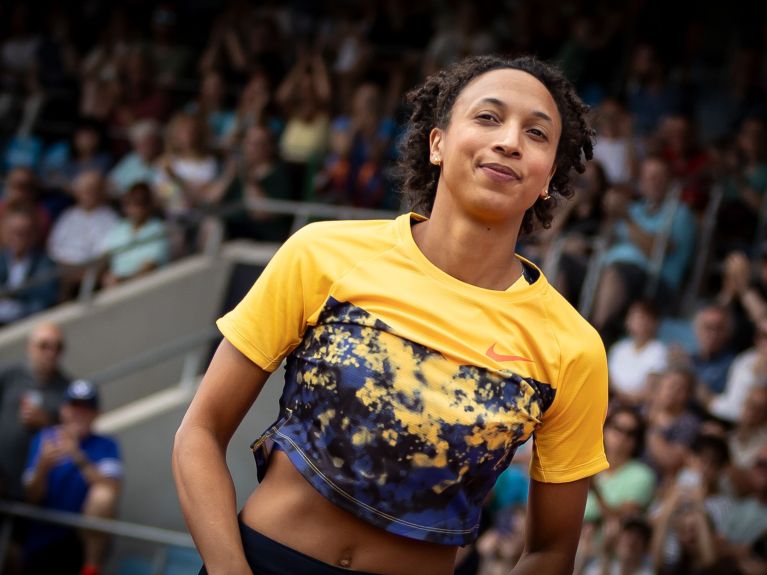
Democracy needs movement
Olympic and World Champion Malaika Mihambo campaigns for equal opportunities, inclusion and environmental protection.
“Let’s go!”, shouts Olympic long-jump champion Malaika Mihambo. And around 40 primary school kids start running - taking small, quick steps and keeping their knees up - across the blue floor of the gym at their school in Waghäusel, a town in the German state of Baden-Württemberg. It’s the first day of a two-week KILANA holiday camp run by the Baden Athletics Association, which Mihambo supports by taking responsibility for specific projects. The camp combines sport with environmental education: the children engage with human rights in a “human memory” game and learn to separate waste correctly in a relay race.
Mihambo, who is 32 years old, is an Olympic winner and two-times World Champion in the long jump. Alongside her career as a top athlete, she studies environmental science and campaigns to protect the environment. She uses the attention her sporting achievements have brought her to take a stance on social issues. “I believe that all action is political. Keeping silent and doing nothing is just as political as getting involved in politics,” she told the “Tagesspiegel” newspaper.
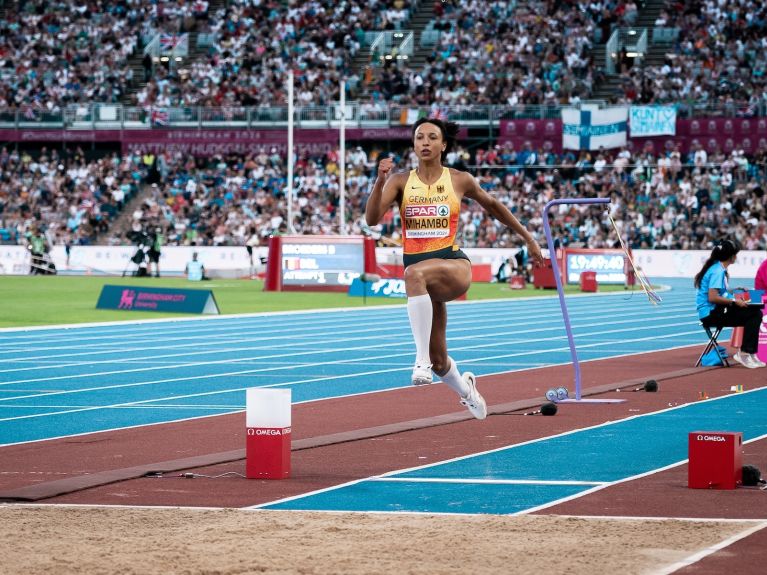
The responsibility that comes with success
This view stems in part from Mihambo’s biography. The daughter of a German mother and a Tanzanian father, she has first-hand experience of racism and says that she developed a political awareness at an early age. She sees her privileged position as an obligation to make a contribution to society.
This is also reflected in her social commitment. In 2020, Mihambo founded a non-profit named “Malaikas Herzsprung”, which aims to give primary school children access to club sports activities even if their families couldn’t otherwise afford it. Funding is provided for at least one year of membership in an athletics club. It’s not only about exercise and sport, however: the charity is also keen to foster equal opportunities, fair play, self-confidence and social contacts.
This provides a vision of how society could work: competition without denigrating others, and participation rather than exclusion. In online magazine “Migazin”, Mihambo describes this philosophy as tying in with the spirit of the Olympic Games: “No country, no place and no person is worth more than any other. We all have a duty to take a stand.”


