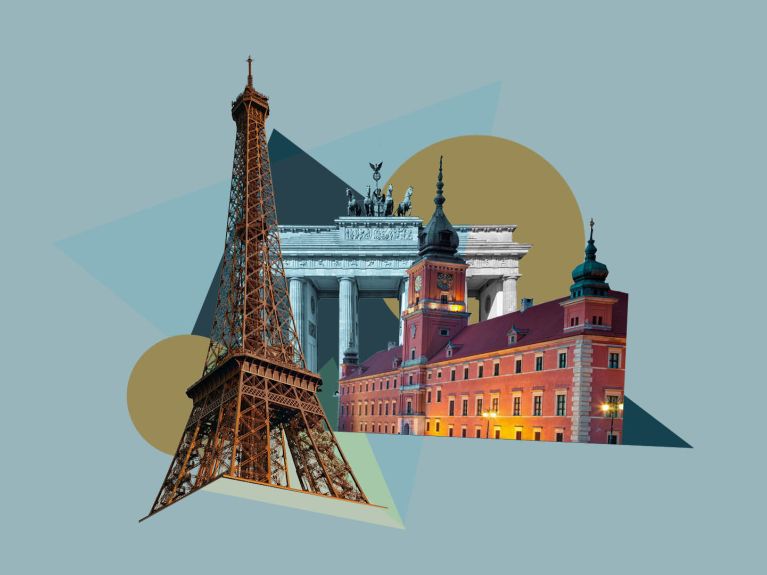
Bringing Germany, France and Poland together
In 1991, three countries launched a special forum for political cooperation in Weimar. How the Weimar Triangle has evolved over the past 35 years and the role it plays in Europe today.
 Ina Brzoska
 When Germany’s then Foreign Minister Hans-Dietrich Genscher invited his counterparts Roland Dumas from France and Krzysztof Skubiszewski from Poland to Weimar in the summer of 1991, Europe was in a state of considerable upheaval: German reunification had taken place less than a year earlier and the Cold War was finally over. The meeting of the three foreign ministers resulted in a format for cooperation that Germany, France and Poland still use to coordinate their policymaking to this day.
Why did the foreign ministers decide to meet in Weimar, of all places?
Weimar was chosen deliberately. The city is synonymous not only with Goethe, Schiller and Weimar Classicism, but also with the first German democracy and the political upheavals of the 20th century. In picking Weimar, Genscher wanted to make it clear that shared values and Europe’s common cultural heritage should form the basis for the new Europe. At the same time, Germany, France and Poland were keen to cooperate more closely and take joint responsibility for Europe’s future following the end of its division.
How did this cooperation evolve over time?
Over the next few years, Poland was increasingly incorporated into the European and transatlantic structures: It joined NATO in 1999 and the EU in 2004. This also changed the role of the Weimar Triangle. What had started out as a format for rapprochement between East and West gradually became a forum for three EU member states to develop joint stances on European issues. These include for example the enlargement and future of the EU, European security and defence, and Europe’s relations with its eastern neighbours.
What role does the Federal Foreign Office play?
On the German side, the Federal Foreign Office shapes cooperation within the Weimar Triangle. The format has neither a permanent headquarters nor its own secretariat. A central role is therefore played by the foreign ministers and their ministries. The cooperation extends even further, however: heads of state and government, other ministers and members of parliament also meet within the framework of the Weimar Triangle. The three countries have been using the format since 1991 to liaise on important European and international matters. They discussed for example the Ukraine crisis in 2014 and the future of the EU following the UK’s Brexit referendum in 2016.
What is the Weimar Triangle focusing on these days?
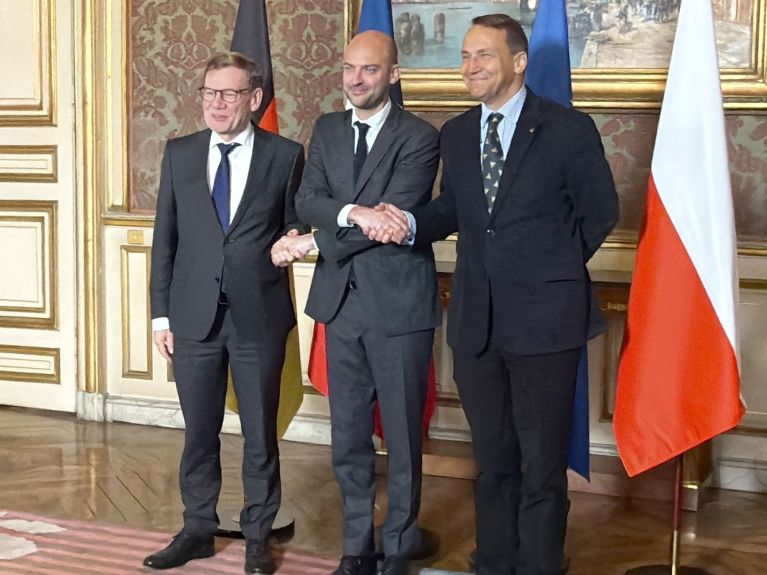
Ever since Russia launched its war of aggression against Ukraine, Europe’s security and defence have been the central focus, along with the need to support Ukraine. In January 2026, the foreign ministers of Germany, France and Poland met in Paris to discuss the security situation in Europe, the ongoing peace talks and security guarantees for Ukraine. India’s Foreign Minister Subrahmanyam Jaishankar also took part in the talks as a guest. One aim of the meeting was to intensify cooperation between Europe and India on security and economic matters.
How the Weimar Triangle connects people in the three countries
The Weimar Triangle goes far beyond government policy. City twinning agreements, youth exchanges and cultural events bring people from Germany, France and Poland together. Universities, associations and other civil society organisations also contribute to this exchange. In recent years, joint projects aimed at supporting Ukraine have also been initiated.


