ESA approves record space budget
ESA is to invest €14.4 billion ($15.8 billion) in space exploration until 2022.
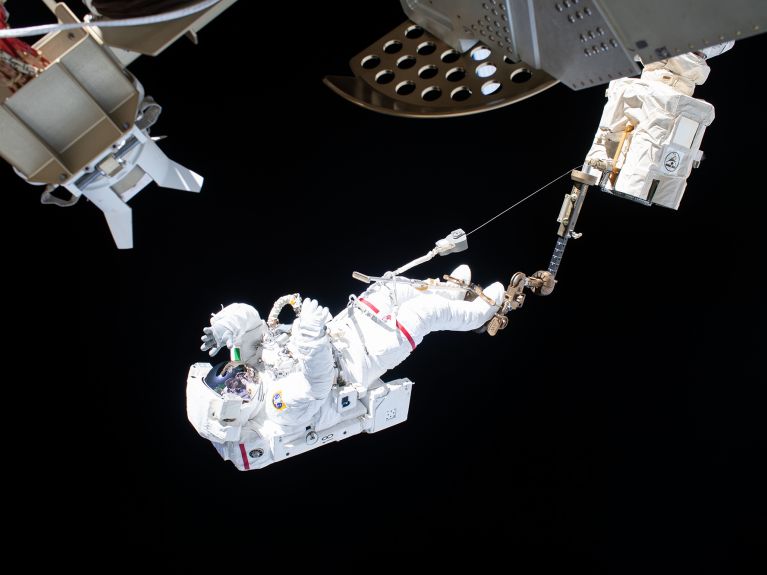
European space exploration is getting its biggest financial boost in 25 years. At a conference in Seville, Spain, the 22 member states of the European Space Agency (ESA) on Thursday agreed on a €14.4 billion ($15.8 billion) budget for the next five years.
"It's a real surprise, it's more than I proposed, I'm very happy," ESA Director-General Jan Wörner said.
Germany now contributes the lion's share of the budget with €3.3 billion, which amounts to 22.9%. France follows with 18.5% before Italy with 15.9%.
What will the money be used for?
- Gateway, the first space station to orbit the moon, allowing European astronauts to go to the moon for the first time.
- To develop "the first fully flexible satellite systems to be integrated with 5G networks"
- The Hera mission, in connection with NASA, to protect the earth from asteroids
- The first gravitational wave detector in space, LISA
- The black-hole mission Athena, designed to "enable fundamental advances in our understanding of the basic physics of the Universe."
- The "Mars Sample Return" mission, also in cooperation with NASA
- Space Rider, "ESA's new reusable spaceship."
New agenda
In addition to these projects the ESA agreed on new focuses:
- Strengthening ESA's leading position in earth observation to monitor the effects of climate change
- Space safety has been approved as a new pillar aimed at keeping space operational
- ESA's commitment to the International Space Station (ISS) was reaffirmed
- Transitioning to the next generation of launchers, like Ariane-6 and the smaller Vega-C
Moon mission and SMEs
Referring to Germany's contribution, the government's coordinator of aerospace policy, Thomas Jarzombek stressed that "we have demonstrated that we are a reliable partner of ESA."
He said Germany will be able to strengthen the role of small-and medium-sized companies in space exploration and "we managed to help enable the European moon mission with a contribution of €55 million."
ESA is closely watching the US space agency NASA's Artemis mission, which aims to send astronauts to the moon by 2024. European states are so far merely providing a module for the Orion spacecraft, but ESA chief Wörner on Thursday assured member states that "we will send Europeans to the moon."


