Investing in Germany
Attractive location: high-tech firms from the US, Asia and Europe are investing heavily in Germany - and creating strong clusters.
 Wolf Zinn
 The dynamism has increased significantly: international companies invested around 96 billion euros in Germany in 2025 - more than twice the previous year’s figure. The federally owned economic development agency Germany Trade & Invest (GTAI) sees this as a clear sign of investor confidence in Germany. GTAI CEO Julia Braune says that Germany is attractive to firms from all over the world because stable conditions and a high degree of legal security make it possible to plan investments reliably. What other arguments are there in favour of Germany? There are many: efficient transport, energy and data networks, a strong research sector, a highly qualified workforce, established industry clusters and, not least, access to the EU single market.
Billions for digital infrastructure
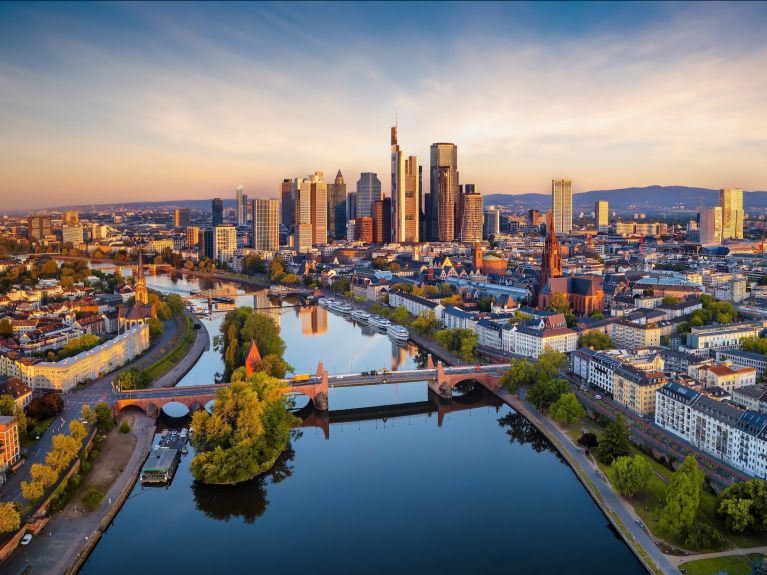
US tech giants in particular are driving the expansion of digital infrastructure. Google has announced that it will be investing 5.5 billion euros in computer centres and cloud capacities by 2029. Microsoft is investing 3.2 billion euros in AI and cloud infrastructure over a two-year period. Oracle is planning to invest another 1.9 billion or so euros over five years in the Frankfurt region. The Rhine-Main region is one of Europe’s most important internet exchange points and attracts providers from across the world. The Japanese company NTT Global Data Centers is also substantially expanding its data centre in Nierstein in the state of Rheinland-Palatinate.
Strong clusters
At the same time, new industrial centres are being built - often in places where researchers, suppliers and consumers are all in close proximity to one another. The European Semiconductor Manufacturing Company (ESMC), which is run by the Taiwanese firm TSMC, is investing over 10 billion euros in building a new chip factory in Dresden. The US manufacturer GlobalFoundries is spending an additional 1.1 billion euros on expanding its production facility in Saxony. And French industrial gas company Air Liquide is investing over 250 million euros to improve the supply of special gases and hydrogen to the semiconductor industry.
The pharma industry is also generating considerable impetus: US company Eli Lilly is investing some 2.3 billion euros in a new production site in Alzey in Rhineland-Palatinate, where drugs to combat diabetes and obesity will be manufactured, among other things. In addition, Sanofi is planning to spend roughly 1.3 billion euros on building a new insulin production plant in Frankfurt by 2029.
Indian investors are likewise active in Germany: Tata Consultancy Services is setting up an automotive delivery centre in Munich and Villingen-Schwenningen. Tata Technologies is taking over Wolfsburg-based ES-Tec Group for 75 million euros. Big changes may be on the cards in the steel sector, too: Jindal Steel International is currently negotiating a takeover of Thyssenkrupp Steel Europe.


