Protecting lives with data
The next pandemic is only a question of time. Two African researchers are working in Berlin to help improve preparedness around the world.
 Ana Maria März
 His memories of his childhood in Nigeria have made Adam Abdullahi the scientist that he is now. Among the most formative of these memories is that of a classmate who was paralysed following a polio infection. He also remembers other disease outbreaks, such that of the so-called swine flu that was declared a pandemic by the World Health Organisation (WHO) in 2009, and these also contributed to raising his awareness. “Back then our knowledge about this type of disease was limited,” he says. These experiences made him realise that information and data were key to improving preparedness for health-related crises.
Protection against new pandemics
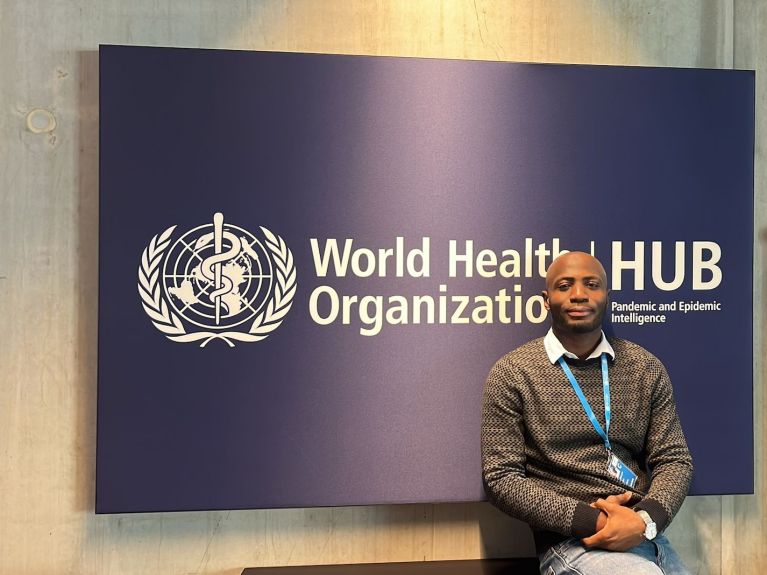
This is what public health intelligence is all about: researchers are collecting and analysing a variety of relevant data. This enables them to detect potential health threats early on and to protect the world population against epidemics and pandemics. There are two institutions based in Berlin, the Charité Center for Global Health and the WHO Hub for Pandemic and Epidemic Intelligence, that are seeking to boost research in this field. To this end they have initiated a new programme: their joint Research Fellowship in Public Health Intelligence was awarded in 2025 for the first time. The programme is open to postdoctoral researchers from around the world. The Charité and WHO selected five visiting researchers from a pool of over 250 applicants, who were granted the opportunity to work on specific projects in Berlin for between three and six months in 2025.
Adam Abdullahi is one of them. He has studied and worked in Britain and the US, focussing on tropical diseases in particular. In addition to this, he has been involved in projects related to HIV/AIDS as well as vaccines against the coronavirus. During the COVID-19 pandemic, Mr Abdullahi observed how even countries with solid healthcare systems were not sufficiently prepared for handling the crisis. “Things get extremely hard if there is no reliable data to use as a basis for decision making,” he says, adding that “most of all, we need more efficient systems to be better prepared in the future.”
Systematic registration of laboratories
Even an overview of the laboratories that exist in a region can be very helpful. This is why the project Adam Abdullahi pursued as part of his fellowship was dedicated to identifying laboratories across West Africa, and in particular those with capacities for conducting clinical studies. “My idea was to systematically register these laboratories to find out where there is a lack of infrastructure,” he explains. Mr Abdullahi had access to a broad network and relevant data sources, thanks to the research fellowship awarded by the Charité and WHO. “The project connects African and German research,” he says. “We are learning from each other and this type of cooperation is very beneficial for both sides, as health security is something that is not relevant to only one country. As a global community we are only ever as strong as our weakest link.”

Fair access to data is another key aspect of health research that plays a decisive role in preparing for future medical challenges. Professor Nicki Tiffin, who was born in Zimbabwe and was also in Berlin as a fellow, is working in the same field. She is the Deputy Director of the South African National Bioinformatics Institute at the University of the Western Cape in Cape Town. She says: “We want for data to be shared around the world in an ethical and fair manner, and for such exchange to take place in a non-discriminatory way.” As part of her fellowship she developed a browser-based tool that supports researchers around the world through fair data licensing. “The goal of my project is to define the conditions of data sharing and to make them transparent.”
Ms Tiffin believes this to be beneficial in a number of ways: if data about certain population groups is passed on, it can be clearly determined what such data can and cannot be used for. This is done to prevent any unfair representation or stigmatisation of particular groups of people. At the same time, the tool allows those whose data is used in research to benefit from the results.
A fairer approach to healthcare
Nicki Tiffin points out that the COVID-19 pandemic highlighted the extent of action needed. “Africa got the vaccines much later than many other regions, despite the fact that we had shared data from clinical studies and virus samples with the world early on.” This type of experience had made many researchers wary, she says. This is why the goal of her project is to create trust and ensure fairer data sharing. “I hope that this will make people more willing to share their data,” Ms Tiffin says.


