
Why do Americans love German discount supermarkets?
German discount chain Aldi is expanding massively in the US. Aldi’s empire also includes the cult supermarket Trader Joe’s – but what links the two?
 Wolf Zinn
 Even US celebs have to stock up on groceries from time to time - and the supermarket is where they do it. It’s striking how often they can be spotted at Trader Joe’s: be it top models like Bella Hadid, actors such as Mindy Kaling, athletes such as NFL star Travis Kelce or musicians like Harry Styles – a never-ending stream of American celebrities seems to frequent this upmarket discount store.

This is probably also why Trader Joe’s, which has been a wholly owned subsidiary of German supermarket chain Aldi Nord since 1979, enjoys something akin to cult status in the US these days. And the store’s shopping bags (the Trader Joe’s mini-tote bags) are highly coveted fashion accessories even far beyond US borders, fetching prices in excess of one thousand dollars online.
There’s something of a hippie vibe in-store, with staff sporting Hawaiian shirts. Rather than using self-checkouts, the company believes in interaction with customers and authenticity. Communications Professor Dustin York from Maryville University talks about strategically “thought-through communication”. What is more, many of the products sold in store are comparatively inexpensive own brands. To date, Trader Joe’s has 631 branches (January 2026) in 43 US states – and is still growing.

Aldi in the US: 50 years on - and now comes the big push to expand
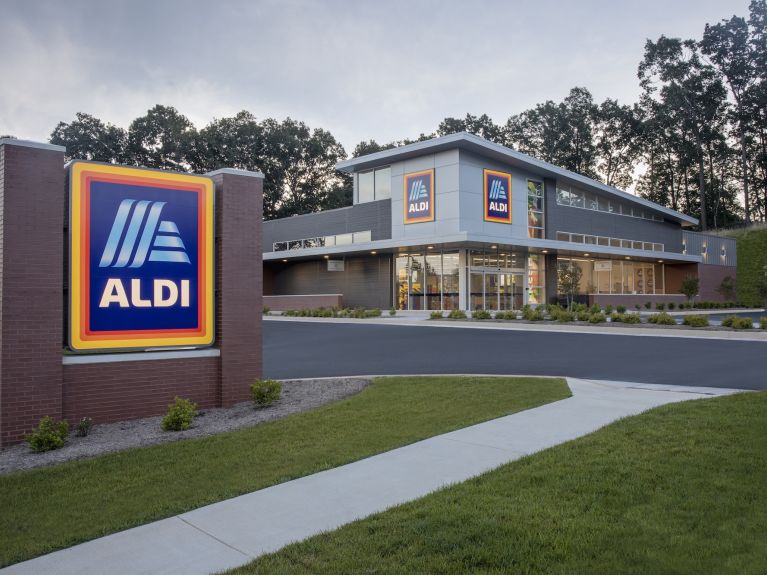
In terms of the number of its stores, Aldi itself - which as of 2026 has been in the US for precisely 50 years - is in a quite different league: with more than 2,600 stores in over 1,700 cities and 40 states (as of the end of February 2026), this long-established German firm is one of the top US grocery store chains. In the popularity ranking, Aldi is the American number one, closely followed by Trader Joe’s. According to Jason Hart, CEO of Aldi U.S., his stores attracted 19 million new customers in 2025, with the number of “Aldi superfans” growing by the day. And expansion is set to continue apace: The network of stores is set to grow to 2,800 in 2026 and to 3,200 in 2028.
One of many signs that Aldi has long become part of everyday American life: Tonight Show host Jimmy Fallon has featured the discount chain in several of his sketches.

Dieses YouTube-Video kann in einem neuen Tab abgespielt werden
YouTube öffnenThird party content
We use YouTube to embed content that may collect data about your activity. Please review the details and accept the service to see this content.
Open consent formThe Aldi story: from small Essen shop to mega discount supermarket chain
Aldi is a retail phenomenon that evolved in Germany following the Second World War: brothers Theo and Karl Albrecht, who have since died, took the small grocer’s shop that their parents had opened in 1914 and created a concept that was as radical as it was simple. A small range, a high turnover rate, transparent processes and a consistent focus on low prices became the core philosophy of their brand - and the successful model for modern-day discount supermarkets. One could perhaps say that Aldi is synonymous with a “typically German”, no-frills and efficient shopping experience.

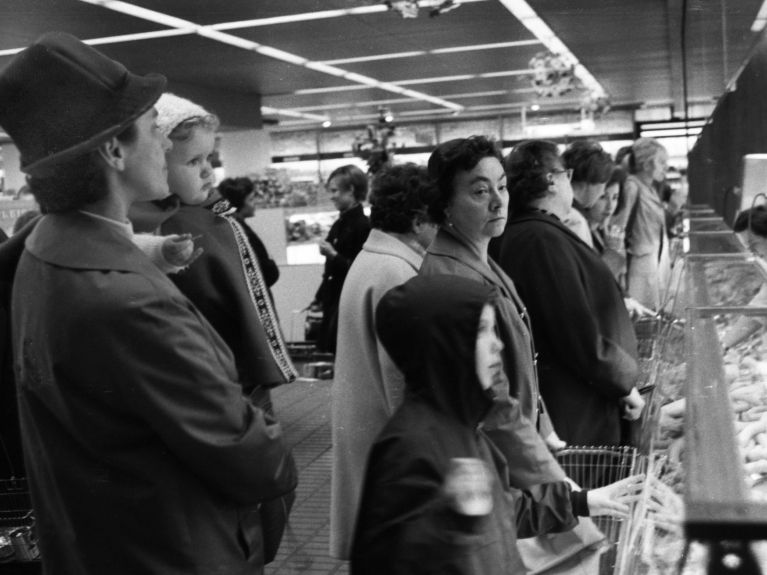
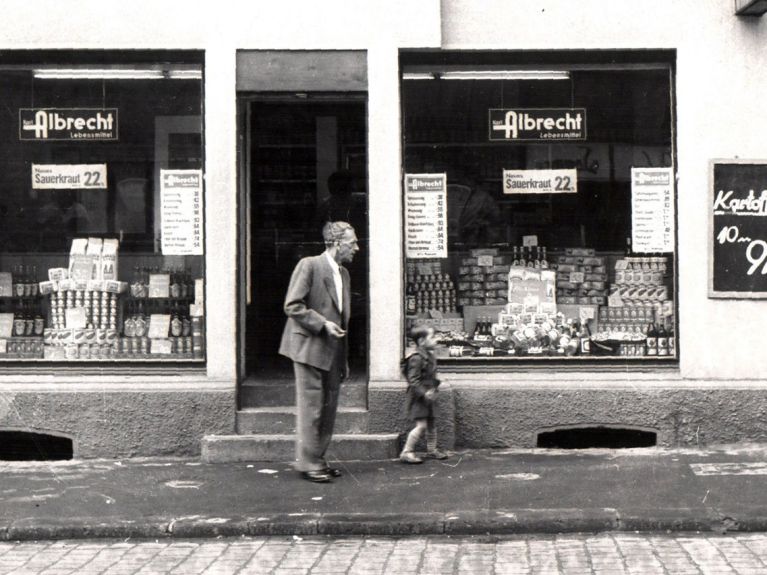
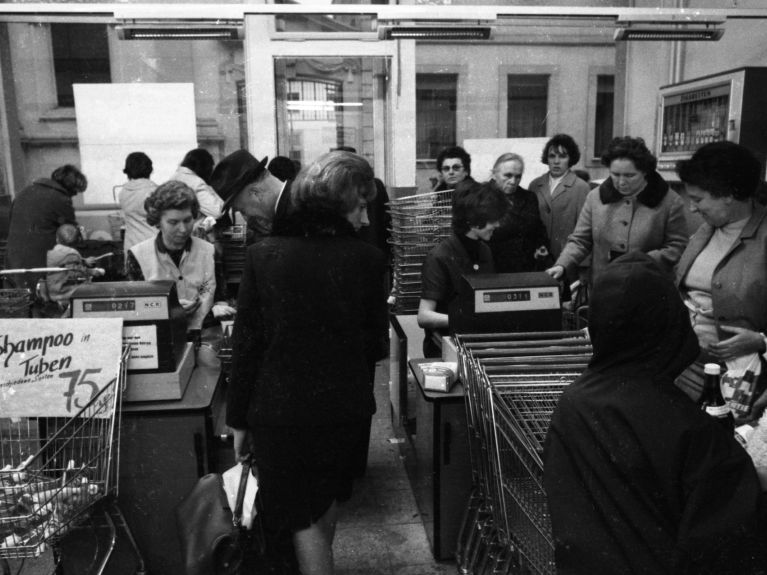
In the early 1960s, the company split into Aldi Nord (Theo) and Aldi Süd (Karl). This is because the brothers fell out, allegedly over the question of whether cigarettes should be sold in the stores - after a break of 40 years, Aldi Süd finally ended its ban on tobacco in 2003.
Nowadays, Aldi is a global discount empire: together, Aldi Nord and Aldi Süd operate over 13,500 supermarkets in 18 countries. They are owned by foundations set up by the Albrecht founding family.
Why discount chains are so successful
Without doubt, the average US customer is attracted first and foremost by the low prices. Inflation in the US was at 2.7 percent in 2025 – prices are rising across the board and people are feeling the pinch. While Aldi tended in the past to attract people on low incomes, US retail analyst Will Auchincloss notes that its customers represent all income segments these days.
Neil Saunders, managing director of the consulting firm Global Data, is convinced that Aldi’s success is rooted not only in its prices: “Aldi has worked hard to optimise other aspects of its offering too – quality, taste, range and store design.” Saunders also believes that the chain benefits from having a not excessive product range (encompassing around 1,600 articles), around 90 percent of which are own brands. He says that it is, quite simply, considered “smart” to shop at Aldi.
A few years ago, Aldi’s positive image was tarnished somewhat by criticism of the pay and working hours of its staff; according to HR Dive, the firm paid two million US dollars to settle a class action.


