Transatlantic growth axis
German and US companies are investing heavily in each other’s countries - despite and also because of the political uncertainties.
 Wolf Zinn
 Tariff conflicts, geopolitical tensions, economic volatility: anyone who’s been keeping up with the headlines in recent months could be forgiven for assuming that the transatlantic economic area is in the midst of a dangerous crisis. However, the investment decisions of major corporations from Germany and the US tell a rather different story.
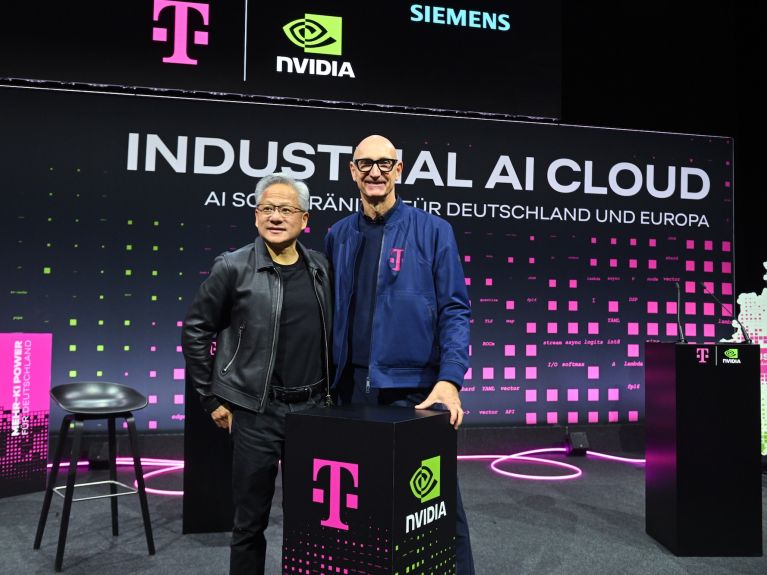
In the first quarter of 2026, for instance, Deutsche Telekom, SAP and Nvidia are jointly setting up an industrial AI cloud in Munich – a high-performance infrastructure for industrialartificial intelligence (AI) applications. Around one billion euros is expected to be invested in the project. Telekom CEO Timotheus Höttges used a powerful metaphor at the press conference in November 2025: “We want to give Germany as a location for industry a cardiovascular workout.” Nvidia founder and CEO Jensen Huang added: “Germany’s strength in engineering and in industry is legendary and will now be further expanded through AI.”
The US rediscovers Germany
The project is by no means an isolated case. US companies are currently investing in Germany on a grand scale - above all in digital and industrial infrastructure. Google announced in November 2025 that it would be investing around 5.5 billion euros in computer centres and cloud capacity by 2029 – with new and extended plants at two sites in the Rhine-Main region. Oracle is planning to spend two billion dollars on cloud and AI regions over the next five years, likewise in the Frankfurt area. Meanwhile, Tesla is expanding its battery production in Grünheide near Berlin: several hundred million euros is to be spent on pre-stage and cell production by 2027.
Such investments constitute more than just capital flows - they are decisions in favour of a particular location. US companies employ several hundred thousand people in Germany. Furthermore, the US is the most important source of foreign direct investment. Germany Trade & Invest (GTAI) speaks of continued robust investment dynamism – underpinned by industrial substance, qualified skilled professionals and access to the European single market.
German companies seek market proximity
A glance across the pond reveals a similar picture. For decades, German businesses have been establishing firm roots in the US - and are continuing to expand their presence. Around 6,200 German firms maintain operational offices or subsidiaries in the United States. Employing roughly 870,000 people there, they are among the country’s largest foreign employer groups.
Siemens alone has more than 45,000 employees in the US and over the past 20 years has plunged over 90 billion dollars into the US market, with firm plans for a further ten billion to follow. Currently, 285 million dollars are being channelled into new and expanded high-tech production facilities in California and Texas. Siemens CEO Roland Busch: “We are creating new jobs, making available key future technologies and strengthening America’s AI competence.”
The latest investment decisions taken by German firms reflect a clear strategy: to remain close to customers, to hedge against trade policy risks, to keep value adding local – such as in the automotive industry. BMW for example is investing 1.7 billion dollars in South Carolina – one billion of the total being spent on electrifying its Spartanburg plant and the remaining 700 million dollars on a battery assembly centre.
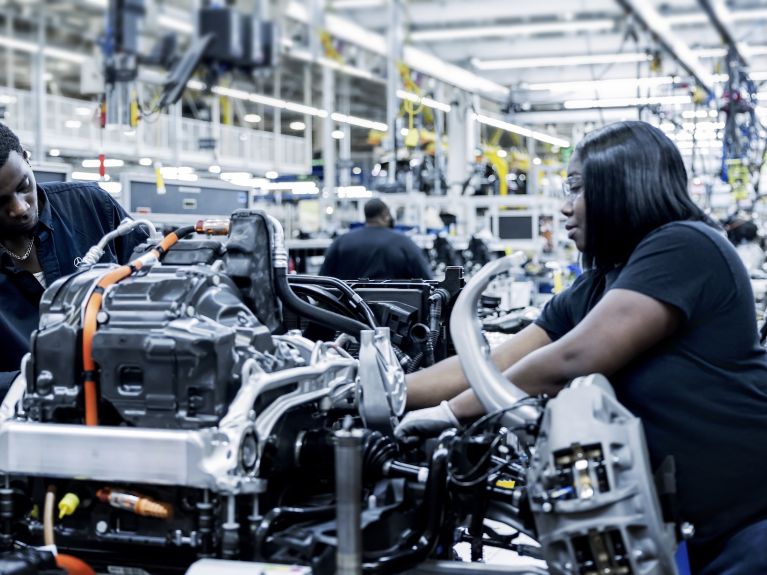
Volkswagen is also increasingly stressing the importance of a local presence. Its new offshoot Scout Motors is setting up a plant for electric pick-ups and SUVs in South Carolina. With an investment volume of around two billion dollars, production is scheduled to begin in late 2026. Mercedes-Benz is planning to start producing a new model tailored specifically to the US market at its Tuscaloosa (Alabama) facility from 2027. “We are very confident that the American market will remain a strategically important growth market for us,” says Mercedes CEO Ola Källenius. “That’s why we are investing massively in the US and why we will also be able to grow significantly there in the medium to long term.”
Trade as the backbone for investment
This momentum is supported by strong trade ties. In 2024, goods with a total value of 253 billion euros were traded between Germany and the US - more than with any other trading partner. Germany supplies machines, vehicles and chemical products, while software, technology and industrial inputs come from the US. New investments are further consolidating this exchange by shortening supply chains, increasing resilience and reducing political independence.
The German American Business Outlook 2025 issued by the German Chambers of Commerce Abroad predicts that the effects will not be only short-term: 84 percent of German subsidiaries in the US plan to step up their investments in the coming three years, while 88 percent are planning to recruit additional staff by 2029.
Strengthening Germany as a location for industry
Meanwhile, the Federal Government wants to make Germany an even more attractive location for industry and to this end has appointed former Commerzbank CEO Martin Blessing to the new role of investment commissioner. Special depreciation rules, corporate tax cuts, less bureaucracy, accelerated approval procedures and state funding programmes are to lure in new investors - especially from the US. Economic considerations are the main driving force, however. In a world of fragmented markets and growing risks, one simple rule applies: if you produce where you sell and invest where you research, you will remain capable of action. Regardless of any political rhetoric and trade barriers, this is the logic that will strengthen the transatlantic growth axis.


