Every fly counts
Millions of insect species are becoming extinct before they are even discovered. The Museum of Natural History in Berlin is using AI in a race against time.
 Stefanie Hardick
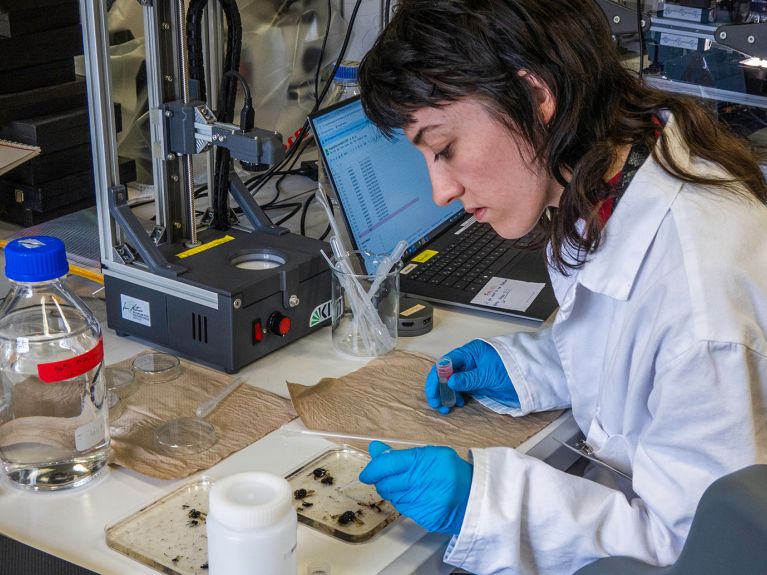
 The robot’s eye glides over the petri dish soundlessly. The dish contains dozens of tiny black dots that are barely bigger than poppy seeds. “This is the difficult part,” Rudolf Meier says, adding that “the robot does not know where anything is, what it is, and what size it is”.
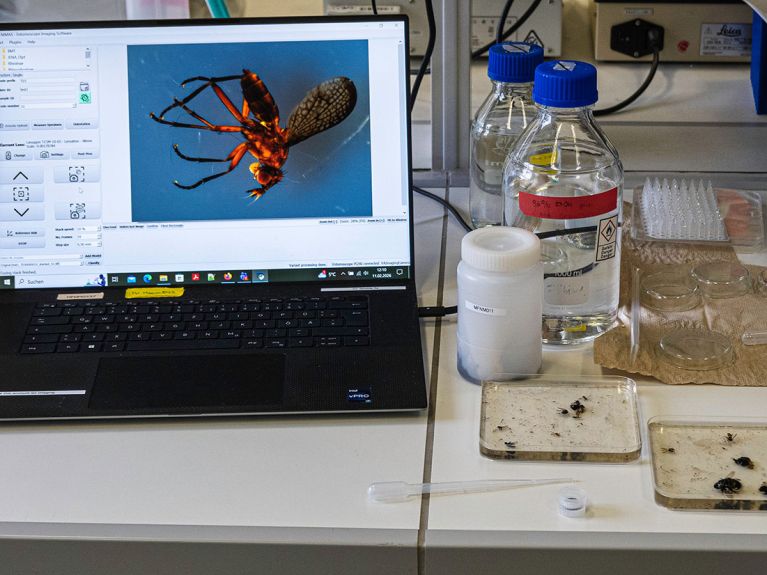
Rudolf Meier is an insect researcher and evolution biologist. He is the Head of the Centre for Integrative Biodiversity Discovery at the Museum of Natural History in Berlin, and his goal is to revolutionise the way in which biodiversity is registered. A glass box that is connected to a laptop: the device he is currently working with is called a diversity scanner, and it does not look particularly spectacular at first glance. What this machine can do is, however, remarkable: it automatically photographs, measures and sorts insects and prepares them for DNA analysis. The resulting images and data are used for training AI models that are to independently identify insects in the future. Meier’s team has developed this device together with robotics and artificial intelligence experts from the Karlsruhe Institute of Technology (KIT).
The camera eye is lowered over a dot very slowly. A moment later, a twenty times magnified image appears on the screen. It shows a common type of fly. “Diplonevra nitidula is one of the most common species in Europe,” Rudolf Meier says. “We catch lots of those, when we set up traps.”
We cannot protect what we do not know
It is a very worthwhile effort. While this type of fly is very common, we know surprisingly little about it. And that’s despite the fact that common species are doing most of the work in ecosystems. Meier explains that their decline can have more severe consequences than the disappearance of a rare species that fulfils a special function. Nevertheless, research used to focus on so-called charismatic species for a long time. These tend to be large animals that have a broad appeal or are threatened. “This distorts what we know about nature,” Rudolf Meier states. He mentions the around 27,000 Natura 2000 areas as an example, which make up Europe’s biggest network of protected areas. These are considered a central instrument of European nature conservation policy. A large share of species remains unidentified, despite the fact that organisms leave genetic traces in the soil and in water. It is often impossible to classify them as a species due to a lack of international reference data. As a result, they remain “dark taxa” – traces of unidentified life forms – that make an effective implementation of European protection strategies difficult.
Bringing light to the darkness of unidentified species
Researchers across Europe are working on identifying dark taxa. Scientific collections such as the Museum of Natural History in Berlin are among the central hubs of this type of research. Insects have been collected and documented at the museum for over 150 years. These reference specimen are key when it comes to identifying new discoveries. Rudolf Meier’s team cooperates with numerous partners around the world, for example in the context of the Horizon Europe Biodiversity and ecosystem services programme.
One of the world’s biggest natural history museums can be found at the heart of Berlin. Animals, plants and fossils have been collected here for over 200 years. The collection comprises 30 million objects, including some 15 million insects. The museum is among the world’s leading evolution and biodiversity research facilities. Its best-known exhibit is a dinosaur skeleton that is over 13 metres tall. Nowadays, the natural history museum also uses robots and AI for its research work, aiming to gradually make its collection digitally accessible.

World’s first 3D scanner for insects
The Museum of Natural History in Berlin has a collection of 30 million reference specimen. Half of these are insects that are either stored in entomological boxes dried and pinned (such as Diplonevra nitidula) or preserved in 70 percent alcohol. The museum has been working on digitalising its collection for a number of years now, so international researchers do not have to travel to Berlin in order to compare specimens to the reference specimens. In its digitize! exhibition, the museum’s visitors are even able to watch three digitisation devices at work, including the world’s first 3D scanner for insects. It takes 25,000 pictures of an insect and then compiles the image from close to 400 perspectives.
Rudolf Meier points out that this is not enough, in consideration of the rapid loss in biodiversity. “We need to describe species ten times more quickly. Insects need to be digitalised in the same way as books in a library,” he says, adding that he thinks of his laboratory as a “biodiversity knowledge factory” in which the identification of species is taking place increasingly automatically. Robots, DNA analyses and AI are used to identify species more quickly and to record their distribution.
Yet time is running out. Species that we don’t even know exist are becoming extinct on a daily basis. This is a race against biodiversity loss in which every single insect counts.


