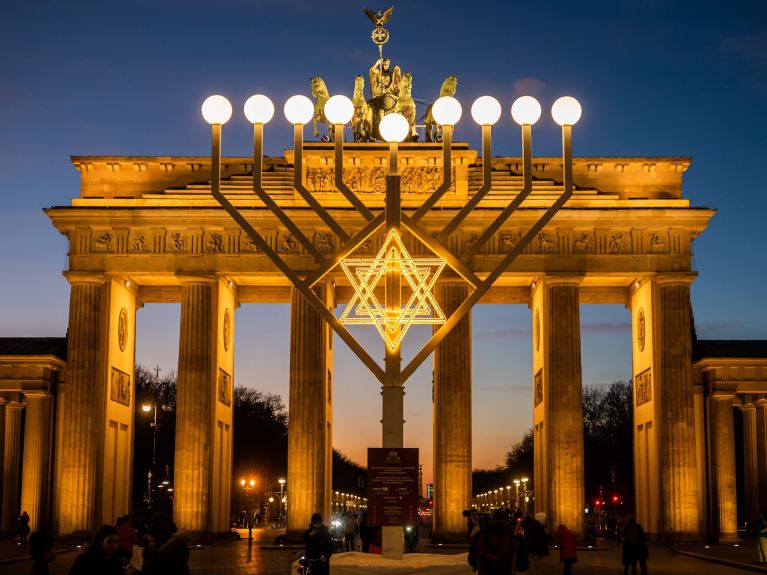
Hanukkah in Berlin: light in times of darkness
This year’s Hanukkah celebration in Berlin is guarded by the police. Rabbi Mendel Brandwine speaks about visibility and Jewish life.
The first candle is lit near Brandenburg Gate on a cold Sunday evening in Berlin to mark the start of Hanukkah, the Jewish Festival of Light. Hundreds of people have gathered on the Pariser Platz square to attend the ceremony. The event around the gate is guarded by the police whose flashing blue lights are reflected by the cobblestones.
The celebration is held under the shadow of the attack that happened in Australia. Just a few hours earlier, 16 people were been killed and many more injured during a Hanukkah event on Bondi Beach in Sydney.
Rabbi Mendel Brandwine from the Jewish community Chabad Berlin does not think of the public event as a matter of course this year. Among other activities, the Rabbi, who is originally from the USA, has recently been in charge of the Chabad-Lubavitch mobile synagogue, that is operated by the Jewish education centre and travels across Germany. “Many are scared and think twice before leaving their homes,” he says, adding that it was a sign of solidarity that both Jews and non-Jews had come, nevertheless.

“Berlin is one of the cities where Hanukkah is particularly visible,” Mr Brandwine says. More than 55 menorahs could be found across the city, the Rabbi continues, and those who walked around Berlin these days could see people lighting candles and celebrating, and therefore see strong signs of Jewish life.
Hanukkah usually starts in December. The festival lasts eight days and commemorates the reconsecration of the Jewish temple in Jerusalem more than 2,000 years ago. It is a festival of hope, religious self-assertion and the power of light in times of darkness. The Hanukkah menorah at the Brandenburg Gate has been set up every year for two decades.


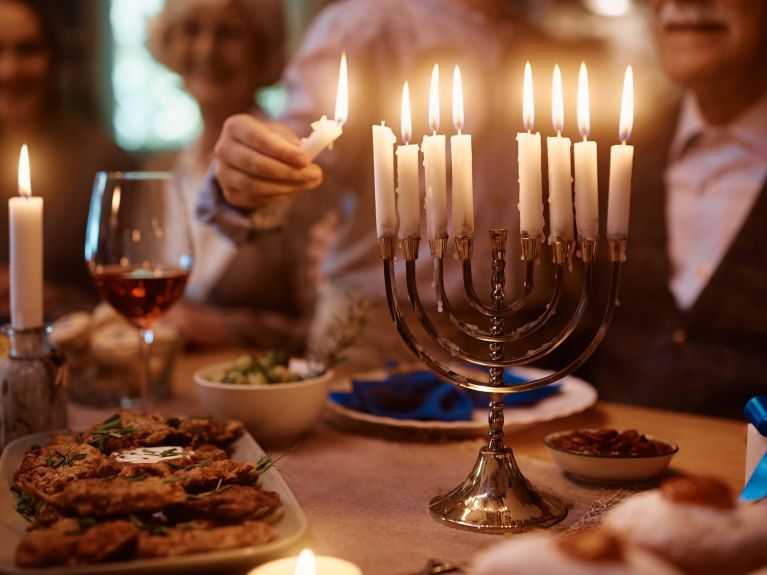
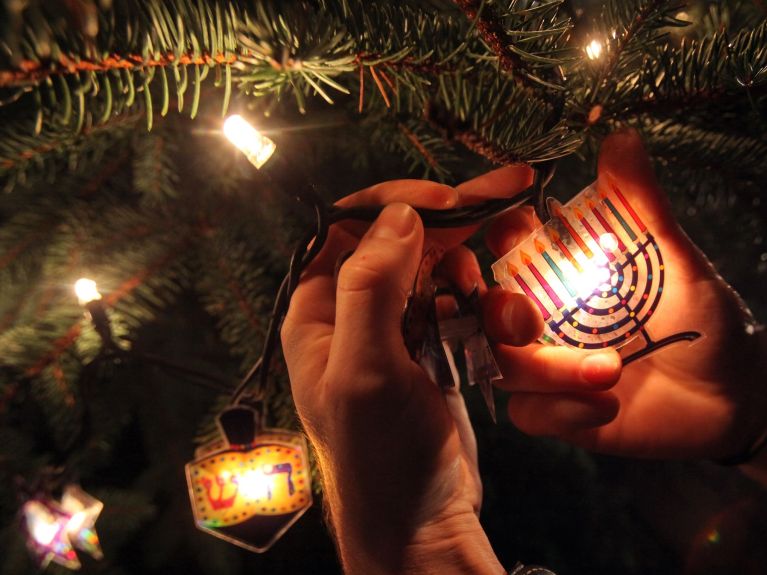
Berlin is not the only German city where Jewish communities place large menorahs in public places. Other examples include Karlsruhe, Leipzig and Chemnitz. It is a way for Jews to make their presence felt in public. Cultural, music and film festivals and many other events are held across the year, and these also help to promote visibility of Jewish culture in Germany.
“It is really special to walk through the streets and see people lighting candles, celebrating and demonstrating solidarity,” Mr Brandwine says, adding that such visibility was not only a matter of religion but also political, especially in the current situation. “Our response is to become stronger and to bring more light into the world.”

