How Christmas is celebrated in Germany
Spending Christmas with the Germans: Which rituals are important and why potato salad is part of a traditional celebration.
The first foretaste of Christmas already comes in early September when gingerbread and Spekulatius biscuits suddenly appear on supermarket shelves out of the blue. From the first Sunday of Advent, Christmas markets, Christmas hits on the radio and fairy lights bring festive cheer to the entire country. But German Christmas has many facets and distinctive features - here are answers to the most important questions.
Do only religious Germans celebrate Christmas?
No. Although it is a Christian festival to celebrate the birth of Jesus Christ, Germans with no particular religious beliefs also celebrate Christmas - around 80 percent of the population in all. Fewer and fewer people in Germany go to church at Christmas - just 16 percent in 2024. This is significantly down on the pre-pandemic level (2019: 24 percent). Increasingly, people in Germany don’t celebrate Christmas for religious reasons but because they see it as a time for the family to come together to enjoy shared rituals. This was revealed by a study conducted by the University of the Bundeswehr in Neubiberg.
Which German Christmas traditions are there?
One of the most popular and best-known customs is to put up and decorate a Christmas tree. More than eight out of ten people in Germany put up a Christmas tree. One in three say they only feel really Christmassy once their home is filled with the fragrance of fresh fir and shiny baubles are glittering on the tree.
And what do Germans give as gifts? The most popular present by far is a gift voucher - or indeed just cash: nearly one in two people (48 percent) opt for this solution, according to a study by consulting firm EY. Food and confectionery take second place (36 percent), closely followed by toys (33 percent), printed books (31 percent) and clothing (30 percent).
How is Christmas typically celebrated on the day?
There are two days of Christmas in Germany, the 25th and the 26th of December. For many people, Christmas Eve, on the 24th of December, has a hectic morning part and a festive evening part. If Christmas Eve falls on a weekday, shops remain open until noon and tend to be packed as people rush to buy their last remaining presents or food for the festive meal. Then it’s time to decorate the Christmas tree with fairy lights and baubles, to wrap the presents and prepare the meal.
Families get together in the early evening. Some have family traditions such as singing or playing music together. After the meal, the presents that are under the Christmas tree can be unwrapped. Children write their wish lists weeks before Christmas and wait excitedly to discover whether they will get the presents they want.
Young adults who have returned to their home town to see their family at Christmas often head out again late in the evening to meet up with old friends.
And now we get to some special insights in german christmas traditions
Constanze Kleis wrote a book entitled “Gebrauchsanweisung für Weihnachten” (Instruction Manual for Christmas). We asked her what the essential elements of a typical german Christmas celebration are.
What are the prerequisites for the perfect Christmas?
Officially, you will need a Christmas tree, candles or fairy lights and Christmas tree decorations, a nativity scene, and a certain repertoire of Christmas carols. Good food and baked goods such as a stollen or Christmas biscuits like vanillekipferl. Sufficient generosity with gifts, including for the postman, your building’s caretaker or for guests, who do not necessarily have to be blood relatives.
Which sweets are typically eaten at Christmas?
Christmas biscuits, known as plätzchen in German – a word that originally meant “flat-shaped cake” – are the undisputed number one Christmas treat. Apparently there are 13,824 different types of plätzchen nowadays, classically flavoured with things like vanilla, cinnamon, chocolate, lemon, orange, coffee, rum, hazelnut, almond, walnut, ginger, cardamom and honey, and typically in the form of crescents, rings, balls, coins, hearts or cubes. Normally they are filled with chocolate, vanilla, jam or marzipan.
What is the traditional procedure on Christmas Eve, 24 December?
In principle, it is just as Nobel Literature Prize laureate Thomas Mann describes in his 1901 novel “Buddenbrooks”: everyone sings Christmas carols. Then there are the presents under the mighty fir tree, “decorated with silver tinsel (…) gifts lying everywhere”. Then an overwhelming abundance of foods and drinks is served up. In practice, the festival nowadays is no longer bound by such a rigid corset of rules. Christmas can be a successful combination of all kinds of rituals that make one feel cosy and comfortable.
What are the classic Christmas dishes?
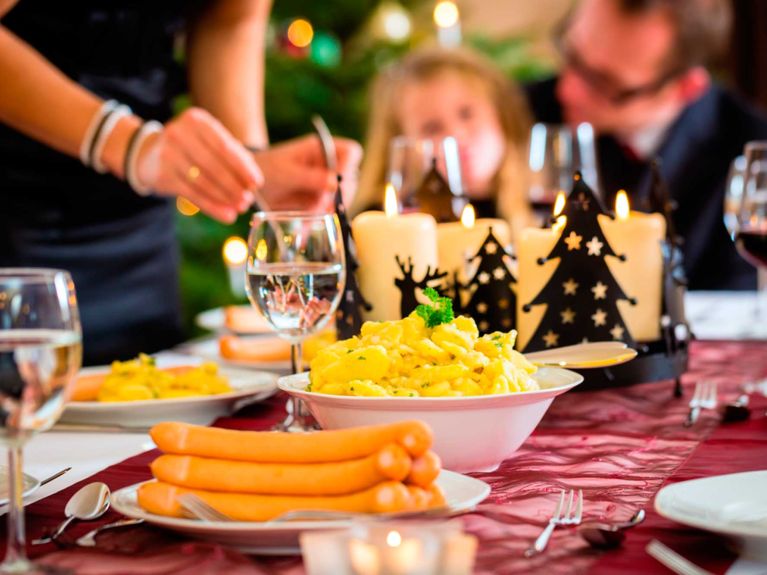
According to surveys, potato salad with sausages is still in pole position as far as favourite dishes for Christmas Eve are concerned, closely followed by fondue and raclette. One survey shows that 288 hours are spent on average – mainly by women – preparing for the festival by the time Christmas Eve arrives. Traditionalists like to serve the family a goose with dumplings and red cabbage on Christmas Day.
Which carols are sung at christmas?
The Office for Christmas Carols in the Austrian city of Graz has around 12,000 songs in its archive. Christmas carols are a bit like the master key when it comes to unlocking the Christmas mood. 90 percent of Germans would not wish to spend Christmas without them. The most famous carol in the world is without doubt “Silent Night”. It was first sung in Austria in 1818 and has been translated into more than 300 languages and dialects.
Is there such a thing as a “modern” Christmas?
I would say that a modern Christmas is characterised by a welcome relaxation of customs. A fir tree? Maybe not the best thing from an ecological point of view. Roast goose? Perhaps a bit too brutal for vegetarians. Instead, people tend to focus nowadays on the original idea of the festival, namely that it’s a good thing to get the whole family together once a year to share a meal. To spend time together. To treat one another with gifts – including the gifts of being close and providing a sense of security – and in some cases to use material gifts to signal: I’ve been thinking about you and about your wishes.